

For many HR teams, leave management has been reactive. Requests escalate, managers struggle to plan around unclear timelines, payroll or compliance issues surface, and HR always finds itself stepping in again and again.
The problem isn’t care or expertise. Most leave systems only surface issues after they’ve occurred. By the time HR gets involved, the organization is already responding to confusion, risk, or frustration.
That’s why a new category is emerging: Leave Experience Management (LXM).
LXM fundamentally changes how HR interacts with leave. Instead of reacting to problems, HR gains the visibility, structure, and context needed to anticipate issues earlier and guide employees and managers with confidence.
The Problems With Traditional Leave Management
To understand why leave management so often becomes reactive, it helps to look at how most organizations manage leave today.
For years, HR leaders have faced a difficult trade-off:
- Manage leave internally, which often creates administrative burden
- Outsource the process entirely, removing HR from the employee experience
Neither option fully solves the problem. Managing leave internally can quickly become overwhelming as policies, documentation, and compliance requests grow more complex. But outsourcing the process entirely often creates distance between HR and the employee. As Brandon Salisbury, Tilt’s CMO, explains, “The problem isn’t that HR doesn’t want to be involved in leave. The problem is they’ve never had the right tools to be involved in the right way.”
Outsourcing promises “set it and forget it” simplicity. In practice, it often introduces new challenges like:
- Employees interacting with a rotating set of representatives and repeating sensitive information
- HR losing visibility into what’s happening in real time
- Managers being left without the information they need to plan for their teams
- Payroll and HR systems disconnecting, creating reconciliation work
Most importantly, HR only becomes aware of problems after employees, managers, or payroll teams escalate them.
By then, the organization is already reacting. “In an attempt to save time and mitigate risk, you hand over your people to a system that treats them like case numbers,” Salisbury says. “The promise was ‘set it and forget it.’ The reality is that your team becomes the apologetic middleman.”
Leave Only Becomes Strategic When the Experience Is Stable
Organizations often want insights into patterns like which teams face the most leave disruption or whether employees feel supported. But without a consistent leave experience, HR gets fragmented signals, keeping them focused on operational fixes rather than strategy.
Leave Experience Management flips that dynamic. By designing the leave journey—from planning to return—organizations create the consistency and structure needed to generate reliable insight. As Hollis Baker, Tilt Product Marketing Manager, explains, “Instead of juggling spreadsheets, email chains, and sticky notes, everyone can see the same up-to-date information in one central place.”
When everyone is working from the same source of truth, small issues are easier to spot before they become larger problems.
Stable experiences generate clear signals, enabling HR to act earlier.

What Changes When Leave Is Treated as a Journey
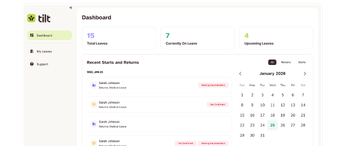
LXM treats leave as a structured journey, not a transaction. Each stage of the leave follows a defined path with clear insight for everyone involved. Employees can explore their options before requesting leave, managers receive real-time visibility, and HR sees the full lifecycle without chasing updates.
This creates three key advantages:
1. Earlier Signals
When employees can explore leave scenarios in advance, they gain clarity into their options before they need it. This reduces confusion and questions from employees while giving HR earlier insight into patterns, scheduling conflicts, or complex eligibility questions. “Through our leave planner, employees can privately explore what leave options apply to them and see what their time away could look like, says Baker. “Instead of being handed a maze of forms, they’re guided step-by-step through a process that is usually overwhelming.”
2. Clearer Control Points
Structured checkpoints from planning, approval, documentation, adjustments, and return give HR visibility into every stage of the leave experience. Alerts notify managers and HR of changes immediately, so the entire team stays aligned. “If leave dates shift or new documentation is submitted, the system sends alerts right away—so no one is left guessing or scrambling to catch up,” Baker adds.
This alignment prevents the common breakdown where employees, managers, and HR are each working from different information.
3. Better Context for Decisions
Leave decisions are rarely simple. Policies intersect with federal, state, and company rules. LXM provides structured context, surfacing relevant policies, historical cases, and compliance considerations. Without the right tools, HR often navigates these decisions manually. “The platform [LXM] isn’t making the decision for you. It presents the facts, structures the options, and flags the trade-offs so HR leaders can make an informed, human-centered decision,” Baker says.
This is where leave begins to shift from administrative burden to strategic decision-making.
From Firefighting to Forecasting
The biggest transformation with LXM isn’t simply automation. It’s how HR spends its time. As Salisbury explains, “Our platform automates the admin, not the human.” By automating eligibility calculations, compliance checks, and documentation workflows, HR teams are freed to focus on what matters most: supporting employees.
This is the shift from firefighting to forecasting. With structured leave journeys and real-time visibility, HR proactively manages leave in a way that strengthens culture and builds trust. “Caring for your people and protecting your company are not mutually exclusive goals. They’re two sides of the same coin,” Salisbury says.
The End of Reactive Leave Management Starts Here
Leave will always be complex. But the reactive chaos that often surrounds leave doesn’t have to be a standard part of the process.
Leave Experience Management gives HR the visibility and context needed to act earlier, guide confidently, and support employees consistently. With structured experiences, automated admin, and AI insights, HR leads rather than reacts.
If you’re ready to move beyond reactive leave management, book a demo with Tilt to see how LXM can transform your leave program, strengthen your culture, and empower HR to focus on what matters most.