

Ask any HR leader about a leave they’re proud of, and it usually isn’t the policy that comes up first. More often, it’s the employee they were able to truly show up for, going above and beyond to support them during a critical moment.
The policy was just the starting point. Everything that made the leave successful came from the application and intention around it. Unfortunately, that’s where many leave programs fall short. For HR leaders who care deeply about their people, that gap can be one of the most frustrating parts of managing leave.
Where Leave Experiences Often Fall Short
Most leave problems are employee experience problems in disguise.
An employee who didn’t understand their pay situation didn’t have a compliance problem. The experience lacked clarity.
A manager who didn’t know how to support their team member didn’t create a legal risk. The experience lacked continuity.
An employee who came back feeling anxious and disconnected wasn’t a retention risk because of a missed form. The experience lacked care.
For smaller teams, these breakdowns show up as manual errors bouncing back to HR, disconnected systems requiring reconciliation by hand, and employees left waiting while one person tracks everything down at once. For larger teams, they show up as inconsistency across leaves and managers who feel out of the loop.
The root cause is the same either way. Compliance checklists alone can’t build a great leave experience. You need intentional design.
Kim Smith, Employee Success Manager at Tilt, has spent years supporting employees through every kind of leave imaginable. “It starts with zooming out as an HR person on what you want your employees’ experience to be? Start there and answer those questions.” Here’s what happens when you do:
Four Qualities of a Good Leave Experience
A strong leave experience comes from four qualities working together at every stage. When all four are present, employees feel supported, managers feel prepared, and HR can operate with confidence. When even one is missing, that is where friction starts to build.
Those four qualities are clarity, continuity, confidence, and care.
Clarity
People show up to leave in two very different modes. Some employees want everything upfront. They want the full breakdown, the complete timeline, every detail mapped out before the leave even begins. For them, more information equals more confidence.
Others need something different. Too much information at once can feel overwhelming. What helps them most is knowing exactly what to do right now, with reminders and guidance as each step approaches.
As Smith puts it, “people have very different definitions of what success is going to look like throughout their leave of absence.” When a program only serves one style, a portion of your people are left feeling uncomfortable from day one. They’re not non-compliant. They’re unsupported.
Clarity comes from designing communication that can adjust to those differences. That means providing employees documentation when they need it, while also guiding them step-by-step through the process with reminders, status updates, and clear next actions.
When information is delivered at the right time instead of all at once, employees stay informed without feeling overwhelmed.
Continuity
Strong continuity means the work is covered, the manager is prepared, and the employee can step away without carrying the weight of what’s being left behind. For smaller companies especially, this is critical. When someone goes out on a ten-person team, there’s no buffer.
For many employees, being asked to document their work triggers something deeper. Smith experienced this herself. “The hardest part of preparing for my leave [was] when I had the conversation with my people leader about writing down all of the things that I do and how I do them…I didn’t want to put these things down…because that’s when the fear starts to creep in of ‘am I replaceable?’” What changed everything was reassurance from her leader that the goal was continuity, not replacement. “The intent is never to replace you. We want to be able to carry things on as best as we can and keep the lights on while you’re out on leave. As soon as I had that conversation, everything changed.”
Continuity is easier to create when expectations are built into the leave process instead of handled reactively. Clear manager guidance, structured transition steps, and defined checklists help teams prepare without making the employee feel like they have to figure everything out alone. When the process supports the transition, employees can step away knowing the work is covered and the team is ready.
Confidence
Confidence in a leave experience comes from knowing what to expect and when. For HR, that starts with how your team communicates throughout the leave journey, not just at the beginning. As Smith explains, “communication is so important…we want to make sure that our communication is tight…and that our employees understand what is going into their leave.”
But confidence isn’t just about getting the information right. It’s about making employees feel like someone is genuinely in their corner throughout the entire time. “I will go over leave information with my employees 100 times if they ask me to. It doesn’t matter how many times or how many ways they ask me questions about leaves or our policies or ‘hey can I do this or does this apply?’ I will always make sure that I’m answering those questions.”
That level of confidence is easier to maintain when the process provides visibility for both HR and employees. Status updates, clear timelines, and consistent communication points reduce the need for guesswork, so employees don’t feel like they have to chase answers or worry about what they might be missing. When the process makes it easy to stay informed, HR can be responsive without every leave turning into a manual effort.
That level of availability is what turns a process into an experience. It’s a small thing on paper, but for someone navigating a major life moment, knowing that no question is too small or too repetitive is exactly what makes them feel like their company actually has their back.
Care
Most programs are designed to get employees out on leave. Far fewer are designed to bring them back well. And yet the return is one of the most emotionally charged moments in the entire process.
Employees come back carrying the quiet anxiety of wondering what shifted while they were gone, who moved on, what changed, and whether they still have a place in the rhythm of the team.
Care at this stage doesn’t happen automatically. It comes from building the return-to-work experience with the same level of intention as the leave itself, so employees aren’t left to figure out how to reintegrate on their own.
Smith’s Rule of Five is a simple, intentional answer to that moment. Instead of a full catch-up dump, prepare five focused updates that give employees exactly what they need to feel grounded:
- Major leadership or team changes: If the org chart shifted, this is the first thing returning employees need to orient themselves.
- Company-wide goals or strategy shifts: If priorities changed at the company level, employees shouldn’t have to piece that together from a backlog of recordings.
- Important product or operational updates: Significant launches or process changes that affect how they’ll do their job are worth surfacing simply and directly.
- Team structure or project changes: A quick summary of shifted ownership or wrapped initiatives limits catch-up conversations.
- Key announcements or cultural moments: Milestones and company news that happened while they were out help employees feel reconnected to the people, not just the work.
When the return is handled with that kind of intention, employees don’t just come back. They come back better than when they left.
Intentional Design Is the Differentiator
Clarity, continuity, confidence, and care don’t happen by accident. They happen because someone made the decision to treat leave as a real employee experience and built the right structure around it. When the administrative weight is lifted off HR’s plate, the human moments finally get the attention they deserve. For a one or two-person team, that’s not a luxury. That’s what makes it sustainable.
Most teams want to deliver this kind of experience. They want employees to feel informed, managers to feel prepared, and every leave to run in a way that feels organized instead of reactive. But getting there usually means building processes, timelines, and communication plans that can hold up across every type of leave — and that takes more time and coordination than most teams realistically have.
That is where having the right structure in place makes the difference.
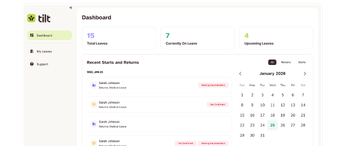
Tilt’s Leave Experience Management platform helps HR teams deliver clarity, continuity, confidence, and care across every stage of leave. With guided workflows, clear visibility into each leave, and support for both HR and employees along the way, teams can manage complexity without adding more manual work. The result is a leave experience that stays organized, stays compliant, and gives both HR and employees confidence at every point in the leave journey.
FAQ
What makes a good employee leave experience?
A good employee leave experience goes beyond having a written policy in place. It’s built on four key qualities: clarity about what the employee is entitled to and what they need to do, continuity through thoughtful coverage planning, confidence that comes from understanding the full arc of the leave, and care that extends all the way through the return.
Why do most leave of absence programs fall short?
Most leave programs fall short because they’re built reactively rather than designed proactively. For smaller companies, that often looks like manual tracking across disconnected systems, pay errors that require reconciling by hand, and one HR person managing everything without a reliable process. For larger teams, it shows up as inconsistency across leaves and managers who feel unsupported. In both cases, the root cause is the same: leave was treated as a compliance obligation rather than an employee experience worth designing intentionally.
How should HR support employees returning from leave?
A strong return-to-work plan includes proactive communication with both the employee and their manager before the return date, a focused summary of what changed while they were out, and ongoing check-ins after return. The Rule of Five is a practical starting point: identify five key updates the employee needs to feel grounded without overwhelming them on day one back. The return is not the finish line. It’s one of the most important moments in the entire leave experience, and one that lean HR teams can execute well with the right framework in place.