

For many HR leaders, outsourcing leave management starts with good intentions. You want to protect employees, reduce risk, and give you or your team some breathing room. Leave is complex, emotional, and high stakes. Handing it off can feel responsible.
Yet over time, a pattern emerges. Employees feel lost. Managers feel disconnected. HR feels stuck chasing answers inside a system they cannot see or shape. What was meant to simplify life quietly erodes trust, culture, and confidence.
Here are five problems HR leaders consistently face with outsourced leave management, and why they matter more than most organizations realize.
1. The Degraded and Impersonal Employee Experience
Leave often arrives at the most vulnerable moments in an employee’s life. A serious diagnosis. A growing family. A personal crisis. These moments test whether a company’s values show up when it counts.
Outsourced leave frequently creates what employees experience as a call center handoff. Instead of calling “our HR team,” they call a 1-800 number. They repeat their story. They talk to different representatives. Updates feel scripted or absent.
As Tilt CEO Jen Henderson puts it:
“The stories are countless of the call center effect. [If] I call a 1-800 number, I get a different person every time, I have to share my story, often sensitive, over and over again. It’s very confusing, it’s very cumbersome.”
Silence between steps compounds anxiety. Employees do not know if paperwork was received or what happens next. That stress lands back on HR, who now must chase answers without real visibility. The loss of nuance hurts too. Vendors do not know your culture, your people, or the context that builds trust.
2. The Illusion of "Set It and Forget It"
Outsourcing promises relief from administrative work. In practice, the work often just moves around.
HR teams still manually enter leave dates, pay adjustments, and intermittent hours to keep payroll accurate. Vendor data rarely flows cleanly into HRIS or payroll systems. Discrepancies appear. Reconciliation follows. Time disappears.
Intermittent leave creates particular strain. Employees are unsure how to log time. Managers are unclear on notifications. Vendor systems lag behind reality. Payroll accuracy becomes guesswork. For small and mid-market teams, this feels especially heavy because every hour spent fixing data is an hour not spent supporting people.
3. Compliance Risk Isn't Eliminated, It's Just Obscured
Outsourcing often brings a sense of compliance relief. The reality feels different once questions arise.
HR still owns compliance outcomes. Vendors apply standardized rules that struggle with nuance across overlapping laws, state programs, and company policies.
Henderson captures this tension clearly:
“The landscape is so incredibly dynamic and complex that the legal risk or the ability to step out of bounds is so high. And so as an HR professional, understandably, the expectation is, make sure I’m doing this right.”
Transparency becomes critical when risk appears. Accessing detailed timelines, notes, and records from a vendor can feel slow and incomplete. HR remains accountable while lacking direct control.
4. The Fragmented Communication Triangle
Leave sits at the center of a triangle between employees, managers, and HR. Outsourced leave management often breaks that connection.
Vendors communicate directly with employees. Managers are left guessing about timelines, return dates, or restrictions. Planning workloads becomes harder. The manager-employee relationship strains and limits their ability to plan their workload.
When confusion builds and the process breaks down, everyone calls HR. HR inevitably becomes the middleman, tracking down answers from the same vendor meant to save time. Instead of clarity, the process creates friction across the organization.
5. Loss of Flexibility and Strategic Control
Leave policies shape total rewards and reflect how a company cares for its people. Unfortunately, outsourced or ‘one-size-fits-all’ systems are rigid by design.
HR leaders know when discretion matters. A long-tenured employee may need a short extension or unique situation may call for a human decision. But vendor workflows struggle with these realities. Exceptions become bureaucratic. Culture takes a back seat to process.
Misaligned incentives play a role. Vendors focus on efficiency and scale while HR focuses on retention, trust, and long-term impact. When flexibility disappears, so does HR’s ability to lead with certainty and trust.
Why This Moment Matters
HR leaders are not asking for more work. They are asking for clarity, confidence, and tools that reflect the human reality of leave. Outsourced leave management often creates distance at the exact moment connection matters most.
Henderson sums up the cultural cost:
“When unnecessary friction exists particularly in people operations or HR, it has so many unintended ripple effects… the customer experience of whatever business you’re running will never exceed your employee experience.”
Modern approaches to leave restores visibility without sacrificing care. They give HR control without pulling them back into spreadsheets. Most importantly, they allow leave to reinforce culture rather than quietly undermine it.
For HR leaders who want their function seen as a growth driver, not a compliance checkpoint, leave management is no longer a background task. It is a moment that defines trust, values, and leadership.
From an Outsourced Process to a Trusted Experience
The common thread across these challenges is ownership. When leave is outsourced, HR loses visibility into a critical employee moment while remaining accountable for culture, compliance, and outcomes. Leave Experience Management (LXM) changes that dynamic by giving HR a clear, connected view of leave as it unfolds and the confidence to manage it in-house.
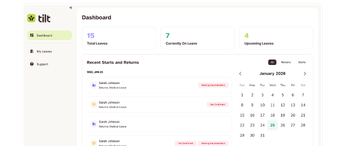
With Tilt, modern leave management is being redefined through LXM. This new leave category brings timelines, documentation, pay, and communication together in one place, handling the administrative complexity of leave while preserving the space for empathy, judgment, and care. Employees stay informed, managers can plan, and HR remains in control without being pulled back into administrative work, turning leave into an experience HR can confidently guide when it matters most.