

Whether you manage leave manually because that’s just what your team always did, or it was the most inexpensive solution, or because you wanted full control over the process, it has probably worked well enough.
There’s a real case for full ownership. You’re not depending on a vendor, you know where things stand, and the process lives with only you.
But here’s what comes with full ownership: everything. The follow-up. The tracking across multiple systems. The double-checking before deadlines. The compliance exposure every time something slips through the cracks. The list goes on.
Manually managing leave gives you control, and along with that control comes a set of costs that, if you’re not paying close attention, tend to quietly compound into something bigger than most teams expected.
1. Time Lost To Administrative and Repetitive Tasks
The time piece is the most visible one, and it still tends to catch teams off guard.
If your team is manually managing leave, you’re likely spending around 6.8 hours per case — compared to 4.2 hours with a hybrid model and 2.6 hours with an automated solution. For some teams, just one person is managing leave alongside everything else, that gap adds up fast. And if it’s any comfort, you’re not alone: nearly half of organizations we surveyed (47.11%) are still running leave this way.
The real issue is where those hours are coming from. For lean HR teams, every hour spent on leave administration is an hour pulled from hiring, manager development, culture work, or any other initiative that moves the business forward. Manual leave management trades your most valuable hours for your least strategic work. One leave case is manageable. Three running at once, all requiring the same manual oversight, is a different story.
2. The Risk of Feeling Stretched or Burnt Out
The time drain is the part that shows up in your day to day, but the mental load is what tends to follow you home.
Manual leave management is reactive by nature, which means it’s always on. Something changes mid-leave, you update the spreadsheet. A manager asks a question, you track down the answer. A deadline approaches, you run through the checklist again to make sure nothing slipped. The process requires sustained attention that’s genuinely hard to step away from, because the cost of missing something is high — 74.4% of HR professionals rate their compliance concern at an 8 or higher out of 10.
That’s where the burnout risk lives — not in a single overwhelming moment, but in the ongoing weight of managing complex, sensitive situations without a system that holds it together for you. Checking that the manager got the memo. Confirming the paperwork came through. Reminding yourself to remind someone else. None of those are high-value uses of your time, but when you’re running manual processes, they’re unavoidable.
For HR leaders already carrying a full plate, that kind of persistent, low-grade drain adds up faster than any time log will show.
3. Gaps in Leave Experience, Retention, and eNPS Scores
Here’s the part that can get overlooked: while you’re managing all of the above, the employee going through the leave is forming an opinion about your organization.
They notice whether information comes to them or whether they have to chase it down.
They notice whether their manager seems prepared or is clearly winging it.
They notice whether their experience feels consistent with what a colleague described, or whether it seems to depend on who happened to be managing things that week.
When the process is held together manually, consistency is hard to guarantee, and employees tend to notice the gaps.
The data makes the stakes clear. Organizations treating leave as a low priority see average eNPS scores of 30, compared to 70 for those treating it as a top priority. Post-leave retention follows the same pattern: 92% in high-priority organizations against 68% where it’s lower on the list. Employees in low-priority environments are three times more likely to report challenges during and after their leave.
These aren’t policy failures. They’re the downstream effect of capacity running thin, and of a process built around data entry with the human experience treated as secondary.
4. Compliance Risk
Most HR leaders aren’t worried about doing something deliberately wrong. The real risk is getting something wrong without realizing it.
Leave laws are constantly evolving. FMLA, ADA, state-specific leave laws, and company policy don’t always align cleanly, and when you’re managing cases manually, the margin for error is wide. A missed deadline, an inconsistent approval, or even a notification that never went out may not feel like a lawsuit in the moment, but they can be.
The cases that end up in litigation aren’t always those that seem like the worst case scenario. They’re the ones where an employee felt their leave was handled differently than a colleague’s, or where the paper trail simply wasn’t there. Inconsistency and poor documentation are two of the most common threads in leave-related legal exposure, and both are predictable byproducts of a manual process.
When your process lives in spreadsheets and email threads, there’s no audit trail that holds up if things escalate. The cost of a single employment lawsuit, legal fees, settlement, time, and distraction, is almost always more than anyone expected. The good news is that most of this exposure is preventable with consistent processes, clear documentation, and a system that creates a reliable record by default.
How HR Is Pivoting To New Approaches
Full ownership of the leave process means full ownership of all three of these costs. And they don’t sit in separate buckets, they feed off each other. When time runs short, mental load increases. When mental load is high, quality and consistency slip. When consistency slips, employees notice.
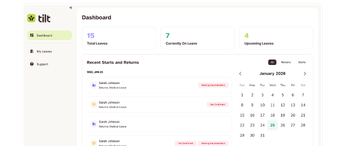
If any of that feels familiar, you’re not alone. The teams working through it are building more intentional, in-house approaches to leave management — ones that give them structure and visibility without the constant overhead. Tilt’s Leave Experience Management platform is built for exactly that: you keep full ownership of the employee experience, without the hours of administrative lift that currently come with it.
If you’re curious what that looks like in practice, a tour of the platform is a good place to start — or you can meet with a member of our team.