

Most HR leaders don’t get the opportunity or the time they need to completely redesign their leave programs—they evolve them incrementally. In practice, that often means focusing on keeping processes working and compliant day to day. But when the priority is maintaining operations, the more human elements—like how employees actually experience leave—can easily be overlooked.
The opportunity isn’t in rebuilding. It’s in being intentional about how the experience is structured, communicated, and supported within the process you already have. It doesn’t require a full reset. There are practical changes you can make that improve how leave is experienced without rebuilding everything behind it.
Here are three steps you can start taking today to design a better leave experience—without changing your policy.
Step 1: Map the Entire Leave Journey
Even with a solid process in place, there are a lot of elements of a leave of absence that can cause confusion, communication gaps, and missed deadlines – especially for the employee who is taking the leave..
Mapping the full leave journey brings clarity to how the experience actually unfolds, helping you to uncover where these gaps are and how you might be able to close them.
This means looking beyond policies and understanding the lived experience of leave at your company. Start by asking questions like:
- When does an employee first notify HR, and what happens next?
- When is the manager involved, and how are they prepared?
- When does paperwork need to be submitted, and how is that communicated?
- When and how is pay information shared with the employee?
- What does the return-to-work experience actually look like?
In practice, HR teams can map the leave journey by reviewing their most recent leaves and walking through them step by step. Where did questions come up? Where did the timelines shift? Where did HR need to step in to keep things moving? Those moments often highlight where the experience isn’t clearly defined.
Another helpful method is to think about leave in phases rather than as one continuous process:
- What employees need before leave begins
- What they need while they are out
- What they need as they prepare to return
Within each phase, key stakeholders should clearly define the steps that move the leave forward. What does the employee need to complete at this stage? What does the manager need to prepare or communicate? What does HR need to track, confirm, or guide?
Tilt’s Employee Success Manager Kim Smith recommends building the leave plan with those phases in mind. From HR’s point of view, “I’m able to look at the leave through every single chapter. What are the steps that this employee needs to pay attention to before their leave even starts [or] while the person is on leave? What actionables do they need to take? As they are gearing up to return back to work, what information or resources do we want to share with them?”
When the full journey is visible, leave becomes more manageable for HR and employees. Instead of reacting to each situation as it arises, HR can anticipate needs and guide employees through a more consistent experience. Instead of feeling confused or overwhelmed, employees have the steps they need to move forward.
Step 2: Define When Human Involvement Is Needed
Once the leave journey is clearly mapped and the steps within each phase are defined, the next step is understanding where that experience needs a more intentional human touch.
Not every moment in a leave requires the same level of support. Some situations can follow a defined process, while others require more sensitivity or attention
Smith has seen two distinct patterns among employees taking leave:
- Those who want every detail upfront
- Those who prefer to move step by step with guidance along the way
“You definitely have the individuals that want it all — they say ‘give every bit of information you can to me, I don’t care how much it is.’ They want to hop on a call and chat through everything so that at any given point throughout the leave they know exactly what needs to be done. You also have the individuals where giving a three-page PDF with company leave policies, state policies, and short-term disability is really overwhelming — they’re saying ‘just give me what I need right now.'”
That insight becomes practical when you look at your leave journey and ask:
Where do employees need reassurance, not just information?
For many teams, these moments can look like:
- Understanding pay and benefit changes
- Preparing coverage plans with managers
- Navigating state or disability programs
- Setting expectations for return to work
- Keeping track of deadlines without feeling overwhelmed
These are the points where a process alone isn’t enough. An well-timed conversation creates clarity and helps employees feel supported in a way written instructions often can’t.
Smith has seen how impactful those moments can be when they’re handled intentionally. “I really think that how those conversations go with leaders can make all the difference — because ultimately that’s what led me to have a really wonderful 12 weeks with my son, and I came back better, probably even than before I left.”
When it’s possible for teams to define these touchpoints ahead of time, the experience becomes more consistent across every leave. Employees know when they’ll have support, and HR can be more deliberate about where their time and attention go.
Step 3: Standardize Your Key Communication Moments
Even with the right structure and support in place, leave can still feel disjointed when communication isn’t consistent.
In many cases, the challenge isn’t the information itself, but when and how it’s delivered. Employees may receive details too late, managers may be unsure what to communicate, and HR often ends up repeating the same explanations across every leave.
Consistency in communication is what brings the experience together.
In practice, this starts by identifying the points in the leave journey where communication has the greatest impact. This often includes:
- The initial overview after a leave request
- Key deadlines for paperwork or claims
- The coverage planning conversation
- The transition back to work
- The first week after return
Once these moments are clearly defined, the focus shifts to how they show up. Not every conversation needs to be identical, but employees should receive the same level of clarity and support each time.
For example, Smith recommends what she calls the “Rule of Five” for return-to-work conversations. Instead of overwhelming employees with everything they missed, focus on the updates that matter most:
- Major leadership or team changes
- Company priorities or strategy shifts
- Important product or operational updates
- Changes to team structure or project ownership
- Key announcements or cultural moments
“That gives the person who’s coming back some insight into what has been going on and what has changed — without you having to share a ton of documents and a backlog of things that have happened months ago that are completely outdated,” says Smith. “It’s not worth going back through weeks and weeks of time that’s already passed while they’ve been out on leave.”
When communication is structured in this way, leave feels more organized and predictable for everyone involved—while still leaving room for the nuance each situation requires.
A Better Leave Experience Is Within Reach
When put together, these steps create a more complete picture of what a well-designed leave experience looks like. It’s not defined by policy alone, but by how clearly the journey is mapped, where support is provided, and how consistently communication shows up along the way.
And how those qualities show up will look different depending on the needs of your organization. For some, it’s by making these elements more intentional—not changing the policy itself, but designing the experience that surrounds it.
For others, it’s by bringing in a trusted parter that can transform the leave experience alongside your team. Many small to mid market organizations are pivoting to modern solutions for their leave needs. Not only for their added support, but also to have complete visibility and insight over the employee experience.
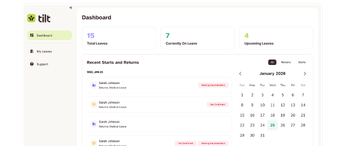
Tilt’s Leave Experience Management platform is built to support HR teams by providing a clear view of the full leave journey, surfacing the moments that need attention, and guiding employees and managers with the right information at the right time. It brings structure to the process so HR isn’t stuck tracking deadlines, repeating answers, or piecing together updates across systems. The result is a leave experience that stays organized, consistent, and manageable for HR while ensuring employees feel supported throughout.
Learn more about Tilt’s platform or by meeting with a member of our team.
FAQ
How can I start improving our leave experience without adding more work to my team?
Start by focusing on visibility rather than volume. Review your recent leaves and identify where your team had to step in manually, where employees had the most questions, and where timelines became unclear. Those moments point directly to where small adjustments—like clearer communication or defined checkpoints—can reduce effort over time instead of adding to it.
How do I know which parts of our leave process need more structure?
Look for patterns, not isolated issues. If employees consistently ask the same questions, if managers approach coverage planning differently each time, or if deadlines require manual follow-up, those are signals that the process isn’t clearly defined. Strong leave experiences don’t eliminate complexity—they make it easier to navigate by making expectations more consistent.
What does it look like to balance automation and human support in leave management?
It starts with deciding which moments benefit from consistency and which require conversation. Tasks like deadline tracking, reminders, and status updates can follow a structured process, while moments like explaining pay, preparing for leave, or returning to work often require a human touch. The goal is to reduce manual effort where possible so HR can be fully present where it matters most.