For many HR teams, managing leave starts in spreadsheets. You already know your employees, understand your company policies, and want to have visibility and control over your leave program.
It makes sense, and that can work well for a while.
But as your company grows, leave often becomes harder to manage. Whether that’s information living across multiple systems, evolving compliance requirements, or triple checking tasks that should have been completed the first time, managing leave internally can quickly consume your week.
That’s where many HR teams start asking whether their current process can keep up.
The Challenges With Managing Leave Internally
When you’re managing leave internally, there’s a lot that can end up on your to-do list. You may be:
- Tracking employee information and leave dates
- Researching state and federal requirements
- Coordinating with payroll and benefits
- Answering employee and manager questions
- Making sure every step and document is completed
At first, everything can feel manageable. You update the spreadsheet, send the email, check the policy, and move on to the next thing.
The challenge is how quickly those small tasks can add up.
And if you’re already balancing recruiting, employee relations, and everything else that comes with your role, those small tasks can become a much bigger part of your week than you expect.
As Allison Mairena, Head of People at Prudentia Sciences, explains, there often isn’t a dedicated person whose entire job is managing leave. “Many HR Leaders just don’t realize that there’s a better way than having somebody doing this off the side of their desk — which is 99.9% of the time. Very rarely do you see a dedicated leave of absence person on an HR team. Oftentimes, HR leaders don’t get the budget for that level of specialization.”
Pricing is another reason why many teams choose to manage leave manually. Keeping a process internal can seem like the most cost-effective option when you’re looking to add another solution. But the time your team spends maintaining that process is part of the equation, too. “The view of managing leave manually for cost savings is, in my opinion, a little bit short-sighted because of all of the hidden costs involved — mostly on top of what an HR generalist is already trying to do. They’re trying to save money and may just not prioritize it as a key point of the employee experience, but it’s actually very impactful.”
The question becomes less about whether you can manage everything internally and more about whether your current process gives you enough time and support to do the rest of your job well.
What Changes As Your Organization Grows
As your organization grows, HR has to keep up with a lot more moving pieces.
You may have employees working across more states. Multiple leaves may be happening at the same time. Managers need visibility into how a leave of absence could affect their teams, while you need a clear picture of what’s happening across the organization.
That broader visibility becomes harder to maintain when information is spread across spreadsheets, email threads, HRIS systems, and other places.
Then there’s compliance.
Federal requirements, state paid leave laws, company policies, eligibility requirements, and different benefit amounts can all overlap—and those requirements can change as your organization grows.
“The other major challenge as companies grow, particularly across the United States, is compliance,” Mairena notes. “There are over 15 states, plus Washington, DC, that have paid family and medical leave laws. It makes your head spin sometimes, especially if you’re a distributed company across many of those states.”
You’re already familiar with how complicated compliance can become. The challenge is keeping up with all of those moving pieces while also giving employees and managers clear answers.
That’s where a process that once felt manageable can start to feel like a lot to hold.
What Gets Lost When Leave Takes Up Your Week
The biggest impact has less to do with any individual task and more to do with everything else you could be doing with that time.
When you’re spending hours researching state benefits, reconciling payroll, tracking documentation, and answering questions, those hours have to come from somewhere.
For HR leaders, that can mean less time for the strategic work you were hired to do. As Mairena points out, “When you are a people team of one, it takes away from your ability to strategize on retention, culture, and workforce planning because you’re spending hours and hours on administrative work.”
And sometimes, the amount of time involved is much bigger than you’d expect.
“On average, I was probably spending maybe 20 hours worth of work on a single leave, which is just not tenable as a people team of one. Beyond being on the phone with insurers, you’re doing manual reconciliation each pay cycle to make sure — did the benefit amount change since I last looked? Is the duration of that state paid leave the same as another state? That’s also a varying part of the equation. It just makes it really, really administratively burdensome.”
When that happens repeatedly, it’s easy to feel spread too thin.
You still want to be there for your employees.
You still want to help managers plan ahead.
You still want to be a strategic partner to the business.
But the administrative side of leave can make it harder to give those things the time they deserve.
And that can affect the experience employees and managers have, too. Without enough support, managers may be left trying to interpret policies on their own or figure out how to plan around an employee’s absence. Employees, meanwhile, may have a harder time getting the clarity and support they need.
How HR Is Rethinking Manual Leave Management
Managing leave internally doesn’t mean you have to personally handle every administrative task. Mairena shares,“There is a best-of-both-worlds scenario where you’re still involved enough in the leave management experience while outsourcing the administrative piece — whether it’s payroll calculations, researching applicable legal compliance, or helping the employee know which government website to go to in order to apply for their state benefit, and when to do so. All of that can be done with a solution such as Tilt.”
That gives you more time for the parts of the process where your involvement really matters. You can focus on:
- Working with employees to build a thoughtful leave plan
- Helping managers plan for an employee’s leave of absence
- Preparing employees for a smoother return to work
- Answering questions that require context and judgment
Because you know your people and your organization, those are areas where your involvement can make a real difference.
When you have the right tools in place, Mairena adds, “You can spend your time creating what the leave plan should look like and what the return-to-work transition should look like so you can retain your top talent. Get ahead of it, plan it out, so that way everybody isn’t scrambling and figuring things out as you go.”
That’s the kind of flexibility an internal leave program should give you: control over the experience, visibility into what’s happening, and a platform that holds everything you need in one location.
A More Sustainable Way To Manage Leave
For HR teams who want to stay close to their employees and maintain ownership of their leave program, managing leave internally is a great option. As organizations grow, though, the administrative demands can become harder to manage alongside the rest of HR’s responsibilities.
That’s why teams are opting for systems that can flex and scale with their needs.
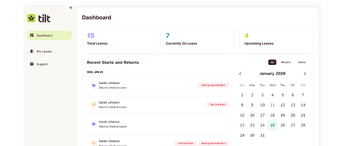
Tilt’s Leave Experience Management platform gives HR teams the flexibility to manage leave their way, with centralized information, greater visibility, and the option for personalized support from dedicated Leave Specialists. See how Tilt can transform your internal leave program by meeting with us here.