

Most organizations have a “leave person.”
They’re the one who knows how the process works, where employees are in their leave journey, how payroll connects to leave pay, and which managers need additional support along the way. Over time, they become the person everyone turns to whenever a question comes up.
And in many cases, that works well.
But if that person takes a vacation, moves into a new role, or takes a leave of absence themselves, organizations often discover just how much of the process was living with one person rather than within a structured system.
Leave Has a Way of Living in HR's Head
Whether it’s onboarding, performance reviews, or benefits enrollment, most HR responsibilities follow a predictable process that guides everyone from start to finish.
But leave is different.
Every leave comes with its own circumstances, timelines, and moving pieces. As a result, HR leaders develop routines that help them navigate situations that don’t always fit neatly into a standard process.
As Tilt’s Employee Success Manager Kim Smith explains, “Most of us HR folks love a good process. Unfortunately, some of those processes don’t always live on paper or in a Google Doc. They tend to live up in our heads. For a lot of people, the full life cycle of how they manage a leave of absence lives there too because they’ve learned what works, what questions usually come up, and where they need to pay extra attention throughout the process.”
That kind of lived experience is often what keeps things moving.
But when critical knowledge only exists in someone’s memory, it becomes difficult for others to step in when needed.
When One Person Becomes the Process
At first, this doesn’t feel like a problem.
Employees are getting answers. Managers know who to reach out to. Payroll gets what it needs. From the outside, everything appears to be working.
The risk usually shows up when someone else has to take over.
Imagine an employee beginning parental leave while the HR team member who normally manages leave is out of the office. Another colleague jumps in to help, but they’re unsure where documentation is stored, whether state benefits have already been filed, or what updates have been shared with the manager.
Nobody made a mistake. The information simply wasn’t easy to access.
Suddenly, time is spent rebuilding context instead of supporting the employee.
Leave doesn’t break all at once in these situations. Instead, it becomes slower, less consistent, and more dependent on who is available at the moment.
And because employees are often navigating significant life events, even small disruptions can have a meaningful impact on their experience.
When Everything Lives in One Place
Over time, the “leave person” doesn’t just become the go-to for questions. They become the place where everything meets — updates, exceptions, manager concerns, payroll context, and employee details all flow through them.
Even when systems or documentation exist, people often still go straight to the person who knows how to make sense of it all. Not because the tools don’t work, but because this person has the context to interpret what matters.
And that’s usually how the deeper dependency forms. It’s not just about where information lives — it’s about how information gets understood. One person becomes the connector between policies, systems, and real employee situations.
From the outside, this can feel efficient. Questions get answered, decisions get made, and employees are supported. But when so much flows through one person, a few things can start to quietly happen.
- Managers and other partners don’t always have a clear line of sight into what’s going on, so they rely on updates instead of having confidence in the information themselves. That can make it harder for them to support their teams without checking in or waiting for answers.
- Employees may also have slightly different experiences depending on how information is relayed or interpreted along the way. Not because anyone is doing anything wrong, but because so much depends on how one person communicates in the moment.
- For HR teams, it can also become hard to scale the work or step back from day-to-day execution. Even with good documentation in place, most questions still come back to the same person because that’s where the full context lives.
And over time, that can make it difficult for others on the team to build confidence managing leave independently, simply because they don’t get as many opportunities to work through the full picture themselves.
So even when everything is technically working, the experience can feel very different depending on who is available, how busy things are, or how much context needs to be reconstructed at the moment.
It’s not that the process is broken. It’s that so much of how it works depends on one person carrying a level of context that’s hard to share.
And that can make it harder to keep the experience consistent, scalable, and easy for everyone involved.
This Isn't Just a Small Company Problem
When people hear about this challenge, it’s easy to assume it primarily affects smaller organizations. In reality, organizations of every size can find themselves in the same situation.
For smaller teams, the challenge often comes from limited resources. HR may be a team of one that manages leave alongside recruiting, payroll, and employee relations. And because leave may happen less often, certain scenarios can feel unfamiliar every time they arise.
As Smith explains, “If you are an employer who has less employees, you may not see the more robust leave cases as often. You may not be managing leaves for particular states that have state programs as often and then you have to do a quick refresher because it’s been a year since you’ve managed a leave of absence.”
Larger organizations face a different version of the same challenge.
More employees often means more leaves, more complexity, and more stakeholders involved throughout the process. There may be multiple leave types, employees in different states, and several teams that need to stay aligned.
As Smith notes, “If you have a larger organization, you’re likely going to see more leaves, those that are in different stages or in different states…It doesn’t matter if you’re supporting an employee population of 50 or less, or up to 5,000, you’re still going to feel those pain points.”
The details may change, but the underlying challenge remains the same: when critical leave knowledge depends on one person, the organization becomes more vulnerable to disruption.
How Teams Can Start Reducing That Dependency
To reduce this dependency, most teams can begin by looking at visibility. Asking questions can help uncover where the gaps are forming and identify where to start making changes. Questions may include:
- Where is leave information actually living today?
- Who has access to it?
- How easily could someone else step in and understand what’s happening without needing a full walkthrough?
From there, a few early shifts tend to make a meaningful difference:
- Capturing key steps instead of relying on memory
- Making leave status visible beyond one inbox or one person
- Aligning managers and HR on where they go for information
- Creating a shared understanding of the leave journey itself, not just individual cases
None of this requires rebuilding everything at once. It’s more about shifting leave from something carried by a person to something supported by a structure.
And that shift usually starts small.
One documented workflow. One shared view. One less moment where someone has to “just know how it works.”
Over time, those pieces start to reduce the dependency on any single individual and make the process easier for others to step into when needed.
Building a Leave Process That Doesn't Depend on One Person
Most HR teams don’t intentionally create leave processes that depend on one person. It happens naturally as trusted team members gain experience, solve problems, and become the go-to resource for leave-related questions.
While that expertise is incredibly valuable, it can create challenges when information lives in HR’s head. The more leave relies on individual memory rather than shared visibility and documented processes, the harder it becomes to maintain consistency for employees, managers, and HR alike.
That’s one of the reasons organizations are beginning to take a different approach to leave management.
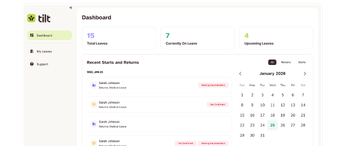
Tilt’s Leave Experience Management platform helps HR teams to manage leave within one centralized experience. By creating greater visibility across the leave journey, organizations can create a more informed, smooth, and consistent leave experience for everyone involved.
To see what this can look like for your team, schedule time with our team or take a tour of the platform today.