
Leave law activity continues to evolve nationwide, with new paid family and medical leave programs, expanded employee protections, and new compliance requirements shaping how employers manage leave. While there has been little movement toward a federal paid leave program, states continue to introduce new legislation and refine existing laws, adding complexity for HR teams managing leave across one or multiple jurisdictions.
This report highlights important federal and state leave law developments including PFML updates, new legislation, benefit changes, and emerging trends to watch. Our leave experts monitor these changes year-round to help you stay informed, prepare for what’s ahead, and manage leave with greater confidence.
Federal Updates
No Federal Paid Family & Medical Leave (PFML) Solution Expected in the Near Term
Since our last report, Congress has made little progress toward establishing a national Paid Family and Medical Leave (PFML) program. Paid leave continues to be driven primarily by state laws and employer policies, leaving multi-state employers to navigate a growing patchwork of requirements.
The most notable recent development is the introduction of a Senate companion to the More Paid Leave for More Americans Act. The bipartisan proposal was first introduced in the House in April 2025. On July 16, 2026, Senators Kirsten Gillibrand and John Boozman introduced the Senate version, giving the proposal bipartisan support in both chambers. The bill would create a competitive grant program for states that establish qualifying paid leave programs through public-private partnerships and provide at least six weeks of paid parental, caregiving, medical, or qualifying military-exigency leave.
The proposal would also create the Interstate Paid Leave Action Network, or I-PLAN, to help participating states align definitions and administrative processes. It would not create a federal leave entitlement or require states to participate. The House and Senate bills both remain in the early stages of the legislative process.
DOL Clarifies FMLA Travel Time Is Protected
On January 5, 2026, the U.S. Department of Labor issued an opinion letter confirming that FMLA leave includes reasonable travel time to and from appointments related to an employee’s or qualifying family member’s serious health condition. The DOL also clarified that a medical certification does not need to separately estimate or reference travel time, so employers should not deny otherwise qualifying travel time solely because it is not addressed in the certification.
State PFML Programs
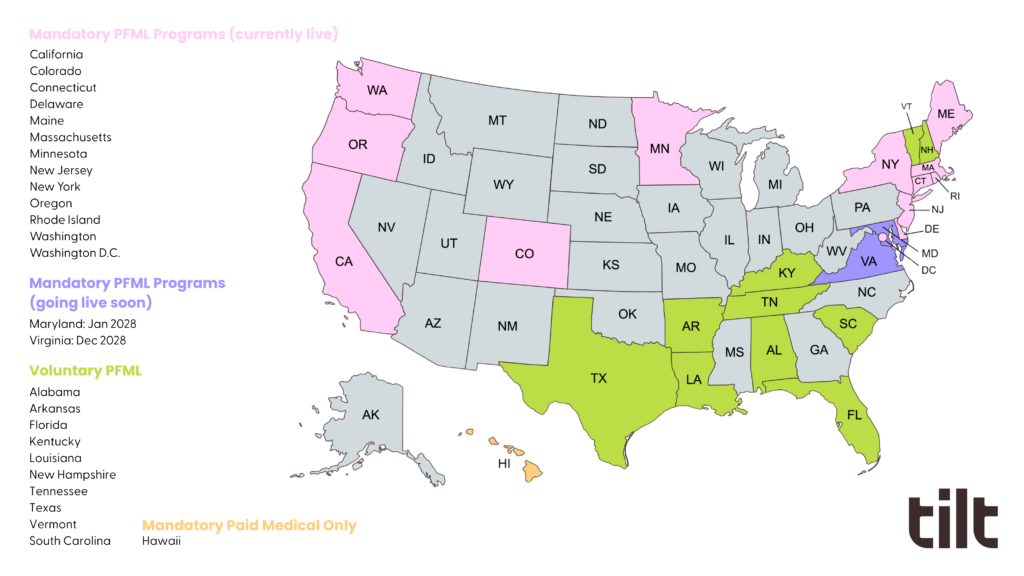
The most meaningful paid family and medical leave developments continue to occur at the state level, where programs typically fall into one of two categories: mandatory or voluntary. Mandatory programs generally operate as social insurance funded through payroll contributions, while voluntary programs generally allow, but do not require, employers to purchase paid family leave insurance through the private market.
As of July 2026, 14 states and Washington, D.C., have enacted mandatory PFML laws. Virginia is the newest state to join that group, enacting its program in April 2026. Twelve states and D.C. are currently paying benefits. Maryland is scheduled to begin paying benefits in January 2028, and Virginia will begin paying benefits on December 1, 2028.
Louisiana joined the states permitting voluntary paid family leave insurance when it enacted the Paid Family Leave Insurance Act in June 2026.
Midyear Benefit Updates
State
Earlier 2026 Maximum
Updated Maximum
Effective Date
Colorado
$1,381.45
$1,448.02
July 1, 2026
Maine
$1,198.84
$1,249.12
July 1, 2026
Oregon
$1,636.56
$1,692.16
June 28, 2026
Rhode Island
$1,103
$1,150*
July 1, 2026
Washington
$1,647
$1,727
January 1, 2027
* Rhode Island provides an additional dependency allowance for eligible claimants, increasing the maximum weekly benefit to $1,552.
The updated rates for Oregon, Rhode Island, and Washington generally apply when an employee’s benefit period begins on or after the applicable effective date. Colorado applies its increase to benefits paid on or after July 1, including claims already underway. Maine generally uses the rate in effect on the July 1 preceding the earlier of the employee’s application date or leave start date.
States to Watch
Pennsylvania
There was meaningful bipartisan PFML activity in both chambers. The House passed one proposal in March after significantly narrowing it, while a separate bipartisan Senate proposal advanced out of committee in June but has not passed the full Senate. Both chambers are scheduled to reconvene in September, so additional action remains possible in 2026. However, lawmakers still have significant work to do before a program could become law.
Illinois
House and Senate PFML proposals both failed to advance out of committee in 2026 and were returned to the House Rules Committee and Senate Assignments Committee. Lawmakers could revive the legislation during the veto session later this year, but enactment in 2026 appears unlikely.
Hawaii
A comprehensive PFML proposal did not pass before the regular legislative session ended. No further action is expected in 2026 unless lawmakers return for a special session.
Ohio
A bipartisan PFML proposal introduced in March received its first committee hearing in June but has not advanced out of committee. Enactment in 2026 appears unlikely.
New Mexico
A 2025 PFML proposal passed the House but died in the Senate, and the state’s short 2026 regular session has ended. Although PFML remains an active issue, legislation is more likely to return in 2027.
State Leave Law Updates
California
Paid Pregnancy Leave for Public Education Employees
Beginning January 1, 2027, eligible employees of California public school districts, charter schools, county offices of education, and community college districts may receive up to 14 weeks of fully paid leave when disabled by pregnancy, miscarriage, childbirth, termination of pregnancy, or recovery from any of those conditions. The leave does not run concurrently with FMLA, the California Family Rights Act (CFRA), California Pregnancy Disability Leave, accrued sick leave, or extended illness leave.
District of Columbia
Paid Leave Reductions Pending
The D.C. Council approved budget legislation that, if fully enacted, would reduce family caregiving benefits from 12 weeks to six weeks and personal medical benefits from 12 weeks to 10 weeks beginning in fiscal year 2027. Parental leave would remain at 12 weeks, prenatal leave would remain at two weeks, and the maximum weekly benefit would decrease from $1,190 to $1,100.
The changes still must complete the District’s enactment and congressional-review processes, so the current benefit durations and maximum remain in effect for now.
Hawaii
Family Leave Expanded for Military Exigencies
Effective July 1, 2026, eligible employees may use Hawaii Family Leave for qualifying military exigencies arising from the active-duty service of a child, spouse, reciprocal beneficiary, sibling, grandchild, or parent. Qualifying reasons generally track the federal FMLA rules and include short-notice deployment, military events, childcare arrangements, legal and financial arrangements, rest and recuperation, and post-deployment activities.
The change does not create additional leave. Employees remain entitled to a combined total of four weeks of Hawaii Family Leave per calendar year. The law generally applies to employers with 100 or more Hawaii employees, and employees qualify after six consecutive months of employment.
Illinois
NICU Leave Law
Beginning June 1, 2026, Illinois employers with 16 or more employees must provide unpaid, job-protected leave to employees whose child is in a neonatal intensive care unit (NICU). Employers with 16–50 employees must provide up to 10 days of leave, while employers with 51 or more employees must provide up to 20 days. Leave may be taken continuously or intermittently, and employers may require increments of at least two hours. For employees who take FMLA leave, Illinois NICU leave must be provided after, and in addition to, any FMLA leave taken.
Louisiana
Organ and Bone Marrow Donor Leave
Beginning August 1, 2026, Louisiana private employers must provide unpaid leave to employees who request time off in writing to serve as an organ or bone marrow donor. The law provides up to 30 consecutive calendar days of unpaid leave, and employers may choose to provide more. The law also protects employees from retaliation for requesting or taking donor leave.
Maine
PFML Benefits Begin
Maine’s Paid Family and Medical Leave program began paying benefits on May 1, 2026. Eligible employees may receive up to 12 weeks of leave in a benefit year for bonding, their own serious health condition, caring for a family member, certain military-related reasons, or safe leave. Employees generally qualify if they earned at least six times the state average weekly wage during the applicable base period, which currently equals approximately $7,495. The maximum weekly benefit increased to $1,249.12 on July 1.
Massachusetts
Employer Contribution Allocation Changes in 2027
Beginning January 1, 2027, Massachusetts will change how PFML contributions are divided for employers with 25 or more covered individuals. Those employers currently must fund at least 60% of the medical-leave portion of the contribution. Beginning in 2027, the required employer contribution will shift to the family-leave portion. Employees may be charged up to 40% of the family-leave contribution and up to 100% of the medical-leave contribution.
Employers with fewer than 25 covered individuals will remain exempt from making an employer contribution and may withhold the full employee share. The total 2027 contribution rate has not yet been set and is expected to be announced by October 1.
New Jersey
Expanded Leave Protections
New Jersey’s expanded leave protections took effect July 17, 2026. Previously, the New Jersey Family Leave Act (NJFLA) covered employers with at least 30 employees and required employees to have worked for the employer for 12 months and at least 1,000 hours during the preceding year. Those thresholds have been reduced to 15 employees, three months of employment, and 250 hours worked during the preceding 12 months. NJFLA continues to provide up to 12 weeks of leave in a 24-month period for bonding and family caregiving, but not an employee’s own serious health condition.
The New Jersey Department of Labor also interprets the July 2026 changes as creating separate job protection for employees receiving Temporary Disability Insurance (TDI) or Family Leave Insurance (FLI) benefits when FMLA or NJFLA does not apply. According to the state, there is no minimum employer-size, tenure, or current-employer hours requirement for this protection; eligibility is based on qualifying for TDI or FLI benefits, which is determined by recent earnings. Employees receiving benefits on July 17 may also be protected even if their leave began earlier.
TDI benefits may be available for up to 26 weeks, while FLI benefits may continue for up to 12 consecutive weeks. Employees who qualify for both could therefore receive significantly more job-protected time than is available under FMLA or NJFLA. Because the NJDOL is interpreting the amendments broadly and regulations have not yet fully addressed their application, additional agency guidance or court decisions may clarify the scope of these protections.
South Carolina
Civil Air Patrol Leave
Beginning October 1, 2026, South Carolina employers must provide qualifying Civil Air Patrol members with at least 30 days per calendar year for emergency-service operations and at least 10 days for training. Public employers must provide paid leave, while private employers may provide paid or unpaid leave.
The law includes notice and documentation requirements, benefit continuation, reinstatement rights, and anti-retaliation protections. Employers may not require employees to use or exhaust PTO or other leave before taking Civil Air Patrol leave. Limited exceptions apply to certain essential employees and employees needed for simultaneous emergency-response duties.
Virginia
Mandatory PFML Program Enacted, Launching in 2028
Virginia enacted a mandatory Paid Family and Medical Leave program in April. Employers will begin remitting contributions on April 1, 2028, and benefits will become available on December 1, 2028.
Eligible employees may receive up to 12 weeks of benefits per benefit year for their own serious health condition, family caregiving, bonding, military-family reasons, and safe leave, although safe leave is limited to four weeks. Employees generally must have worked for their current employer for at least 120 days before leave begins to qualify for job protection.
Washington
PFML Premium Allocation Changes Coming in 2027
Washington enacted legislation changing how Paid Family and Medical Leave premiums will be allocated between the family and medical portions of the program beginning in 2027. The change responds to federal tax guidance and shifts employer contributions from the medical-leave portion to the family-leave portion through a technical accounting adjustment. This is intended to prevent certain medical-leave benefits from becoming subject to federal employment taxes and to avoid additional administrative burdens for employers.
The change does not affect the 2026 premium rate or the overall contribution split between employees and employers. For 2026, employees may be charged up to 71.43% of the total premium, while employers subject to the employer contribution requirement pay 28.57%. Employers with fewer than 50 employees remain exempt from paying the employer portion.
The state expects to announce the 2027 premium rate and detailed calculations by mid-November and will provide additional implementation guidance later this year. Employers should coordinate with their payroll providers regarding any necessary reporting or system changes.
About Tilt
Every leave is a defining moment in the employee experience. Tilt exists to transform these moments from sources of stress and risk into opportunities for trust, care, and connection. Through Leave Experience Management (LXM), we ensure leave is seamless, compliant, and empowering—so HR can lead with confidence and employees feel fully supported when it matters most.