

When organizations think about the cost of leave, they typically look at the obvious expenses. Payroll continuation. Benefit claims. Legal fees. Those costs are easy to find because they show up on financial reports.
But they’re only part of the story.
Some of the biggest costs of managing leave never appear as a line item in a budget. Instead, they show up in HR’s workload, employee retention, compliance risk, and the overall employee experience.
Because these costs are difficult to measure, they’re often overlooked, and that makes them even more expensive over time.
Here are three hidden leave management costs every HR leader should understand.
The Gap Between Visible and Invisible Leave Costs
Most teams are already aware of the visible costs associated with leave. These are factors that regularly show up within your company’s statements. For leave, this can often include:
- Payroll continuation
- Claims
- Outside legal counsel
- Possible vendor expenses
But there’s another layer of costs that often go unnoticed.
Tilt’s Chief Revenue Officer Brandon Salisbury explains “Visible costs are right there. You can go and search for them or finance can help you find them. Invisible costs often consist of factors and moments that still impact the bottom line, but don’t show up neatly within a company’s financial records. They don’t always get assigned a dollar value, but they’re real and super impactful.”
Hidden costs often include:
- Compliance exposure
- A poor leave experience
- Total time spent managing leave
Left unaddressed, these issues can quietly increase your team’s workload and overall cost for managing leave. Interested to see how much your leave program is costing you? Find out with our new ROI calculator.
Hidden Cost #1: Compliance Exposure
A company can have years without a compliance issue and still be carrying significant risk.
The challenge isn’t today’s regulation, it’s tomorrow’s. As Salisbury notes, “Exposure is always growing. Whether a company is navigating a multi-state workforce, additional leave types, or different state regulations, there’s more regulatory complexity every year. If compliance breaks, those are all areas of exposure.”
The problem is that compliance failures don’t always come from major mistakes. Sometimes they’re caused by something as simple as:
- Sending a required notice one day late
- Missing documentation
- Incorrect eligibility calculations
- Failing to follow the required timeline
Those small errors can become expensive legal issues.
“Lawsuits don’t just stem from worst-case scenarios. They can come from something as small as a notification that came up a day too late,” Salisbury warns. “The goal for HR teams is to minimize those compliance gaps to limit your exposure and cost.”
If you’re navigating new leave laws and want to ensure you’re up to date on the latest changes, the best way to stay informed is to explore our latest leave law reports. Check them out here.
Hidden Cost #2: A Poor Leave Experience
Most HR leaders know that how leave is handled has a significant impact on your organization’s culture.
But fewer recognize the financial impact it can have when those costs aren’t tracked or reported.
If the leave experience is designed well, companies likely benefit in key areas like improved retention, performance, and engagement—more on that in our 2026 Leave Benchmark Report.
But when companies have a poor leave experience, it ends up costing them much more than they want to admit.
“When an experience is disorganized or unclear, that breakdown breaks trust in a way that’s hard to rebuild,” says Salisbury. “Knowing that a poor leave experience can leave a bad taste in that employee’s mouth could cause them to look somewhere else. And let’s face it, turnover is expensive.”
A recent SHRM report revealed that the cost of replacing an employee can range from 50-200% of their annual salary.
For someone earning $100,000 annually, replacing that employee could cost as much as $200,000. That’s a cost that rarely gets connected back to the leave experience, but it’s often part of the story.
The implications of a poor leave experience go far beyond what others notice or how it affects your organization’s culture. Those that address this invisible cost will help save your team and organization hundreds of thousands, if not more, in turnover and lost talent.
Hidden Cost #3: HR's Time Spent Managing Leave
One of the largest hidden costs of leave management is something every HR team feels: their time.
Salisbury explains, “Managing leave manually is very time intensive in ways that are hard to overstate. Every case requires coordination across HR, managers, payroll, and HR is often the one holding everything together. They own this process, and that time has a cost even when it doesn’t necessarily appear as a line item in the budget.”
And when HR is spending all of its time on administrative tasks, that opportunity cost grows quickly.
“The opportunity cost is very real,” Salisbury shares. “Every hour spent on leave admin is an hour not spent on retention, culture, and strategic work. HR teams are often working longer hours when leave cases come up, and many have told us that it can even be a source of burnout.”
When that adds up across dozens or hundreds of leave cases, it starts to shape what HR is able to focus on at a strategic level. It can mean:
- Less time spent on retention strategy
- Reduced focus on manager enablement
- Delayed culture initiatives
- Risk of burnout inside HR teams
This is where invisible cost becomes a capacity issue, not just an operational one.
How Teams Can Improve the ROI of Leave
Fortunately, the first step doesn’t require a complete transformation of your leave program. In many cases, it starts with understanding what is happening today.
Salisbury recommends HR leaders “start with the basics. Look at how many leaves you managed over the last year and see how many hours you’re spending on each case.”
Once you have a baseline, then take some time to review the smaller details.
Track operational signals like:
- Time spent per leave
- Manual touchpoints
- Corrections or errors
- Compliance issues
- Legal escalations
Then connect those activities to business outcomes, including:
- Return-to-work rates
- Retention after leave
- Turnover within months of return
- Employee satisfaction
- HR capacity
Salisbury concludes by saying, “the goal is to not only give a really complete picture that you can act on, but also to start building the business case for getting help from the rest of your leadership team.”
By identifying the invisible costs associated with your leave program, your team will have better insight into what’s working, what’s not working, and the actual value of having a solution in place.
Bringing Invisible Costs Into Focus
Invisible costs in leave management rarely show up in financial reporting. They show up in how time is spent, how risk builds, and how employees experience critical moments in their lives at work.
By making these hidden costs visible, HR leaders get a clearer picture of what leave is actually costing and where support or structure could reduce unnecessary strain.
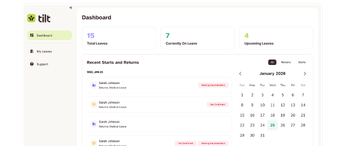
Tilt’s Leave Experience Management platform helps bring visibility to each step of the leave journey, connecting people, process, and outcomes in one centralized location. See how this can fit inside your organization by scheduling time with our team or by exploring our platform.