Updated on October 7, 2026
To all the Short-Term Disability (STD) carriers out there, we’ve got nothing but love for you.
Carriers provide an invaluable service by helping protect employees financially when they’re unable to work. For many employees and employers, that coverage is an important part of a broader benefits strategy.
But there’s an important distinction between providing disability benefits and managing a leave of absence.
A leave can involve much more than an STD claim. There may be federal and state leave requirements, company policies, payroll considerations, manager responsibilities, employee communications, and multiple types of leave happening at the same time.
So when an organization tells an employee to “reach out to the carrier” to manage their leave, they may be relying on a resource that wasn’t designed to manage the full leave experience.
As Tilt Founder & CEO Jen Henderson explained on From the Ground Up:
“Often a leave of absence is supplemented from a pay capacity through a short-term disability policy. An organization will tell an individual who needs a leave of absence to, ‘Talk to the insurance company. Reach out to them.’”
For HR and People Ops teams evaluating leave management solutions, it’s important to understand where carrier support fits—and where a dedicated leave management solution can fill the gaps.
1. Carriers Aren't Designed to Be a Complete Leave Management System
A single leave of absence can have countless moving parts.
HR may need to coordinate information across an HRIS, payroll system, employee records, leave policies, state requirements, and other internal processes. Meanwhile, employees need clear information about what they need to do and what happens next.
When the carrier operates separately from those systems, HR can end up bridging the gaps themselves.
That can mean managing information across:
- HRIS systems
- Leave tracking tools or spreadsheets
- Payroll
- Company leave policies
- State and federal leave requirements
- Workforce planning
- Employee communications
The result can be duplicated work, disconnected information, and less visibility into the overall leave process.
A dedicated leave management platform can give HR a centralized place to manage leave information and workflows, while connecting the different pieces of the leave experience.
The goal isn’t necessarily to replace the carrier. It’s to give HR a system of record for leave that can work alongside the benefits and systems they already have.
2. Disability Benefits Are Only One Part of Leave
STD coverage can be an important part of an employee’s leave, but it’s rarely the entire leave.
As Henderson explains:
“Carriers are singularly focused on the part of the leave that’s impacted by the STD policy. The problem is that there are a lot of other moving pieces with a leave of absence.”
An employee could have an STD claim alongside FMLA, a state leave program, employer-provided leave, or another applicable protection.
That means HR needs to understand how those different pieces fit together—not just whether an employee has an STD claim.
Leave management requires an understanding of the broader leave landscape, including changing federal and state requirements and how those requirements interact with an employer’s policies.
For HR teams, having access to leave-specific technology and expertise can make it easier to manage those moving pieces consistently.
3. Leave Management Requires Compliance Visibility
Leave laws and regulations continue to evolve, creating an ongoing challenge for HR teams.
But compliance isn’t just about knowing what the law says.
HR also needs to be able to apply those requirements consistently, maintain accurate records, track important information, and give managers appropriate guidance about their role in the leave process.
Managing leave information across multiple systems or relying heavily on manual processes can make that more difficult.
It can also create opportunities for important information to get lost, deadlines to be missed, or employees to receive inconsistent guidance.
Managers are another important part of the equation.
They need to understand what they should—and shouldn’t—ask an employee about their leave, what information they need to know, and how to support an employee without inadvertently creating compliance concerns.
A modern leave management solution should give HR the visibility and tools they need to manage these responsibilities with greater confidence.
4. Leave Requires Clear, Consistent Communication
Leave can be confusing for employees, managers, and HR teams alike.
An employee may have a question about their leave that their HR team doesn’t immediately know how to answer. A manager may be unsure what they can communicate to their team. HR may need information from a carrier or another benefits provider to keep a leave moving.
When every question requires reaching out to a different resource, the experience can become fragmented.
As Henderson puts it:
“(Carriers are) an independent third party. A 1-800 number. It’s never the same person twice.”
The issue isn’t that a carrier’s customer service team isn’t helpful. It’s that leave often requires context.
Employees may need information specific to their situation. HR needs visibility into the overall case. Managers need guidance appropriate to their role.
A dedicated leave management solution can help centralize the information and communication around a leave so everyone has a clearer understanding of what’s happening and what comes next.
And depending on the organization’s approach, employees can get that support through the technology, their HR team, or additional support from a dedicated Leave Specialist.
5. Modern Leave Management Requires Modern Technology
Many HR teams are still managing some or all of their leave processes through spreadsheets, disconnected systems, email, and manual data entry.
That can work for a time—but as an organization grows or leave requirements become more complex, those processes become increasingly difficult to maintain.
As Henderson explains:
“They don’t scale well and they’re prone to human error. With the complexity of leave that has risen in the last 5 years, spreadsheets can’t handle the ‘if/then’ scenarios that arise in a leave through cells and formulas.”
Modern leave management technology should help HR move away from those manual processes.
That means technology that can:
- Bring leave information into one place
- Integrate with existing HR systems
- Keep leave data current
- Help automate repetitive administrative work
- Give HR visibility across the organization
- Provide managers with appropriate information
- Help employees understand their leave
- Support the different leave scenarios organizations encounter
The goal is simple: use technology to handle the administrative complexity so HR can spend more time on the people behind each leave.
How A Modern Leave Management Solution Can Help
A dedicated leave management solution doesn’t have to replace the systems or benefits providers your organization already uses.
Instead, it can connect the different pieces of the leave experience and give HR a clearer way to manage everything happening around a leave.
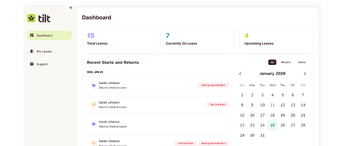
Tilt’s Leave Experience Management platform gives HR teams visibility into leave across their organization through tools like the HR Reporting Dashboard, while integrations help keep leave information connected to the systems HR already uses.
Tilt’s in-house leave law experts also help keep the platform aligned with changing leave requirements. HR teams can access resources like Tilt’s Leave Law Reports to stay informed, whether they’re managing leave themselves or using additional support.
Managers can also have access to the information and guidance they need to understand their role in the leave process.
And importantly, organizations can choose how much support they want.
Some teams have the expertise and capacity to manage the leave experience themselves. For those organizations, Tilt provides the technology, visibility, and tools to do that with greater confidence.
Other organizations may want additional support for employees or for more complex leave situations. Tilt’s optional Premium Support add-on provides access to dedicated Leave Specialists who are backed by leave compliance expertise.
The technology is there either way. The level of support is up to you.
Give HR More Control Over Leave
STD carriers play an important role in providing financial protection for employees. But managing a leave of absence involves much more than the disability benefit itself.
HR teams need technology that brings the pieces of leave together, visibility into what’s happening, and access to the expertise and resources they need to manage increasingly complex leave requirements.
Whether your team wants to manage leave entirely in-house or add support from dedicated Leave Specialists, Tilt gives you the flexibility to build the approach that works for your organization.
Explore Tilt’s Leave Experience Management platform or talk with our team to see how Tilt can fit into the way your organization manages leave.