In HR, you already know how much of an impact a leave of absence can make on an employee.
They may be preparing to welcome a child, managing a health condition, or taking time away to care for a loved one. At the same time, you’re thinking about everything that needs to keep moving while they’re away—their manager, the team, benefits, coverage, and the list goes on.
For HR, that can mean a lot of moving pieces to coordinate. But leave isn’t just another administrative task. It’s a meaningful part of the employee experience.
The way you support someone through that experience can shape how they feel about your organization and impact key business outcomes like retention and more.
Why Leave Management Matters for Employee Retention
Allison Mairena, Head of People at Prudentia Sciences, encourages HR leaders to think about the employee journey the same way you would about a customer journey. There are certain moments that carry more weight than others, and leave can be one of them.
“Just as in a sales process, you’re thinking about the customer lifecycle and the customer journey, we also have to think about the employee journey,” Mairena notes. “Having a child or having a medical procedure is oftentimes a pretty big milestone or impact on one’s day-to-day life. So having a supportive leave from an employer can be such a massive retention lever.”
When an employee feels supported and cared for, they can come away with a very different impression of their employer than someone who spends the process searching for answers or wondering what happens next.
Tilt’s 2026 Leave Benchmark Report found that organizations that highly prioritize leave report stronger outcomes across retention, performance, and employee engagement. Among surveyed organizations, retention was 92% for those that highly prioritize leave, compared with 68% among those that do not.
For you as an HR leader, that makes leave an important part of the employee experience and one that can influence what happens long after an employee returns.
How Better Leave Management Improves the Employee Experience
So what does getting leave right actually feel like?
For an employee, it can feel like a weight being lifted.
They already have plenty on their mind, so adding uncertainty around pay, benefits, paperwork, or what happens next can make an already demanding moment even harder.
Mairena describes what happens when those questions have clear answers: “As an employee, when leave is right, you get a sense of a weight being lifted off of your shoulders—especially if you are about to be a first time parent. You’re running on 500 coffees and like 30 minutes of sleep. If your organization can answer their questions as simply as possible, [like how much is coming into my paycheck this week, etc,] it’s so great.”
That’s the experience you want to create. Employees should be able to find the information they need and understand what comes next without having to piece everything together themselves.
And employees aren’t the only ones who benefit from that clarity.
How Better Leave Management Helps Managers Navigate an Employee's Leave
Managers have their own set of questions when someone on their team goes on leave.
- When will they be out?
- What needs to happen before they go?
- How will the team handle their workload?
- What should the manager expect when the employee returns?
Having a plan gives managers somewhere to start.
“Having some semblance of a game plan will help to ease any anxiety leading up to it,” Mairena explains. “That way you can revert to: ‘We’ve already prepared for this. We’ve already talked about this. Maybe we’re just doing it a little bit early or maybe we need to adjust the game plan.’ That’s a very different cognitive load than not having anything in place.”
For HR, it also means fewer gaps to fill later. When the employee and manager understand what to expect, you can spend less time answering questions and more time making sure the overall experience stays on track.
What Better Leave Management Frees Up for HR
You have plenty of things competing for your attention already.
One day you’re working on onboarding. The next, you’re interviewing candidates, helping a manager navigate a people issue, or working through a new state requirement. Leave management can take up that same time when every detail requires manual follow-up.
Mairena knows what that feeling is like as a People team of one: “As a current People team of one, I got a sweet hat collection, as we like to say, because I’m wearing all of the different hats. [Just today,] I applied for a California state tax account, I’ve conducted interviews, I’ve also started to develop a new onboarding program for our employees. But [getting leave right] allows you to do some of the more longer term strategic work. There’s just so much more strategic unlocking when you’re able to feel confident about handing off those administrative pieces.”
Another component that clears up is compliance. With leave laws changing and evolving just as quickly as your organization, having a strong leave program enables your team to stay on top of the leave compliance landscape.
“Companies can certainly underestimate the compliance complexity,” Mairena shares. “I’m an extreme extrovert. So if I can be doing more HR business partnership or talent acquisition, that’s where I’m going to thrive. You also want to make sure that you’re playing to the employee’s strengths in their day-to-day so that they can feel challenged.”
How HR Can Build a Stronger Leave Program
If you’re looking at your current process and wondering where to start, Mairena has a straightforward answer: start with the manager.
“The short answer here is start with the manager of the employee that’s going on the leave. In the same vein of retention, people don’t necessarily leave companies—they leave managers. Your manager is a massive, massive, massive part of the leave experience. Even if you have done an incredible job about keeping the employee in the loop, but you haven’t said anything to the manager about the timing and the communication touch points, the whole thing could ultimately go kaput because they’re left in the dark to come up with their own devices.”
A strong leave process gives you a clear place to start and a consistent way to support everyone involved:
- Before leave: Align with the employee and manager on timing, expectations, benefits, and coverage.
- During leave: Keep communication clear and make sure employees and managers know what they need to know.
- After leave: Plan for the employee’s return and help create a smooth return to work.
That gives employees and managers a clearer experience while giving HR a process you can rely on from one leave to the next.
Where Teams Are Pivoting to Next
A strong leave experience reaches well beyond the time an employee is away.
It can help an employee feel supported during an important moment, give a manager the confidence to plan ahead, and create more capacity for HR to focus on strategic work. Over time, those experiences can contribute to retention, employee advocacy, recruiting, and the broader employee experience.
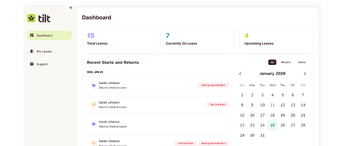
Tilt’s Leave Experience Management platform helps HR teams simplify the leave experience by bringing leave information, timelines, and documentation into one centralized location. Whether you prefer to manage leave in-house or alongside premium support, Tilt gives your team the flexibility to manage leave your way. To see how Tilt can fit inside your team, take a tour of our platform or meet with a member of our team.