

AI is moving quickly into HR workflows, and your team is likely expected to adopt it while staying accountable for complex people decisions.
But AI is not a one-size-fits-all solution.
Some tools are strong at giving quick answers. But there is a meaningful difference between getting a quick answer and having a system in place that helps ensure decisions stay consistent and compliant over time.
Understanding the difference between AI answers and AI systems is what helps teams use AI safely and effectively, without losing control of the outcomes that matter most.
Where Quick Answers Are Helpful
On the surface, quick answer tools like ChatGPT and Google Gemini can be useful. You can ask a question and get a fast, structured response almost instantly.
In many day-to-day HR tasks, that speed is valuable.
These tools are especially helpful for:
- Summarizing long or complex information
- Drafting employee or internal communications
- Organizing notes, documents, or case details
- Answering general HR questions and definitions
In these moments, clarity and speed reduce friction and help HR teams move faster.
But this only works when the task is isolated. When decisions connect to broader workflows, policies, or employee-specific context, the limitations start to show.
Why Overrelying on Quick Answers Introduces Risk
The pressure to expand AI in HR workflows is real. Most teams are not questioning whether to use AI, but how far to extend it.
And in many parts of HR, AI can absolutely play a valuable role.
The challenge begins if AI moves from supporting decisions to making them.
As Tilt’s VP of Leave Compliance Jon Nall explains, “When AI is treated as the decision-maker, HR can end up relying on an output that looks definitive but is actually incomplete, based on the wrong assumptions, or missing key context.”
If AI is treated as a decision-maker, it introduces risk into the process. With an HR function like leave compliance in mind, that risk could look like:
- Missing context from earlier steps in the workflow
- Overlooking overlapping policies or legal requirements
- Skipping required notices, timelines, or documentation
- Failing to identify when escalation is needed
“It also creates an accountability gap,” says Nall. “The employer is still responsible for the outcome, but the reasoning behind it may be shaky, inconsistent, or hard to defend. That is why AI can be very useful as a support tool, but HR still has to own the judgment and the process.”
Tips To Using AI Effectively and Safely Within HR
This is where the way your team uses AI really matters. These tools can be helpful, but they are not designed to take on the complex, evolving employee situations or decisions that need to hold up over time.
To use AI more effectively and remain in control, begin with simple practices like:
- Asking AI to show how it arrived at an answer: this helps surface assumptions and makes it easier to identify any gaps or inconsistencies
- Requesting sources or references when needed: especially in areas where the finer details matter, this adds an additional layer of validation before acting on a response.
- Do not include sensitive or confidential information: private information should always remain within secure, governed environments
- Using AI to support your thinking, not to finalize your decisions: AI is great at organizing information and giving detailed reports, but the final judgement should always stay with your team after you have done your due diligence.
To learn more about safely adopting AI within your people team, read this new resource.
When used this way, AI becomes a helpful support layer for thinking instead of a crutch to lean on for final answers.
That distinction becomes more important in areas like leave management, where each step builds on the last and context carries forward over time.
How It Relates To Leave Management
Leave is one of the clearest examples of why AI answers alone are not enough.
Leave management involves coordination across multiple timelines, policies, regulations, and employee-specific circumstances that evolve over time. It is not a static question with a single correct response.
Generic AI tools respond to the question in front of them. They do not reliably maintain the full context of a leave as it evolves.
That can lead to gaps that appear quickly:
- Decisions made without full context
- Timing issues around required notices or documentation
- Inconsistent guidance across similar cases
- Employee experiences that shift as new information surfaces
As Nall notes, “Those are not small misses. They can create real compliance risk and a frustrating experience for the employee.”
And those experiences matter. They shape trust, clarity, and perception at moments that are already sensitive for employees and HR teams alike.
Better Outcomes Come From Better Systems
HR leaders are not just looking for faster answers. You are looking for confidence in how decisions are made and sustained.
Confidence that context is not lost.
Confidence that policies are applied consistently.
Confidence that outcomes can be explained and defended when needed.
That kind of confidence does not come from better answers.
It comes from better systems.
Better Outcomes Come From Better Systems
HR teams can begin by identifying where AI systems can help the most as opposed to quick answers. If you’re pursuing outside vendors, Nall recommends to “look at whether the AI is operating inside a governed workflow or just generating answers. Does it preserve context, support review before action is taken, and handle sensitive employee information appropriately? The most useful AI in leave is the kind that helps HR do the work more accurately and efficiently while still staying in control.”
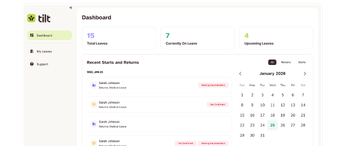
Tilt’s leave experience management platform uses a combination of AI and AbsenceIQ, our leave intelligence system, to automate the admin side of the leave process. That means your team stays in control where it matters, reducing repetitive work, maintaining compliance, and protecting the employees experience.
To see Tilt in action, take a quick tour of our platform or by meeting with a member of our team.