

When leave management becomes complex, many HR teams reach the same conclusion: outsource it.
It’s an understandable decision. Leave is full of regulatory nuance, employee questions, documentation requirements, and coordination with payroll and managers. Handing it off to a vendor promises relief: fewer tasks on HR’s plate and the confidence that someone else is managing the details.
But here’s the reality many HR leaders discover after outsourcing leave:
The work doesn’t actually disappear.
It just changes shape.
That’s where Leave Experience Management (LXM) comes in. Despite the similar sounding name, LXM isn’t simply outsourced leave done better. It’s a fundamentally different approach to how leave should operate inside an organization.
The “Set-It-and-Forget-It” Myth
Outsourced leave management is often positioned as a clean handoff: transfer the leaves to a third party and let them handle the rest.
But leave rarely behaves like a tidy process.
Employees have questions. Managers need guidance. Leave plans change. Payroll calculations done incorrectly. Documentation has to move between systems. Complicated leave cases introduce even more moving parts.
Even with a vendor in place, HR teams still end up involved—just in different ways.
They’re correcting payroll issues.
Reconciling data between systems.
Answering confused employee questions.
Or stepping in when something breaks down.
The reality was that HR didn’t eliminate the work. It just lost visibility and control.
Meanwhile, the employee experience can suffer from what many HR leaders recognize as the “call center effect.” Employees speak with different representatives each time, repeat their story, and struggle to understand what’s happening next.
And when employees are frustrated during leave, that frustration rarely stays with the vendor.
It comes right back to HR.
The Challenge with One-Size-Fits-All Leave
Most outsourced leave models rely on standardized workflows. It’s the only way vendors can manage large volumes of cases efficiently. But leave itself is rarely standardized.
Employees take leave during some of the most personal and unpredictable moments of their lives, whether they are welcoming a child, navigating illness, supporting a family member, or grieving a loss. In other words, leave sits at the intersection of life and work.
Even the most common types of leave rarely follow a perfectly predictable timeline. Babies arrive early. Medical situations evolve. Caregiving responsibilities change. A continuous leave might become intermittent.
Rigid workflows can struggle to adapt to those realities.
What starts as an attempt to simplify leave management can unintentionally create friction for employees who are already navigating difficult or emotional situations. And when employees feel confused or unsupported, HR is usually the team they turn to for answers, regardless of who technically manages the leave.
Delegating Tasks Doesn’t Remove Accountability
One of the biggest misconceptions about outsourcing leave is that it transfers responsibility along with the work.
But HR still owns the outcome.
If payroll data doesn’t line up with leave schedules, HR has to resolve it.
If documentation is missing during an audit, HR has to track it down.
If an employee feels unsupported during leave, the cultural impact lands within the company – not the vendor.
In other words, outsourcing may change who executes the tasks, but it doesn’t change who is accountable for the experience.
This is why many HR teams eventually realize that leave isn’t just an administrative process that can be handed off entirely. It’s an operational system that requires coordination, clarity, and ownership.
A Different Approach: Leave Experience Management
Leave Experience Management starts from a different premise.
Instead of asking, Who should we delegate this to? it asks:
How should the leave experience actually work?
LXM treats leave as a system that needs to be intentionally designed, not just a set of tasks that need to be completed.
That system focuses on three core ideas:
Ownership
HR maintains visibility and control over the leave experience while reducing the administrative burden.
Continuity
Employees, managers, payroll, and HR stay aligned through clear communication and shared context.
Insight
Data and technology help HR anticipate challenges rather than reacting to them.
In this model, technology doesn’t replace HR, it simply handles the repeatable mechanics of leave management. Forms, documentation tracking, notifications, and compliance updates can happen automatically, freeing HR teams to focus on the human side of leave.
Less paperwork.
Fewer reconciliations.
More time for meaningful employee support.
Tech handles mechanics, HR stays present.
Designing Leave for the Moments That Matter
At its core, leave is about people navigating important life moments.
Those moments shape how employees experience their workplace—and how they remember it long after.
Handled thoughtfully, leave can reinforce trust, loyalty, and connection to the organization.
Handled poorly, it can create confusion, stress, and disengagement.
That’s why HR leaders are beginning to rethink their leave management process entirely. Instead of outsourcing to a vendor who is viewing leave as a series of cases to process, they’re seeking a partner who will help them to design it as an experience. One that supports employees while keeping HR teams in control of the process.
That shift from transactional management to intentional design is what separates Leave Experience Management from traditional outsourced leave models.
How Tilt Supports Leave Experience Management
Tilt was built around a simple idea: leave should work better for both employees and HR teams.
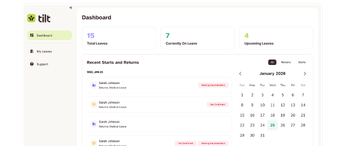
Our platform supports a Leave Experience Management approach by combining technology, expert guidance, and thoughtful process design to simplify the complexities of leave.
With Tilt, HR teams can:
- Maintain clear visibility into active leave journeys
- Reduce administrative workload and manual processes
- Keep managers, payroll, and compliance aligned
- Support employees with clarity and confidence throughout leave
The result is a leave experience that works better for everyone.
Because the future of leave isn’t about handing it off and hoping for the best.
It’s about intentionally designing a system that supports employees, empowers HR, and strengthens company culture when it matters most.