2025 Leave Benchmark Report

2025 Leave Benchmark Report - Overview

Tilt’s new benchmark survey data provides key insights from nearly 200 HR leaders across the country in order to help organizations understand how competitive their leave benefits are in comparison to companies in similar industries, employee size, and growth classification.

It also provides key analysis that demonstrates the impact leave of absence has on key business outcomes, assisting Heads of HR in becoming strategic business partners at the executive level. 

Our research has concluded that companies that grant their HR teams the time, headcount, and resourcing to develop and manage diverse and equitable leave of absence program experience financial stability and significant growth.

Companies seeing significant growth also had high retention rates for employees who took leave. Having a well-thought-out employee experience and re-onboarding plan for employees taking leave leads to higher retention.

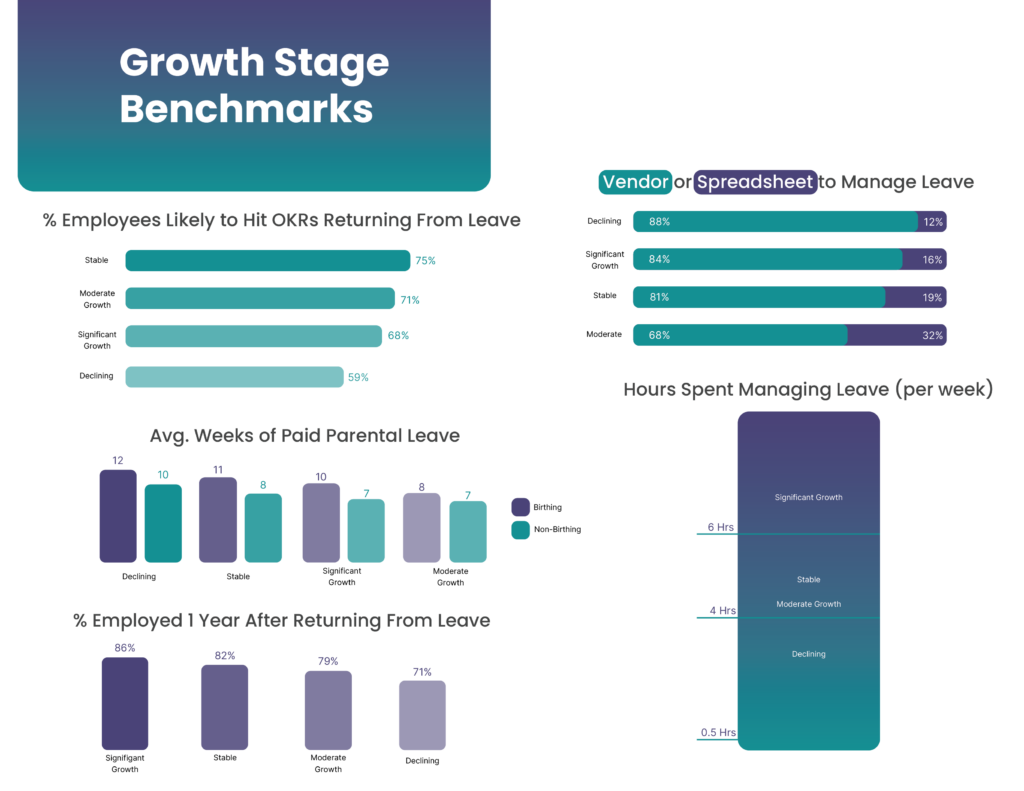
There appears to be a strong correlation between the growth of an organization and its ability to retain employees after a leave, with an 86% retention rate for organizations experiencing significant growth and only a 71% retention rate for organizations on the decline.

The same holds true for achieving OKRs after returning from a leave, with 41% of employees only sometimes or rarely hitting them in the year following a leave of absence if the company is on the decline. Compare that with 74% of employees either always or often hitting them in a stable organization.

Organizations seeing significant growth see an average of 3X the number of employees taking leave than companies in decline.

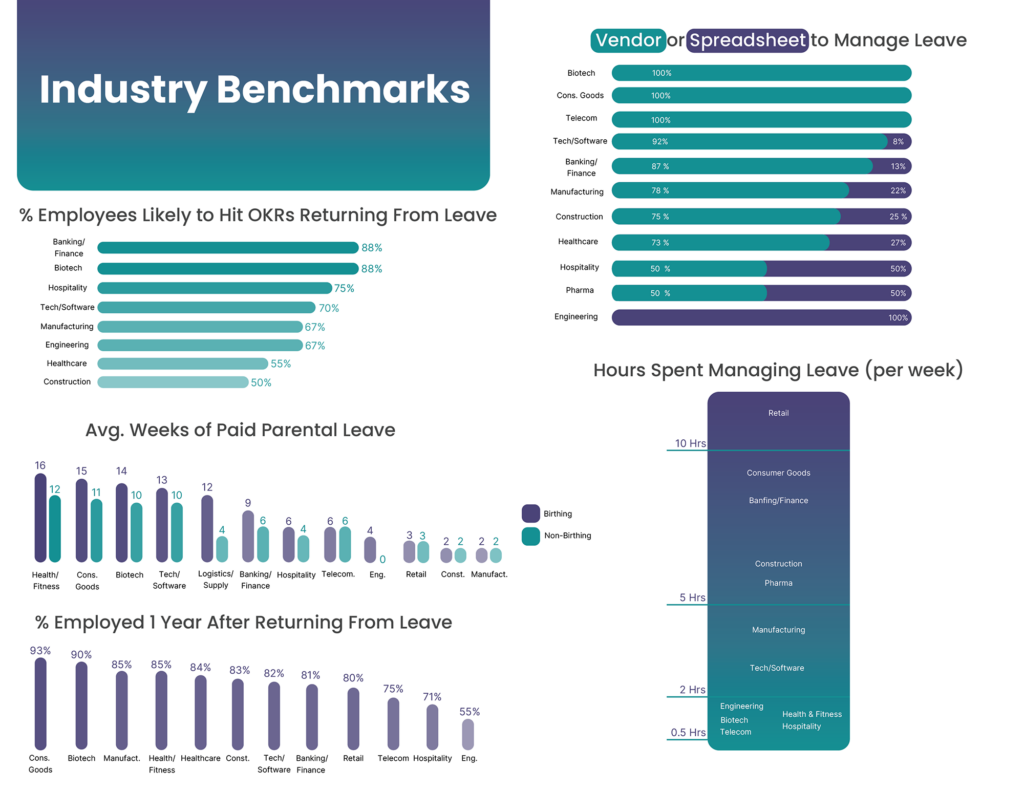
Industries resistant to vendor leave managements and opt to manage leave with a spreadsheet are in the bottom 3rd in the amount of paid parental leave they offer. Additionally, they are in the bottom half of performance when it comes to employee retention within the first 12 months of an employee returning from leave.

Similarly, these industries had 33% or more of employees who were unlikely to reach their OKRs after returning from leave, and are in the bottom 3rd of industries that show concern over staying compliant with leave-related laws.

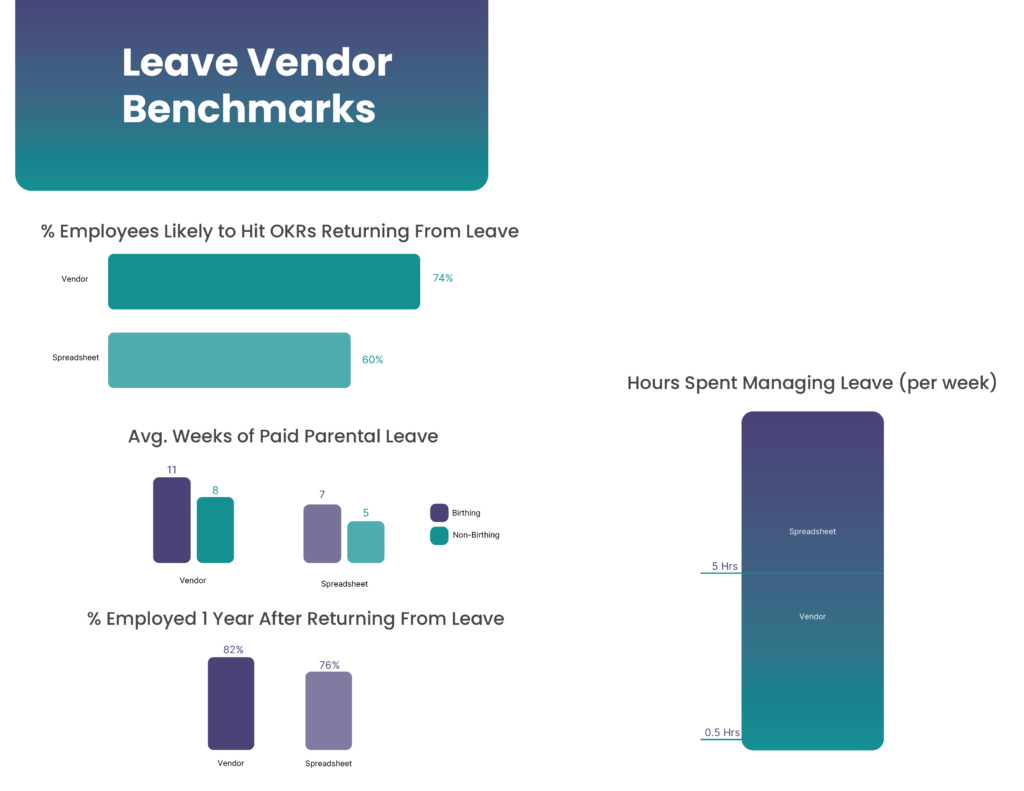
Employers using a vendor to manage leave were able to offer 33% more paid parental leave and demonstrate a higher retention rate for employees returning to work than those relying on a spreadsheet. Similarly, employees of those companies are more likely to achieve their OKRs after returning from a leave if that leave is managed with a vendor. All of this while spending 20% fewer hours a week on leave management.

Summary

There is a strong correlation between companies that are growing and the amount of importance placed on leave management in their operations. Organizations that emphasize leave and use a vendor to manage them demonstrate a greater commitment to compliance, spend less time managing leave, have higher retention rates, and have better employee performance.

It’s clear organizations are positively impacted by employees taking leave and the direct benefits from relying on vendors to manage them. As leave requests rise, compliance is complex, and leave of absence’s influence on operational success strengthens.

Industry Benchmarks
Industry Benchmarks

Industry Benchmark Analysis

Seeing the variation of industries taking leave seriously, or not (by way of amount offered, spreadsheet management, retention post-return, etc.), it’s easy to let the results speak for themselves. When you treat life events that employees navigate like an afterthought, or worse, an inconvenience to your business, you see that direct-line negative impact to your business.

Leave is here to stay, it is more complex than ever before in history, and accurate and empathetic management of LOAs are being demanded by our workforce. Companies can either stick their head in the sand and be a laggard (paying significant costs in turnover, legal exposure, inefficiencies, rework, and reputational damage along the way) OR they can reframe their biases, lean into areas they don’t understand, and get proactive with one of the most impactful events in an employee lifecycle.

Industries that are resistant to adopting modern leave management solutions, instead opting for outdated methods like spreadsheet tracking, are feeling the consequences. These industries consistently find themselves in the bottom third for the amount of paid parental leave they offer, signaling a lack of investment in employee well-being. This reluctance isn’t just about benefits; it extends into employee experience and retention.

The data shows that industries clinging to manual leave processes are in the bottom half for employee retention within the first 12 months of an employee returning from leave. These organizations are also struggling with performance metrics, experiencing more employees failing to meet their OKRs post-leave, which suggests that inadequate support during this critical time impacts overall productivity.

The impact of leave mismanagement goes beyond just individual employees. Companies that do not prioritize leave compliance are setting themselves up for substantial legal risks, falling into the bottom third of industries that are concerned with adhering to leave-related laws. This can lead to costly litigation and penalties, not to mention the damage to employer brand and employee trust. By contrast, industries that have embraced proactive leave management, offering comprehensive and well-managed leave policies, see clear benefits: stronger employee loyalty, higher retention rates, and a more engaged workforce.

The message is clear and the data backs it up; the way industries manage leave of absence directly correlates with their ability to attract, retain, and engage top talent. Organizations that acknowledge the critical role of leave in the employee lifecycle are positioning themselves not only as employers of choice but also as resilient, future-ready businesses.

Those who continue to dismiss the importance of modern, empathetic leave management are leaving themselves vulnerable to turnover, reduced employee morale, and diminished organizational performance. The data validates what we’ve known all along: adapt and thrive or resist and risk falling behind.

Growth Stage Benchmarks
Growth Stage Benchmarks

Growth Stage Benchmark Analysis

From the influence of private investors to the expectations of public markets, companies live and die by their ability to project and then achieve growth. These external expectations translate to management and human resources adopting a posture of constantly preparing for a future that is scaled beyond current operations.

This generates specific challenges when considering employee experience and employee retention, and leave management is one of the hardest elements to manage through scale. The response to this reality is visible in the adoption of vendor solutions by Significant Growth companies over Stable or Moderate Growth companies. Leveraging a vendor for quality and scale of leave management is a logical and accretive choice for companies seeking employee experiences that retain talent and unlock economies of scale.

While Significant Growth companies are embracing leave out of necessity, the strategic takeaway is that unlocking quality and scale of leave via leave vendor partnership is available to companies across the growth spectrum.

“Our people are our most important asset” is a common refrain. Leave is the moment when life intersects with work for an employee and their employer, and the results of how a company manages leave impacts company performance and competitiveness. The results from our research reinforce two concepts. Approach to and employee experience of leave management impacts:

• Employee Retention

• Employee Performance

Any company that believes its people are the driver of their success can leverage leave to drive business outcomes.

Specifically, when approaching leave management as a lever for employee retention, it is necessary to think of leave for an employee in the same manner as any critical business or human resources moment: plan proactively and then execute to outcomes. Our research shows that a well-thought-out employee experience and re-onboarding plan for employees taking leave leads to higher retention. Whether a business has calculated a specific cost of employee turnover, the CEO, CFO, and HR leader all know that turnover costs are commonly hidden and massively detrimental to business progress.

Company Size Benchmarks
Company Size Analysis

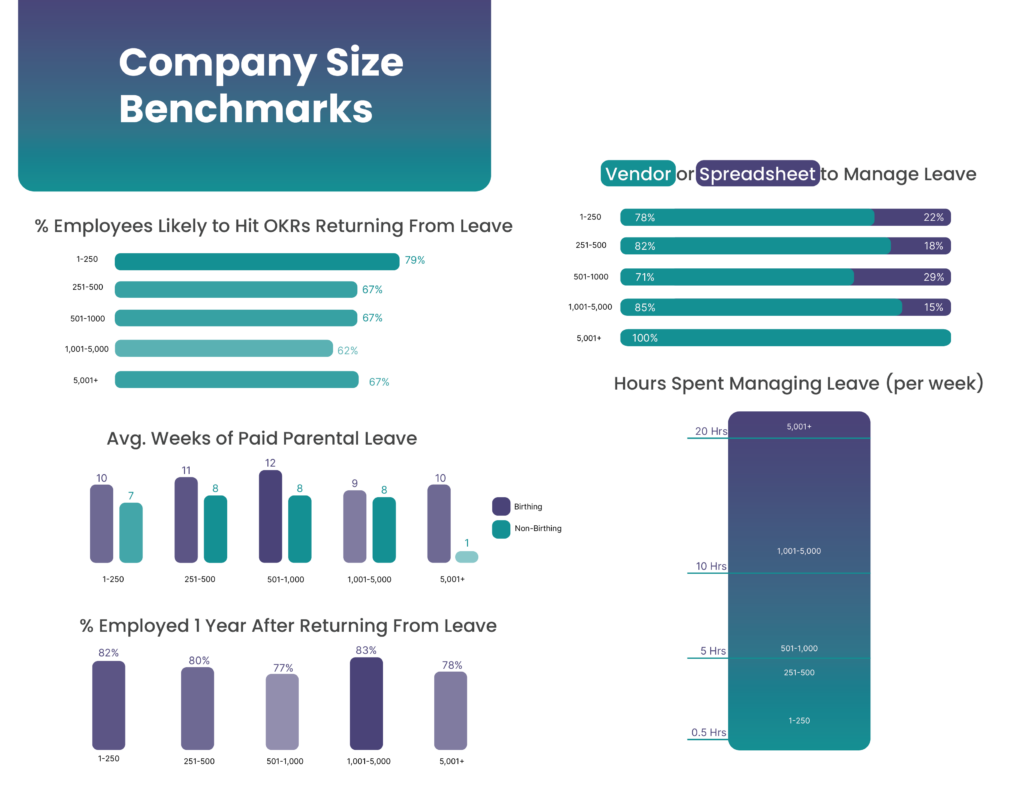
When examining leave management practices across different company sizes, data shows that the amount of leave offered and the percentage of employees hitting their OKRs post-leave remains relatively consistent regardless of company size. However, a critical disparity emerges in the 500-1000 employee range.

These mid-sized companies are facing more significant challenges with retention, particularly within the first 12 months after an employee returns from leave. Companies in this bracket are also the least likely to use a specialized vendor for managing leave, relying instead on manual processes like spreadsheets, which can lead to inefficiencies and errors.

The hypothesis here is that companies with 500-1000 employees are often caught in a tricky middle ground. They are large enough to experience a high volume of leave requests, which requires more robust management solutions, but they may lack the support or resources from leadership to invest in advanced tools that streamline this process. These organizations might believe they can continue managing leave the way they always have (similar to smaller businesses) but the retention data tells a different story. Without scalable systems in place, these companies struggle to provide the level of support employees expect, which directly impacts their ability to retain talent.

Larger companies, unsurprisingly, spend significantly more time managing leave due to the sheer volume of requests. However, despite their size, many still lack the dedicated staff needed to handle leaves at scale. This often results in overburdened HR teams, increased risk of compliance errors, and inconsistent employee experiences. Without adequate support systems, even the largest organizations face challenges in providing timely, accurate, and empathetic leave management.

On the other hand, companies that have embraced leave management solutions, regardless of their size, are reaping the benefits of improved employee satisfaction, stronger loyalty, and a more engaged workforce.

These findings highlight how essential it is for companies of all sizes to invest in structured leave management. Our data shows a strong connection between robust leave policies and key business metrics like retention and productivity. Organizations that prioritize efficient leave management—especially those working with a vendor—see noticeable benefits in employee satisfaction, retention rates, and operational efficiency. Adopting modern leave solutions isn’t just an operational improvement; it’s a strategic investment in long-term growth and employee loyalty.

Leave Vendor Benchmarks
Leave Vendor Benchmarks

Leave Vendor Analysis

Managing leave with spreadsheets often leaves HR teams feeling overwhelmed and stretched thin. They care deeply about their people, but the administrative burden of navigating complex leave policies can keep them from fully supporting employees during life’s critical moments. Employees in turn may feel confused or unsupported, which can add stress to an already challenging time.

So it’s not surprising to see the data show that when an employer relies on spreadsheets to manage leave, the employees returning from leave are less likely to hit their OKRs and are less likely to stay employed with that organization a year after returning. Further, it explains why employers can offer better benefits and spend less time managing leave when they use a leave vendor who are experts in leave.

The contrast between organizations that use a leave management vendor and those that stick to spreadsheets is apparent. Employers who leverage software solutions for leave management are able to automate complex tasks, streamline workflows, and reduce the risk of errors. This frees up HR teams to focus on providing personalized support when necessary, which significantly improves the employee experience, contributing to better overall business performance.

On the other hand, organizations relying on spreadsheets often find themselves struggling to keep up with the administrative demands of leave management. The manual process can become a time sink for HR, leading to delays, inconsistencies, and even compliance risks. This not only affects the HR team’s efficiency but also leaves employees feeling unsupported during critical life events like parental leave, medical leave, or caregiving responsibilities.

The trend towards automating HR processes, including leave management, is gaining momentum for good reason: it’s not just about cutting costs, but about driving better business outcomes. Beyond freeing up HR professionals to focus on strategic initiatives that add value to the business, these companies can also offer more competitive benefits packages because they are not bogged down by the inefficiencies of manual leave tracking. This positions them as employers of choice in a competitive job market, helping them attract and retain top talent.

Furthermore, automating leave management with a specialized vendor enhances compliance with ever-changing leave laws, reducing legal risks and protecting the company’s reputation. With experts handling the complexities of leave regulations, organizations can avoid costly mistakes and focus on creating a supportive culture that prioritizes employee well-being.

Thank you for your interest in the 2025 Leave Benchmark Report! How did you stack up?  At Tilt, we live and breathe all things leave and are passionate about supporting and educating everyone on the importance of empathetic and compassionate leaves of absence. If you have any questions about the benchmark report or about how to better support your people when they need a leave…drop us a line.

About Tilt

Tilt is leading the charge in all things leave of absence management through easy-to-use tech and human touch. Since 2017, our proprietary platform and Empathy Warriors have been helping customers make leave not suck by eliminating administrative burdens, keeping companies compliant, and providing a truly positive and supportive leave of absence experience for their people.


Related Posts

What the HR Industry Can Expect in 2025

As we look into the 2025 Crystal Ball of Certainty (amazing what you can find on Facebook Marketplace), it envisions a world in which the HR industry is on the verge of a significant transformation. 

Gone are the days when HR was just about staffing, discipline, and paperwork. 

Today, HR is being viewed more and more as a strategic powerhouse shaping the future of work. Let’s dive into the trends that will define HR in 2025, and explore what developments ahead will play a crucial role in this new era.

Technological and Analytical Advancements Will Drive HR

Savvy HR departments (or at least ones with savvy executives who understand its importance) are already using modern technologies and analytics to predict and assess everything from employee retention to recruitment strategies to the success of wellness programs and productivity.

Technology, of course, should serve to augment the capabilities of HR teams as well as provide the employees they’re supporting with a better experience.

“Technology is enabling us to provide employees with a more consumer type of presence at work, with a greater ability to have richer digital experiences and find what they need 24/7,” says Larry Nash, U.S. director of recruiting at EY.

AI and automation are stepping up to handle repetitive tasks like payroll, onboarding, leave management, and even answering employee questions through chatbots. Predictive analytics give HR teams their own crystal ball of sorts to identify workforce patterns and anticipate employee and employer needs alike, reducing turnover and improving operational output.

Technology and analytical advancements are the driving force behind transforming HR from a reactive to a proactive and indispensable function for organizational growth. In 2025, being tech-savvy will be as essential for HR professionals as people skills once were (and still are, of course).

Balancing the human side with tech will define the future of the profession.

A Shift in HR Practices and Positioning

By 2025, HR will undergo a major shift not only in its practices but also in how it positions itself within the organization’s power structure. Gone are the days of HR simply managing compliance and employee relations from the sidelines. 

HR leaders will need to master the art of navigating internal politics and building strong relationships with the C-suite to truly elevate their departments and, by extension, the entire organization.

One of the biggest game-changers? Speaking the C-suite’s language of data and ROI. Executives are driven by metrics, KPIs, and business outcomes, and for HR to have a seat at the decision-making table, it must embrace data-driven insights. 

By leveraging data analytics, HR can forecast workforce trends, identify skill gaps, and quantify the impact of employee engagement on business performance. This shift allows HR to position itself as a strategic business partner, rather than a reactive department.

Imagine HR not just presenting the usual retention and turnover rates but providing insights into how talent strategies directly contribute to revenue growth or operational efficiency. HR professionals will need to transition from being task managers to workforce advisors, ensuring their department plays a key role in executing business strategy.

As HR leaders master these skills, they can transform not only how they’re perceived within the company but also how they help drive business success.

What Will Be the HR Jobs of the Future?

So if you’re going to be more data-driven, and you’re spending less time on manual, tedious, and repetitive tasks, what new job functions are expected to emerge?

According to the Talent Management Platform GFoundry, People Experience departments will emerge.

As businesses increasingly acknowledge the vital role employee experience plays in driving operational performance, there will be a shift from traditional HR toward the emergence of “People Experience Departments.” 

This trend represents a more comprehensive approach to talent management, focusing on the entire employee experience rather than just HR processes. These departments will be designed to enhance every touchpoint of an employee’s journey, fostering higher engagement and boosting productivity.

As for specific roles, SHRM predicts the following jobs to be prevalent in future HR departments:

  • HR Data Scientist
  • Employee Experience Specialist
  • Head of Talent-Acquisition Technology
  • Head of Candidate Experience
  • Performance Coach
  • Organizational Psychologist

Every organization is unique, of course, and the way in which yours evolves will likely influence how quickly and effectively you’ll be able to help keep your organization thriving in this new competitive landscape.

Focus on Employee Well-being and Experience

We’ve been alluding to this throughout, but by 2025, employee well-being will take center stage in the hearts and minds of HR departments across all industries. 

Physical, mental, and emotional health aren’t just buzzwords, they’re essential components of a productive and happy workforce and have been for some time. 

From wellness programs to mental health support to robust leave of absence policies, HR will be tasked with creating a workplace environment that supports the whole person throughout their entire employee lifecycle.

But it won’t stop there. HR will need to focus on the full employee experience, from the first interview to career development and all the foundational experiences in between. Almost like being a career concierge for your workforce. 

By focusing on well-being, companies not only retain top talent but also boost engagement and productivity.

And let’s not forget: a happy, healthy employee is far less likely to burn out and need extensive leave time when you least expect it. It’s about investing in people upfront and throughout, so both employees and companies reap the benefits down the line.

Skills-Based Hiring and Workforce Transformation

Credentials are so 2019. By 2025, the trend will shift toward skills-based hiring. Instead of focusing solely on degrees and past job titles, HR teams will prioritize the specific skills candidates bring to the table. It’s all about what you can do, not just what’s on paper.

According to TestGorilla’s 2024 Skills-Based Hiring Report, two surprising statistics stand out:

  1. 81% of employers use skills-based hiring (up from 73% in 2023 and 56% in 2022)
  2. 94% agree that skills-based hiring is more predictive of on-the-job success than resumes

This shift means HR will need to sharpen their talent radar, identifying the skills that will be crucial for the future. This could range from technical abilities to soft skills like adaptability and emotional intelligence. 

The workforce has also changed dramatically, as gig workers and remote employees are much more established in the workplace ecosystem. It’s on HR to manage this diverse talent pool, ensuring the right mix of skills to drive success.

On the flip side, companies will have to focus on reskilling and upskilling their existing teams. As automation takes over repetitive tasks, employees will need new skills to stay relevant. HR will be at the heart of this transformation, guiding employees through career shifts and preparing them for the future.

DEIB Ethical Practices to Evolve in 2025

Diversity, equity, inclusion and belonging (DEIB) aren’t just initiatives anymore, they’re essential to business success and In 2025 technology and AI are going to play a bigger role than ever before.

AI-driven tools are being utilized to examine diversity metrics, uncover unconscious biases, and promote fair hiring and advancement practices. In hybrid work settings, technology plays a crucial role in fostering virtual inclusion, ensuring equal access to opportunities for all employees.

Training on cultural sensitivity, anti-harassment, and unconscious bias will remain top priorities, of course. But beyond training, HR will need to embed these values into the company culture to see the fruits of these efforts.

HR will also play a key role in ethical decision-making, ensuring the company upholds its values in all practices. From pay equity to equal opportunities for growth, HR will need to ensure that ethics are woven into the fabric of the organization. It’s not just the right thing to do; it’s also good for business.

The Importance of Leave Management in 2025

Leave management has historically been treated as a back-office, reactive function, often overshadowed by flashier HR initiatives like talent acquisition or performance management. 

As we move into 2025, however, it’s stepping into the spotlight as a cornerstone of effective HR strategy for achieving larger organizational objectives. This is due to a shift in both their perception of leave and HR’s role within organizations. Leave management is no longer just about compliance or checking a box, it’s now viewed as a critical driver of employee well-being, retention, and organizational resilience.

In today’s work environment, knowledge and flexibility reign supreme. 

Employees are juggling more responsibilities than ever, both at work and at home. Whether it’s caring for a new baby, recovering from an illness, or taking time for mental health, employees need leave policies that are transparent, supportive, and easy to navigate, and HR needs effective solutions to support expanding policies.

A clunky or unclear leave process not only adds stress to HR and employees alike, but can erode trust in the organization if things go awry. This is an unfortunately common result when manual processes are at play.

Conversely, a well-structured leave system shows employees they’re valued and supported, strengthening their connection to the company.

From a business perspective, the stakes are high. Companies that prioritize effective leave management will see tangible benefits; fewer cases of burnout, higher engagement, improved productivity, and ultimately, greater retention. After all, a workforce that feels cared for is a workforce that sticks around and performs at its best.

The numbers back this up as well. In a recent survey conducted by Tilt across all major industries it was found that employers who rely on spreadsheets to manage leave experienced nearly 25% of employees no longer employed with them within the year after returning from leave.

Similarly, only 60% of the employees who did stick around hit their OKRs the following year.

Effective leave management in 2025 goes beyond spreadsheets and manual tracking. It’s about creating a seamless, user-friendly experience that aligns employee needs with organizational goals. 

Leave management solutions like Tilt are here to help navigate this new leave dynamic, offering a leave management solution designed to evolve with the times and scale as organizations do. By providing seamless, compliant, and employee-centric leave management, Tilt gives HR teams the ability to focus on needle-driving initiatives with an engaged and supported workforce.

The Future of HR is Looking Bright and Sophisticated

The HR landscape is poised to transform into a dynamic blend of technology, strategy, and human-centric practices. 

The integration of advanced technologies like AI, data analytics and automation will equip HR teams with the tools to make smarter, more informed decisions.

At the same time, a focus on DEIB and employee experience will push HR leaders to adopt more holistic approaches that prioritize the well-being and satisfaction of their workforce to drive business impact to new heights. 

The evolution of HR roles, the emphasis on skills-based hiring, and the adaptation to hybrid work environments further highlight how this field is evolving to meet the demands of an ever-changing world of work.

Leave management stands out as a critical area that can no longer be overlooked as an emphasis on efficiency, productivity and employee well-being reaches its tipping point for thriving organizations. 

As HR teams reduce administrative burdens, ensure fairness, and create a supportive environment where employees feel valued, their perception as institutional thought leaders will increase. By embracing these trends and investing in the right tools, businesses can build a resilient, engaged workforce ready to thrive in the workplace of the future.

Tilt is leading the charge in all things leave of absence management through easy-to-use tech and human touch. Since 2017, our proprietary platform and Empathy Warriors have been helping customers make leave not suck by eliminating administrative burdens, keeping companies compliant, and providing a truly positive and supportive leave of absence experience for their people.

Related Posts

The United States Leave Law Report Vol. 10

As we look toward the future, Tilt remains committed to keeping you informed and well-prepared with the latest developments in leave law. Staying current with these changes is crucial as you navigate the ever-evolving landscape of People Operations, and it’s our passion to make that journey as smooth as possible for you.

Our team of leave law experts continuously monitors these new developments and updates to ensure you’re equipped with the knowledge and tools to adapt to any modifications that might impact your organization today or in the near future.

This report provides the latest updates on leave programs across the country that you need to know about, offering insights into how these changes could affect you and your team. Staying informed is essential for supporting your employees and maintaining compliance with relevant regulations.

We sincerely  hope you find this report valuable in achieving those goals, and as always, thank you for trusting Tilt as your partner in all things leave of absence management. If you have any questions about this report, or need further assistance in managing your leaves, don’t hesitate to reach out.

Looking for insights from previous volumes? See what you might have missed here.

Federal Updates

No National Paid Family & Medical Leave (PFML) Program Expected Soon

With Donald Trump’s election and Republican control of Congress, a national Paid Family and Medical Leave (PFML) program is unlikely in the near term. PFML wasn’t a focus of Trump’s campaign and doesn’t appear to be a priority for his administration. In the absence of a federal program, states and the private sector will likely continue driving PFML efforts, further complicating leave administration for employers.

Regulatory Changes on the Horizon

The incoming Trump administration is expected to bring changes to the Equal Employment Opportunity Commission (EEOC), potentially reshaping key policies and regulations. For instance, a Republican-led EEOC may revisit or roll back certain aspects of the Pregnant Workers Fairness Act (PWFA), such as requirements for employers to provide reasonable accommodations for elective abortions or broader reproductive health needs.

State PFML Programs

There are two types of state PFML programs: mandatory and voluntary.

Mandatory programs generally operate as “social insurance,” funded through payroll deductions, with paid benefits provided to eligible employees for qualifying reasons. In contrast, voluntary programs allow—but do not require—employers (and sometimes employees) to obtain PFML coverage, often by purchasing insurance through the private market.

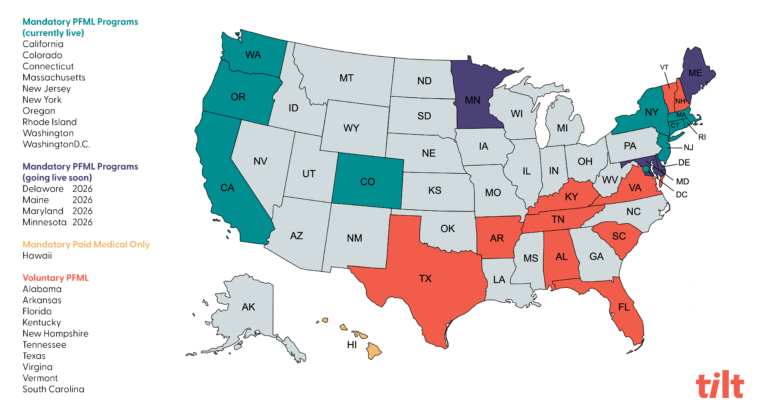
The following map highlights states with mandatory and voluntary PFML programs.

U.S. Map of mandatory and voluntary PFML programs

Mandatory program updates: 

As shown above, 13 states and Washington, D.C. have enacted mandatory PFML laws. Nine of those states (plus D.C.) are currently providing benefits to eligible employees.

In January, many of these programs will implement updates to employer and/or employee contribution rates, taxable wage caps and weekly benefit maximums.

Mandatory PFML programs: Delaware, Maine, Maryland, and Minnesota will start providing benefits to eligible employees in 2026

Key details of these programs are outlined below, but may be subject to change as the states finalize their rulemaking processes. 

Potential PFML developments for 2025

We expect more states, particularly those with Republican leadership, to adopt voluntary PFML programs.

At the same time, a few states with Democratic trifectas (control of the governorship and both legislative chambers) could move toward enacting mandatory PFML programs, with benefits potentially starting in 2027 or 2028. The most likely candidates include:

  • New Mexico: Has come close to passing a mandatory PFML program in each of the past two years.
  • Hawaii: Employers are already required to provide Temporary Disability Insurance (TDI), and paid family leave bills have been proposed in the past.
  • Illinois: Known for enacting several employee-friendly laws in recent years.
  • Michigan: Multiple PFML bills are in committee, but the clock is ticking as the state’s Democratic trifecta will end after the current legislative session concludes on December 19.

State Leave Law Updates

California

Employers Can No Longer Require Employees to Use Vacation/PTO Before PFL

California’s Paid Family Leave (PFL) program provides wage replacement benefits to individuals needing leave for new child bonding, caregiving, or certain family military-related reasons. Under current law, employers can require employees to use up to two weeks of accrued vacation or paid time off (PTO) before accessing PFL benefits. Starting January 1, 2025, employers will no longer have this option.

Employees Can (Soon) Apply for State-Paid Benefits Before Leave Begins

Currently, California requires employees to begin their leave before filing for state-paid medical or family leave benefits (SDI and PFL). This approach can create stress for employees who must start leave without knowing if their benefits are approved or how much they will receive. To address this, California will soon allow employees to apply for benefits up to 30 days before their anticipated leave.

Employees will also receive benefits sooner: either within 14 days of applying or as soon as leave begins, whichever is later. These changes will take effect once the Employment Development Department (EDD) implements its new integrated claims management system, though the exact implementation date has not been announced.

Changes to SDI and PFL rates

Starting January 1, 2025, California’s State Disability Insurance (SDI) and Paid Family Leave (PFL) programs will increase their wage replacement rates. Currently, workers can receive up to 60-70% of their regular income while on leave, capped at $1,620 per week, for up to eight weeks of PFL or 52 weeks of SDI within a 12-month period. 

Beginning January 1, eligible employees will receive 70-90% wage replacement, with a maximum weekly benefit of $1,681. These changes aim to address inequities, as many low-income workers currently forego leave due to the financial strain of living on 70% of their pay. The new rates ensure that eligible employees earning about $60,000 or less will receive 90% of their pay.

Note: The updated rates apply only to benefits starting in 2025. Employees with claims extending from 2024 into 2025 will not see any changes to their benefit amounts on January 1.

Expanded Employment Protections for Victims of Violence

Effective January 1, 2025, California is expanding protections for employees who are victims of a “qualifying act of violence,” which includes domestic violence, sexual assault, stalking, or any act involving bodily injury, death, or threats of physical harm.

Employers may be required to provide leave as a reasonable accommodation for victims or their family members to seek relief or address other qualifying needs under the law. Additionally, employers must provide written notice of employees’ rights under this law at the time of hire, annually, upon request, and whenever they become aware that an employee or their family member is a victim.

To help employers comply, the California Civil Rights Department will release a model notice by July 1, 2025. Tilt will send a copy of this notice to employees when supporting applicable leaves.

Delaware PFML – ACTION REQUIRED

The Delaware PFML program will begin paying benefits on January 1, 2026, but employers with 10 or more employees in Delaware have responsibilities to address now. Covered employers should:

  • Register in the Delaware LaborFirst system right away, if they haven’t already.
  • Display the PFML workplace poster in a conspicuous location.
  • Distribute the Notice of Employee Rights to Delaware employees as soon as possible, if they haven’t already. This notice must also be provided:
    • To new employees when they are first hired.
    • When an employee requests leave.
    • When the employer believes the employee might need leave for a PFML-qualifying event. 
      • Tilt will include a copy in its employee communications for applicable leaves.
  • Update payroll systems to withhold PFML contributions starting January 1 and provide notice of contribution to employees.

Massachusetts PFML – ACTION REQUIRED

Employers with Massachusetts employees should review and comply with updated responsibilities under the MA PFML program. Key requirements include:  

  • Workplace poster: Employers must display the updated 2025 PFML poster in a location where it is easily visible to employees (for example, alongside other workplace posters such as those addressing wage and hour laws and workplace discrimination).
    • The notice must be available in English and any language spoken by five or more employees.
  • New hire notice: Employers are required to provide all new Massachusetts employees with the appropriate version of the individual employee written notice. Employers should:
    • Provide new hires with the correct version based on:
      • Whether the employer has 25 or more covered individuals or fewer.
      • The languages spoken by employees.
    • Obtain the employee’s signature within 30 days of hire.
    • Retain a copy of the signed form for their records.
  • Annual rate sheets: Employers must complete and distribute 2025 PFML rate sheets to all current employees. 
    • The rate sheet provides details on employer and employee contribution rates for the upcoming year.
    • Different versions exist for employers with 25 or more covered individuals and those with fewer than 25.
    • Contribution rates remain unchanged for 2025.
    • While a signed acknowledgment is not required, employers should distribute the rate sheets using a method that provides proof of delivery.

Updated versions of these resources are available for download from the Mass.gov website.

Maine PFML – ACTION REQUIRED

Although Maine PFML benefits won’t be available to employees until May 2026, employers with one or more employees in Maine must fulfill the following responsibilities before then:

  • Assess whether their organization employed 15 or more Maine employees between October 1, 2023, and September 30, 2024, as this affects contribution rates.
  • Display the Maine PFML poster in a conspicuous place on their premises no later than January 1, 2025, in English and any other language spoken by at least three employees.
  • Register their business in the Maine Paid Leave Portal when it opens in early 2025 so that they can submit premiums and wage reports. (Updates on the portal status will be available here.)
  • Ensure that payroll systems are ready to begin withholding PFML contributions beginning with the first pay date in January 2025, and inform employees about any deductions.

Rhode Island: TCI Benefits Increased (Previously Reported)

Rhode Island’s Temporary Caregiver Insurance (TCI) program currently provides eligible employees with up to six weeks of paid leave for family caregiving and new child bonding reasons.

The maximum benefit duration will increase to seven weeks on January 1, 2025 and eight weeks beginning January 1, 2026. In addition, the minimum weekly allowance for dependents has doubled from $10 to $20 per dependent and is available for up to five dependents.

Leave-Adjacent News: Sick & PTO Law Updates

In addition to recent updates to leave of absence laws, we want to spotlight several changes to paid sick time and PTO laws. Employers with employees in the states below should: 

  • Consult with counsel as needed.
  • Review the requirements of these new laws.
  • Update time off policies and employee handbooks.
  • Train HR and managers.
  • Prepare payroll systems to implement the required changes. 

Paid Sick Ballot Measures Approved in Three States

In November, voters approved paid sick leave ballot measures in Alaska, Missouri, and Nebraska, bringing the total to 22 states (plus Washington, D.C.) with statewide paid sick leave or PTO laws.  

Effective dates:

  • Missouri: May 1, 2025
  • Alaska: July 1, 2025
  • Nebraska: October 1, 2025

Connecticut: Expanded Paid Sick Leave Requirements (Previously Reported)

Connecticut’s paid sick leave law currently applies to employers with 50 or more “service workers” in the state. Effective January 1, 2025, the law will expand to cover employers with 25 or more employees, regardless of whether they are classified as service workers.

Michigan: Paid Sick Leave Law Expands

Effective February 21, 2025, Michigan’s paid sick leave law will expand under the reinstated Earned Sick Time Act (ESTA), replacing the current Paid Medical Leave Act (PMLA). Key changes include its broader application to employers of all sizes and all employees in Michigan (except for federal government employees).

New York: PTO for prenatal appointments (Previously Reported)

Employers must provide up to 20 hours of paid time off (PTO) to pregnant New York employees for prenatal appointments and procedures beginning January 1, 2025.

Pregnant employees can use the PTO for “physical examinations, medical procedures, monitoring and testing, and discussions with a health care provider related to the pregnancy.” The twenty hours of prenatal PTO is in addition to the bank of time required under New York’s paid sick leave law, and the PTO can be taken in hourly increments. 

In early December, the state released guidance clarifying the rights and responsibilities of employers and employees. Notably, the guidance specifies that employers cannot request details about prenatal appointments or require supporting documentation.

Thank you for your interest in learning more about the latest leave laws impacting states across the country! At Tilt, we live and breathe all things leave and are passionate about supporting and educating everyone on the importance of empathetic and compassionate leaves of absence. If you have any questions about the latest leave laws or about how to better support your people when they need a leave…drop us a line.

About Tilt

Tilt is leading the charge in all things leave of absence management through easy-to-use tech and human touch. Since 2017, our proprietary platform and Empathy Warriors have been helping customers make leave not suck by eliminating administrative burdens, keeping companies compliant, and providing a truly positive and supportive leave of absence experience for their people.

Related Posts

HR’s Best Kept Secret for Delivering Data-Driven Insights

Feeling the squeeze yet?

The increased pressure HR leaders now face to make data-driven decisions has become undeniable, and one hidden source of valuable insight that organizations often overlook is leave of absence management.

And it’s not from a lack of want.

HR teams would love to leverage leave of absence data to proactively predict workforce trends, boost operational output, and increase employee productivity and sentiment, but manually tracking LOAs on spreadsheets or having information housed across multiple systems makes capturing and leveraging this important data nearly impossible.

Modernizing your approach to leave management can transform your process from a tedious task on a checklist into a critical strategic asset. 

When HR teams have the tools to drive informed decisions and align their efforts with organizational success the sky’s the limit on what can be achieved.

What is The Strategic Importance of Leave Data in Modern HR?

Leave data holds more power than HR teams may realize. 

Beyond simply tracking start and end dates and crunching pay calculations, leave data can offer rich insights that allow teams to analyze patterns in policy usage, can help predict upcoming and ongoing staffing shortages and enable better workforce planning and resource allocation. 

Additionally, leave data can often signal broader issues, such as burnout or work-life balance challenges that impact overall productivity and morale.

The financial side shouldn’t be overlooked either. Properly managing leave can lead to cost savings by reducing the need for last-minute temp hires or overtime. On the compliance front, having accurate data that is securely stored is crucial for avoiding penalties related to regulatory breaches, which could result from overlooked or mishandled leaves. 

Essentially, leave data isn’t just about compliance or filling in gaps. When properly utilized, it becomes a core component of workforce optimization and strategic planning that leadership now depends on HR for.

If you want to bridge the gap in your own organization, you’ll need to align your people analytics initiatives with metrics that matter most to executives. By doing so, you can demonstrate your programs’ fiscal value. 

How to Transform Leave Management Into a Strategic Asset

Turning leave management into a strategic asset begins with recognizing its value beyond operational necessity, which you’ve likely done if you’ve made it this far down the blog.

It also requires getting leadership to see your vision.

More specifically, the C-suite needs to see realistic financial projections with and without a modern leave solution. Transform the language of HR to terminology that executives appreciate and value and they too will see the benefit of a modernized leave approach.

According to Lattice’s State of People Strategy Report, 45% of HR professionals report increased pressure to justify program spend, while just 27% believe the C-suite recognizes HR’s impact on business revenue.

HR leaders must bridge the data gap to elevate team and organizational growth.

Not only does accurate leave data help you align your team’s goals with your organization’s workforce optimization desires, there are other tangible benefits employers are likely to experience when managing leaves with modern tools.

A recent Tilt survey of HR leaders across multiple industries found that employers who use a dedicated leave management solution experience:

  • Employees more likely to hit their OKRs in the year following the leave (generating more revenue)
  • Employees more likely to still be employed with their organization a year after returning from leave (improving retention rates)
  • Being able to offer more leave policies (improving the employee experience).

The study also showed that organizations experiencing significant growth saw on average 3x the number of employees taking leave compared to organizations on the decline.

Leave is good for business, meaning with the right tools HR can be the driver of organizational growth.

Key Steps for HR Teams to Start Leveraging Leave Data

To fully leverage leave data as a strategic resource, you first need to assess your current processes. 

The truth is that HR can’t become a high-business impact function unless it adds analytic capabilities, and the key to this shift often lies in modernizing outdated processes, starting with leave management.

Modern leave management solutions, like Tilt, syncs with your HRIS, creates accurate, consistent, and compliant leave plans, tracks changes to leave parameters in real-time, calculates payroll, guides state benefit applications, and provides 1-1 employee support.

Tilt’s leave management platform is designed to eliminate the hassle of manual tracking while providing HR teams with comprehensive, real-time data that can be used to move the needly at your organization.

From understanding employee well-being through leave patterns to ensuring compliance with evolving regulations, to more effective workforce planning, Tilt transforms leave from a compliance task into a strategic asset. 

Once a modern leave management tool is in place, the next step is to regularly analyze the data. With these insights, HR can develop strategies to reduce unnecessary leaves, address workforce imbalances, and improve overall employee satisfaction. Research shows that companies with high employee engagement are 21% more profitable, and leveraging leave data can be a crucial driver in realizing those gains.

By transforming leave management with data-driven solutions like Tilt, HR teams can move beyond paperwork and start making impactful, strategic decisions that align with the company’s goals while improving employee experience and well-being.

Tilt is leading the charge in all things leave of absence management through easy-to-use tech and human touch. Since 2017, our proprietary platform and Empathy Warriors have been helping customers make leave not suck by eliminating administrative burdens, keeping companies compliant, and providing a truly positive and supportive leave of absence experience for their people.
Related Posts

Leveling Up: How HR Leaders Can Make Moves With Modern Leave Management

The impact that HR has on organizational success can no longer be refuted, and yet still, many leaders are faced with roadblocks when it comes to getting recognition for the vital work they do.

Advancing in your career is rarely a linear process, but with the perception of HR shifting from a reactive to a proactive function, now is the time to take advantage of tools that can put you and your team in an appropriate position to shine.

Leave management, for example, has historically been seen as an administrative “have to have” capability that kicks in when an employee requests a leave and kicks off an avalanche of tedious manual tasks, calculations, and compliance checks.

Through integration and automation, modern leave management solutions are transforming this struggle-fest of a function into a strategic advantage for organizations, and an opportunity for HR teams to elevate their teams, improve processes, and more strategically move the proverbial needle.

How Can HR Streamline the Leave Process and Reduce Errors?

The least controversial thing you’ll read on the internet today is that manually administering leaves of absence is time-consuming and prone to errors. Inaccurate pay calculations and missed deadlines and compliance risks…oh my.

These inefficiencies create extra work for your team, leading to frustration, lost productivity, and the potential of costly lawsuits for your organization. 

Automated leave management tools streamline these processes by eliminating manual data entry, ensuring accurate tracking, and ensuring compliance every step of the way. This reduces the administrative burden on HR, minimizes costly errors, and frees up time for teams to focus on strategic, higher-value tasks. 

The result is increased efficiency, improved accuracy, and a smoother employee experience throughout the leave process.

Of course, all technology “should” make your day-to-day easier, and leave software is no exception. However, the reduced administrative burden on you and your team is only the tip of the iceberg when it comes to how you can leverage leave software.

Leveraging Leave Data for Strategic Workforce Planning

Modern leave management software provides real-time data and analytics on employee leave trends and workforce gaps, giving HR leaders the insights they need to make more strategic decisions. 

By monitoring leave patterns and having a holistic view into all upcoming leaves, you can proactively allocate resources and ensure adequate staffing during periods of increased leaves. 

This reduces the risk of workforce shortages and keeps operations running smoothly, even when key employees are on leave. The ability to foresee potential gaps allows you to align your workforce with organizational needs, creating a more agile and resilient operation.

This data-driven approach helps HR level up because instead of responding to issues as they arise, you and your team can use leave data to plan for the future. With these insights, you can position yourself as a strategic partner within your organization. 

A strategic partner that is finally recognized as vital for sustained growth. 

Your ability to leverage this information will allow you to contribute to higher-level business goals, from improving productivity to optimizing workforce efficiency, elevating your impact and trust throughout the organization.

Leave Software for Compliance Confidence and Reduced Risks

Do you know what organizations love more than earning money? Not losing the money they’ve earned due to employee lawsuits that could have been avoided. 

This leads us to the second-least controversial thing you’ll read today, which is that leave compliance is complex. 

With evolving laws and regulations that vary by state, industry, and employee type, HR teams are tasked with keeping up-to-date on these rules while ensuring proper documentation for every leave request.

Manual leave law Google searches and data tracking increases the risk of non-compliance, leading to costly employee lawsuits and penalties. What kind of penalties are we talking about here?

Well, the average cost to defend an FMLA lawsuit is approximately $75,000, regardless of the outcome. This includes attorney fees, court costs, and other related expenses.

If you lose an FMLA lawsuit or settle out of court, the costs can be much higher:

According to the EEOC, employees who successfully sued for wrongful termination based on FMLA absence received on average between $87,500 – $450,000 in damages.

All this to say that the right leave management software simplifies this process by tracking all current legal requirements and incorporating them into the platform, managing documentation securely, and ensuring compliance with relevant laws, reducing the chance of errors.

By minimizing legal and financial risks, HR not only protects the organization, but also builds trust with employees and leadership alike. When leave compliance is seamless and stressless, HR gains enhanced visibility and reliability when handling critical, risk-laden processes. 

Demonstrating your value by supporting both the workforce and the organization’s long-term success through leave compliance will contribute immensely to your professional upward movement.

Can HR Leverage Leave to Improve the Employee Experience?

Improving the employee experience through better leave management isn’t just good for employees, it’s good for business. 

According to a recent study from Tilt, employers who leverage a dedicated leave vendor noticed:

  • An increase in employees hitting their OKRs in the year following their return from leave
  • A reduction in employee turnover
  • An increase in the amount of leave they offered

There is a strong correlation between an employee’s experience while on leave and organizational growth, which is why relying on leave experts to help manage the process delivers the best of three worlds:

  • Fewer administrative burdens on HR
  • Better experiences for employees during their time of need
  • Scalable business growth

Modern leave management software creates a smoother, more transparent process, allowing employees to easily request leave and track the status of their journey from beginning to end.

By automating workflows and relying on leave experts for support, HR can provide employees with timely, consistent responses to any questions that might arise, reducing confusion and stress for employees navigating the leave process.

Employees value the clarity and consistency of a secure and automated leave process when compared to the confusing, and sometimes scary, experience of going through leaves the traditional way. 

When employees feel supported and confident in the leave process, they are more likely to trust their employer, stay loyal, and contribute positively to the workplace.

Elevating HR's Role as Strategic Partners Through LOAs

Automated leave management is transforming HR teams from administrative processors to strategic partners within their organizations. 

Solutions like Tilt free up HR from time-consuming tasks, allowing them to focus on larger initiatives, such as improving employee experience, optimizing workforce planning, and driving innovation across departments.

By automating the complexities of leave compliance and documentation, Tilt strengthens organization resiliency while streamlining processes, positioning HR as leaders in operational efficiency. 

This shift gives HR the reputation and freedom to contribute to broader business goals that drive the business forward (which will look slightly different for every organization).

As an HR leader you play a crucial role in shaping the future of your organization and leveraging modern leave management tools is imperative in helping you do just that. Tilt’s software and 1-1 human support for employees enables you to manage leaves of absence efficiently and empathetically while ensuring compliance with ever-changing regulations.

By demonstrating how effective leave management can positively impact overall business operations, HR leaders solidify their position as strategic partners, essential to the organization’s long-term success.

Tilt is leading the charge in all things leave of absence management through easy-to-use tech and human touch. Since 2017, our proprietary platform and Empathy Warriors have been helping customers make leave not suck by eliminating administrative burdens, keeping companies compliant, and providing a truly positive and supportive leave of absence experience for their people.
Related Posts

5 Impactful Ways to Leverage Employee Leave Data

Well, would you look at that? It’s a day that ends in “y,” which means it’s a day that HR professionals are being tasked with more responsibilities than ever.

From balancing employee well-being, organizational efficiency and everything in between, HR leaders have noticed a shift in perception of their true impact. And it comes with a shift in mindset.

As a Chief People Officer for The Granite Group, Tracie Sponenberg was leveraging technology and automating processes to survive their organizational growth, but that wasn’t what established her team as a trusted partner throughout the org.

“It was shifting away from being the complaint department and the compliance police,” she said on the Modern People Leader Podcast. “Now, we’re coaches, consultants, and guides, and we help people to help themselves. And, we aggressively, in a good way, work with our managers to make sure that they’re equipped to handle the day-to-day things.

Tracie also emphasizes the importance of getting buy-in from other decision-makers, and in order to do that it’s going to require coming to the table with data. And once that happened, they “outsourced, got rid of, and automated the day-to-day things, so that the team could focus on the fun, more strategic things.

In the world of leave of absence, successful administration can often feel like navigating a maze with trap doors and hidden surprises around every turn. However, by leveraging leave data strategically, HR leaders can transform what is traditionally viewed as a cumbersome process into a powerful tool for workforce planning, compliance, and more. 

Here’s how.

1. How Leave Data Improves Workforce Planning

Employee leave data offers a wealth of insights that can dramatically improve workforce planning. 

By analyzing trends such as which policies are used the most, frequency of employee leave requests (and time of year), and duration of absences, HR leaders can help organizations proactively anticipate staffing gaps and make better decisions about workforce capacity. 

With this leave data in HR’s quiver, you can be your organization’s catalyst for ensuring adequate workforce coverage, optimizing operational efficiency when it would otherwise be derailed, and putting your organization in a position to achieve their goals.

In fact, it’s been shown that companies that integrate workforce planning into their overall strategy are 3.5 times more likely to outperform their competitors. Moreover, predictive analytics, which should include leave data, is being adopted by 60% of large enterprises to forecast future talent needs. 

Utilizing this data enables organizations to mitigate the impact of unexpected leaves of absence, optimizing staffing and minimizing costly overtime or reliance on temporary replacements.

2. Leave Data Leads to Compliance Confidence

Fewer complaints about compliance sounds comical if you aren’t completely sure your leave data is pure. 

Compliance with labor laws and regulations is as critical as it is complex and leave management plays a significant role. 

Managing leave data effectively helps ensure compliance with regulations like FMLA nationally, as well as various state-specific (and sometimes municipality-specific) leave mandates. Failure to comply with such laws can result in hefty fines or legal penalties, not to mention damage to an organization’s reputation.

Lawsuits are certainly expensive. 

In fact, the average cost to defend an FMLA lawsuit is $80,000. They aren’t only expensive, though, they can also be extremely labor-intensive and time-consuming to resolve and thus remarkably disruptive.

By leveraging leave data, HR teams can more accurately track employees’ leave entitlements, monitor usage, and ensure that all time off is properly recorded. Automating these processes through data-driven tools minimizes the risk of errors that could lead to non-compliance, providing peace of mind for HR teams and company leadership.

3. Better Employee Experience With Better Leave Data

Leave data isn’t just useful for the organization operationally, it’s also a key to enhancing the employee experience. 

When HR leaders analyze patterns in leave requests, they can better understand employee needs and adjust leave policies accordingly. For example, if data reveals a high frequency of leave requests related to family caregiving, organizations might consider expanding family leave options or providing more flexible working arrangements.

In a recent study by Tilt, employers who used a leave-specialist vendor to help administer employee leaves found that employees were more likely to hit their OKRs and more likely to stay employed with the organization the year after they returned from leave.

Offering more tailored leave policies based on real data leads to greater employee satisfaction, fostering a culture of trust and support. This, in turn, can improve retention rates and overall workplace morale, making the organization more productive and attractive to top talent.

4. How Does Leave Management Control and Reduce Costs?

Leave-related costs can spiral out of control if not properly managed.

Data on employee leave can help organizations track and minimize these costs, whether they are associated with temporary replacements, overtime expenditures, or payroll overpayments. 

By gaining visibility into leave patterns as well as being able to forecast upcoming gaps in the workforce, HR teams can identify inefficiencies and work cross-functionally to account for gaps in production and adjust policies to reduce unnecessary expenditures.

Leveraging data to automate and monitor leave processes can significantly reduce this financial leakage. Additionally, modern leave management tools can use demographic data from your HRIS in real time to ensure overpayments to employees don’t occur.

For example, if you have 50% of your workforce in a Paid Family Leave (PFL) state and 50% in a non-PFL state, but you’re covering 100% of your employee’s time on leave and not asking them to file for state-funded benefits, you could be saving your organization a tremendous amount of money by leveraging this data and changing your policy.

5. Leave Software For Strategic Decision-Making

Leave data can serve as more than just a tactical resource, it can also inform broader strategic HR initiatives. 

By leveraging data from leave software like Tilt, HR teams can align leave management with key business objectives, as a study by SHRM found that 56% of HR professionals believe using analytics for HR decisions has positively impacted their organizations’ overall business performance

Moreover, data on employee leave can help organizations tailor their wellness programs. For example, high instances of stress-related leave might indicate a need for mental health support, leading to more effective wellness strategies that promote long-term employee health and productivity.

Incorporating leave data into HR’s broader strategic decisions ensures that organizations are not just reacting to absences but using this information to drive initiatives that improve employee well-being and align with business goals.

Better Leave is Good for HR and Good for Business

Incorporating leave data into HR practices is a game changer for modern organizations. From improving workforce planning to enhancing compliance, boosting employee satisfaction, controlling costs, and informing strategic decisions, the benefits are clear. 

By taking a data-driven approach to leave management, HR leaders can position their organizations for greater efficiency, resilience, and success in the long term.

Solutions like Tilt make managing leave easy and empathetic while giving HR the data to be difference-makers within the organization.

Tilt is leading the charge in all things leave of absence management through easy-to-use tech and human touch. Since 2017, our proprietary platform and Empathy Warriors have been helping customers make leave not suck by eliminating administrative burdens, keeping companies compliant, and providing a truly positive and supportive leave of absence experience for their people.

Related Posts

Take Control of the Employee Leave Process with Confidence

Managing employee leaves of absence can sometimes feel like juggling flaming torches while riding a unicycle (so we’re told). 

One minute you’re dealing with an employee’s unexpected family loss, the next, you’re navigating new and complex leave laws, all while trying to keep balance with who’s already on parental leave, who’s on medical leave, and who just needs a mental health day.

It’s chaotic, it’s stressful, and can leave even the most seasoned HR teams feeling frazzled. 

But there is good news (as the title of this blog suggests). Leave management doesn’t have to be the headache it’s been historically. 

You can transform this unpredictable process into a well-oiled, resilient machine so that instead of scrambling to stay on top of it all, you can manage leave with ease, knowing everything is tracked accurately, administered compliantly, and most importantly, done with confidence.

Why Does Leave Management Feel Unpredictable and Overwhelming?

If you’ve ever found yourself lost in a maze of spreadsheets trying to track who’s on leave, what type of leave they’re taking, when they leave and when they come back, and how much they need to be paid, you know just how unpredictable and overwhelming leave management can be. 

From the most straightforward leave scenario to the most complex, managing all the moving parts efficiently, compliantly, and consistently can quickly spiral into chaos. 

There’s no telling when a leave request is going to pop into your inbox, and one small slip-up throughout the leave journey, and suddenly you’re dealing with an avalanche of confusion and frustration for all parties involved…and then there’s the potentiality of lawsuits.

The right tools can bring calm to the storm (there’s that good news), turning this tangled web into a process that’s far easier to manage. Resilience in the face of unpredictability can do wonders for you, your HR team and the employees you’re trying to support in their time of need.

Leave Management Software as a Game-Changer

It might be easy for you to imagine spreadsheet purgatory if that’s all you’ve known when managing LOAs. But imagine, if you will, having all your leave management woes and worries replaced with the calm confidence of having everything automated and neatly managed in one place. 

No hopping from one spreadsheet to another, or manually searching your HRIS for demographic data, or having to extract pertinent details from your insurance carrier.

That’s the beauty of implementing the right leave management software.

It takes what used to be a messy, manual process across multiple systems and platforms and turns it into a smooth, reliable and scalable process. The right software automates the complexities involved in leave management, from leave request submittals, to adjusting leave start and stop dates, to guiding employees through state benefit programs and calculating pay.

With everything in one easy-to-access system, you can say sayonara to spreadsheets and chasing down emails. Leave management software brings structure and order to what once was a chaotic cluster(bad word), allowing you to focus on what really matters: supporting your employees and helping the organization run smoothly.

The Power of Confidence: Elevating HR’s Role and Ensuring Compliance

There exists a world where you can live without the constant fear of costly details slipping through the cracks when managing a leave of absence.

Not only does automation take care of approvals, tracking and payroll, but it also handles the nitty-gritty of compliance, ensuring that every leave aligns with state, federal, and company policies. That means fewer headaches and more confidence in knowing you’re not risking costly legal issues.

Following the rules goes beyond crossing items of a checklist, of course. Managing leaves compliantly also builds foundational trust between employees and employers. 

This strategic mindset can help elevate you and your team professionally as well. To advance in your HR career, it is crucial to adopt a strategic mindset. Understand your organization’s overall goals and align your HR initiatives accordingly. Look for opportunities to contribute to the company’s growth by developing HR strategies that support business objectives. 

Employees need to feel assured that their leaves are handled fairly and consistently. When HR operates proactively with precision and care, employees see that their well-being is a priority, strengthening their trust in the organization and increasing engagement. 

This trust helps foster a positive, supportive work environment where employees feel comfortable taking time off when needed, without any concerns over mismanagement.

With compliance handled and processes running smoothly, HR is no longer bogged down by the administrative burden of leave management. Instead, you’re free to focus on bigger, more strategic initiatives that drive organizational growth. 

This shift from reactive to proactive allows HR to take on a more respected, leadership-driven role within your organization. In short, leave management software empowers HR to manage leaves with confidence, knowing that both employees and the organization are protected.

HR as a Strategic Partner to Drive Organizational Stability

When leave management is no longer a constant battle, HR can step into a whole new role. One that’s more focused on shaping the future of the organization. 

With an efficient system in place, your team can finally breathe and focus on bigger-picture projects like talent development, employee engagement, and building a thriving company culture. 

You’re no longer just keeping the wheels of the business turning. With a rock-solid foundation in place for your people, HR can now contribute to organizational stability and growth by ensuring that leave is handled smoothly. 

When you can minimize workforce disruptions and keep the business running without a hitch, all while providing a positive employee experience, you are now a key player in driving operational success. 

The ability to manage leave effortlessly elevates your team’s reputation, transforming the department into a strategic partner that helps guide the company forward while creating a supportive, compliant, and efficient work environment.

Take Control of Leave with Confidence

By adopting leave management software like Tilt, HR teams can transform an unpredictable and overwhelming process into one that is handled with ease, accuracy, and reliability. 

Tilt automates the complexity of leave and gives your team the confidence to manage them at scale while minimizing errors and mitigating legal risks. 

“Our leave management process was cumbersome and time-consuming, that is no longer the case thanks to Tilt! Tilt has helped us to keep our high-touch approach through great communication, clear guidance and an easy-to-navigate platform for our employees, while also ensuring compliance is at the forefront.” – Kenda Bussin, People Ops Director at Pocket Gems

Tilt’s leave software is a powerful tool for positioning HR as a vital part of your organization’s strategic leadership. With Tilt, you and your team can not only support employees during their time of need, but also will be seen as an indispensable element for shaping your organization.

Ultimately, leave management software like Tilt helps your team to operate at its highest potential, ensuring that leaves are managed efficiently and compliantly, while also reinforcing trust and confidence in their role across the organization.

Tilt is leading the charge in all things leave of absence management through easy-to-use tech and human touch. Since 2017, our proprietary platform and Empathy Warriors have been helping customers make leave not suck by eliminating administrative burdens, keeping companies compliant, and providing a truly positive and supportive leave of absence experience for their people.

Related Posts

Unlocking HR Potential with Simplified Leave Management

Given the right conditions, it’s been shown that a locksmith can pick a lock in as little as five seconds. Under less favorable conditions, however, even the most skilled at their craft can be left on the outside of success looking in.

The same holds true for HR leaders trying to get the most out of their team.

Unlocking your team’s potential has less to do with your abilities as a leader and motivator, and more to do with the conditions you and your team face when trying to achieve your goals.

By identifying and removing the unfavorable constraints that are currently keeping your team’s potential under lock and key, you can achieve the results you’re striving for while finding more purpose and satisfaction in the day-to-day trenches of HR.

Cultures that focus on fulfillment see clear improvements. That’s true for organizations as a whole and individual teams. The Harvard Business Review notes that “engaged employees perform better, experience less burnout, and stay in organizations longer.”

Leave Management: The Most Complex Necessity

One of the most important functions HR leaders are trying to get their arms around today is leave management. As complex as it is foundational, leave management is a multi-faceted responsibility that impacts several key performance metrics.

Compliance, trust, workforce optimization, employee engagement and satisfaction, turnover and your company’s reputation are all at stake every time an employee takes a leave. 

Not only that, every leave request is its own unique case. Each leave involves a unique human experiencing a different life moment and depending on what state the employee is in will have different rules and regulations that must be adhered to.

And they all need to be managed and administered consistently to avoid the risk of discrimination.

It’s no surprise then that when HR teams are asked to manage leaves manually in spreadsheets, or with inefficient solutions that create more work than they alleviate, it’s like trying to scratch an itch while wearing a straightjacket. 

Not only that, it drains an incredible amount of valuable time and emotional energy from your team who only want to help your people in their time of need.

The (Not So) Hidden Power of Simplified Leave Management

“Simplified leave management” might sound as oxymoronic as “jumbo shrimp” or “original copy,” but HR leaders have been seeking a way to modernize this process for years and the tools finally exist to make simplified leave management a reality.

And the power of simplified leave management is undeniable. 

The old way of managing leaves requires your team’s focus to shift from strategic work to chasing paperwork, correcting errors, triaging leave-related questions (AKA Googling), and navigating compliance issues. 

By simplifying the leave management process, however, you can unlock your team’s potential by fostering a balanced, fulfilled HR team that allows them to handle unpredictable events with confidence.

More than just a process improvement, easier leave management creates an environment where HR teams can thrive, making your team an essential contributor to organizational success.

Achieving Time Balance: Focusing HR on Strategic Work

One of the greatest and most obvious advantages of simplifying leave management is the time it frees up for HR teams. Traditional methods of tracking employee leaves, especially when using spreadsheets or manual data entry, can consume hours of your team’s time.

In fact, one of the larger organizations we help manage leaves with at Tilt was using three full-time employees just to keep track of all the leaves of absence occurring at any given time across their organization across the country.

This is time that could be better spent on more strategic and fulfilling tasks like talent development and employee engagement initiatives.

A better and more predictable time balance means less firefighting and more proactive planning for you and your team. With a more efficient and consistent leave management process that scales, HR can shift its focus toward activities that drive the business forward. 

By automating leave tracking, leave planning, communication and compliance checks, HR teams can avoid the constant distractions of leave-related issues and maintain a stronger focus on projects that align with organizational goals.

Enhancing Team Fulfillment: Reducing HR Burnout and Frustration

Research shows that personal fulfillment is the single largest contributor to a positive employee experience. A PwC survey found that 83% of workers said “finding meaning in day-to-day work” was their top priority.

The administrative burden of leave management can lock your team in a cycle of burnout and frustration. 

Constantly managing leave requests, adjusting schedules, and ensuring compliance creates stress, especially when your system is outdated or spreadsheet-based. This repetitive work prevents HR teams from feeling fulfilled in their roles, as they spend more time solving logistical and clerical obstacles rather than contributing to personal and company growth.

The right leave management solutions untethers your team from these restrictions enabling everyone to focus their energy on extracting more impactful experiences from their work. 

A smoother process also improves team dynamics, as fewer errors and quicker responses create a more collaborative and less stressful environment. 

The result is a more engaged HR team that finds fulfillment in their ability to make a difference, driving both personal satisfaction and organizational success.

Handling Unpredictability with Confidence: Building a Resilient HR Function

In any organization, unexpected leave events can cause significant disruptions. Whether it’s a sudden illness, a family emergency, or a family addition, HR is required to react quickly to ensure operations run smoothly. An automated leave management process gives HR teams the support they need to handle these unpredictable events with confidence and composure.

Relying on technology and integrating real-time data, a good leave management software allows HR professionals to respond efficiently and empathetically when the unexpected happens. 

They can easily access the necessary information, ensuring that payroll, compliance, and scheduling remain accurate even during unforeseen absences. This resilience helps organizations stay agile, with HR as the backbone of operational continuity. 

Moreover, when HR can confidently manage unpredictable leave events, it reinforces your team’s reputation as a reliable, well-organized department, fostering trust across the organization.

Empowering HR to Unlock Their Full Potential

Simplifying leave management is more than a convenience; it’s a strategic enabler that allows HR teams to reach their full potential. 

Solutions like Tilt combine tech and human support to streamline processes without losing the empathy required to deliver the level of service your employees expect.

With Tilt, HR teams regain the time and focus they need to work on more meaningful initiatives, which directly create better outcomes for your organization. Tilt taps into your team’s potential by freeing them from the manual, repetitive, and stressful tasks associated with leave, empowering them to contribute strategically in a way that matters to them. 

Tilt’s ability to handle unpredictable leave events confidently, consistently, and compliantly makes HR an unwavering cornerstone of organizational resilience.

Investing in a simplified leave management system like Tilt is an investment in the potential of HR and the potential of your organization. It’s a key to unlocking time balance, boosting team morale, and ensuring your HR department becomes an indispensable, respected part of the business.

Tilt is leading the charge in all things leave of absence management through easy-to-use tech and human touch. Since 2017, our proprietary platform and Empathy Warriors have been helping customers make leave not suck by eliminating administrative burdens, keeping companies compliant, and providing a truly positive and supportive leave of absence experience for their people.

Related Posts

Leave Software: A Game Changer for HR Teams Facing Unpredictability

The only thing predictable about HR’s day-to-day is unpredictability.

Adapting to changing laws and regulations, economic shifts, unforeseen employment issues, talent retention challenges, and staying on top of the latest technologies and trends is enough to have HR teams living on the edge.

If that weren’t enough, HR teams have to navigate all of that unpredictability with the unpredictable nature of managing employee leaves of absence.

Whether it’s a sudden medical emergency, a first-time parental leave, an unexpected request due to injury or to take care of a loved one, unplanned absences can throw ill-equipped HR departments into disarray.

Without the right tools in place, manual tracking becomes more than just inefficient, it is also prone to errors that affect both employees and the organization at large. Managing these challenges is even harder with shifting (and newly emerging) leave laws and compliance requirements that vary from state to state, making the stakes higher for HR professionals than ever before.

If the name of the game is unpredictability, how can you go about changing the game?

This is where leave management software steps in as your team’s stabilizing force.

By automating leave tracking, ensuring compliance, and providing consistent and accurate leave support for all employees, the right leave software can transform what used to be a source of stressful unpredictability into a streamlined, manageable, and predictable process.

Leave Software Enhances Operational Stability

Aside from saving your sanity, being able to keep operations running smoothly in the face of unpredictability is vital for organizational survival.

“Unpredictability can negatively affect employees and therefore business and talent outcomes, including productivity and retention,” says Ania Krasniewska Shahidi, group vice president in the Gartner HR practice. “Stability is not only integral to breaking boundaries, but we’ve found that organizations that offer more stability see a significant rise in employee engagement.

Leave software like Tilt can take what once was a destabilizing situation, a sudden flurry of complex leave requests, and gives HR the automated processes in place to ensure employees are getting the support they need while HR initiatives aren’t interrupted. 

This kind of stability is an engagement boost to your HR team and employees taking leave alike.

Reducing HR’s Leave Administrative Burden

Managing leave manually is a time-intensive task that often bogs HR down in paperwork, spreadsheets, and tedious email exchanges.

“(Before Tilt) we were living in Excel spreadsheet hell,” says Erica Bernal, Benefits Specialist at Certinia. “We had four HR business partners managing the entire process, all with different levels of knowledge of managing leaves. On top of their day-to-day, it was just becoming completely unmanageable.” 

Leave software automates and streamlines all aspects of the leave process, significantly reducing the administrative burden on HR teams. 

By eliminating the need for manual administration of leave requests, pay calculations, leave plan preparation, answering questions, and helping with paperwork, HR can focus more on strategic initiatives that drive value for the organization, like improving employee engagement or refining talent acquisition strategies. 

Instead of constantly monitoring who’s on leave or who is about to go on leave, HR leaders can use a system like Tilt to handle requests, approvals, and leave tracking seamlessly. 

The time saved from these administrative tasks translates into more productive hours spent on impactful projects. In short, leave software empowers HR teams by relieving them from repetitive tasks and allowing them to reallocate their efforts toward initiatives that bolster the organization’s business objectives.

Leave Software to Improve Compliance and Risk Mitigation

Between federal, state, and municipalities there are over 400 different leave laws that HR teams need to be informed of and organizations must adhere to. 

It’s no wonder why leave compliance is one of the most unpredictable aspects HR has to deal with.

Implementing an integrated leave management solution can mitigate uncertainty and risk by ensuring that your organization remains compliant with all relevant federal, state, and local leave policies. 

By automating compliance tracking, leave management tools help HR avoid costly mistakes such as miscalculated leave entitlements or non-adherence to required leave policies. 

Moreover, leave software like Tilt updates when regulations change so HR teams don’t have to stay up late searching Google and hoping they are acting in accordance with the latest laws. 

For HR teams, this mitigation of compliance risks not only saves the company from financial loss but also ensures that employees receive the benefits they are entitled to, promoting fairness and trust within the organization.

From Driving Blind to Data-Driven Decision Making

Another powerful advantage of leave software is the wealth of data it provides. HR teams can analyze leave patterns, identify trends, and use this data to make more informed workforce planning decisions. 

For example, if a company notices an uptick in medical leaves during certain times of the year, or if HR has visibility into how many leaves across the organization begin the next month, they can proactively prepare for these absences by arranging additional staffing or redistributing workloads. 

By leveraging this information, HR can transform leave management from a reactive task to a proactive strategy that enhances overall organizational performance. The ability to make data-driven decisions ensures that HR can allocate resources more effectively, optimizing workforce planning and reducing disruptions.

Don’t Get Caught Off Guard Managing Leave

In an unpredictable world, HR teams must find ways to manage the unexpected while still driving strategic value for their organizations.

Leave software like Tilt offers a powerful solution for HR teams looking for relief, transforming leave management from a burdensome and error-prone process into one that brings clarity, efficiency, and control. 

By improving stability, reducing administrative load, and ensuring compliance, Tilt enables your team to become more agile and strategic. With insights into all things leave, Tilt equips HR with data-driven decision-making power to anticipate challenges, optimize workforce planning, and contribute to organizational resilience.

Tilt’s leave management platform is designed to meet these needs head-on, offering seamless integration, automated compliance, and an intuitive user experience that empowers both HR teams and employees. 

With Tilt, you can manage even the most complex leave scenarios with confidence, at scale, and ensure your team can focus on what matters most. Don’t let unpredictable leave management hold your HR team back; Tilt can help you stay ahead of the curve and lead your organization to success.

Tilt is leading the charge in all things leave of absence management through easy-to-use tech and human touch. Since 2017, our proprietary platform and Empathy Warriors have been helping customers make leave not suck by eliminating administrative burdens, keeping companies compliant, and providing a truly positive and supportive leave of absence experience for their people.

Related Posts

Strategies For Strengthening Your HR Team From Within

A strong HR team is the backbone of any successful organization, playing a crucial role in both day-to-day operations and long-term strategic planning. 

Without one, an organization can turn into an unstable and unsustainable mess (life is hard without a backbone…).

Poor morale, decreased productivity, underperforming for clients, employment lawsuits, and a damaged reputation are just some of the ramifications a business might face without an HR team firing on all cylinders.

As businesses grow and evolve, so too must the HR department, not just to manage administrative tasks but to drive initiatives that shape the company’s future. 

The methods with which you can strengthen your HR team from within aren’t always straightforward, but doing so ensures that they are equipped to handle emerging challenges, from improving employee engagement to optimizing workforce planning. 

By focusing on key areas like leave management, training, technology, and collaboration, HR can transform from a support function to a strategic powerhouse, leading to greater operational efficiency and a more resilient organization.

Prioritizing Leave Management for Predictable Operations

Effective leave management is a crucial but often underappreciated element of running a smooth HR operation. 

There’s perhaps nothing more derailing to HR’s day than when you log in expecting to work on a new workforce engagement initiative only to learn an employee’s life has taken an unexpected turn. What once was a casual Tuesday has turned into an all-hands-on-deck affair to empathetically support them and figure out how to backfill their production.

Of course, there is no predicting when that will happen or just how urgent the matter will be, and when urgent employee issues collide with daily HR duties, effective time management isn’t just helpful, it’s essential. 

By adopting comprehensive leave management strategies and implementing tools designed to handle complex leave scenarios efficiently and at scale, HR teams can significantly minimize disruptions to daily operations. 

This not only keeps workflows efficient but also empowers HR teams to focus on high-value projects such as talent development and those engagement initiatives alluded to above.

When the effort level to administer leaves becomes more predictable, HR can allocate resources more effectively and shift from reactive problem-solving to proactive strategy execution. 

This ultimately creates a more organized, efficient department that contributes to the overall success of the business, helping maintain operations even during periods of high leave activity.

Investing in Training and Development for Stronger Teams

The saying goes, invest in yourself to the point that it makes someone else want to invest in you. Investing in the continuous development of your HR team is one of the most effective ways to strengthen it from within and also demonstrate to your organization how vital you are to its success.

Regular training and upskilling equip HR professionals with the latest knowledge and tools, enabling them to address more complex challenges and take on a more strategic role within the organization.

Beyond technical skills, training programs can also focus on leadership development, conflict resolution, and cross-functional collaboration, all of which enhance the team’s ability to contribute at a higher level.

Upskilling also promotes employee engagement within the HR team. When team members feel they are growing and developing professionally, they are more likely to be motivated and committed to their roles.

This engagement can lead to a more agile department, ready to adapt to changing business needs and capable of leading key initiatives, such as employee retention strategies or culture-building programs.

Providing opportunities for professional growth is not only an investment in the team’s skills but also a commitment to long-term organizational success.

Cultivating a Proactive, Data-Driven HR Mindset

While we can’t all be money-rich (if only), it behooves HR in numerous ways to be data-rich. 

“Data-driven” might feel like the new “synergy” of corporate buzzwords, but the truth is HR teams can no longer afford to operate without a data-driven approach. 

By leveraging HR analytics, teams can gain valuable insights into workforce trends, identify potential issues before they become problems, and allocate resources more effectively. For instance, predictive analytics can help HR determine when to ramp up hiring efforts or when to prepare for an influx of leave requests, allowing the department to be proactive rather than reactive.

Data-driven decision-making ensures that HR efforts are focused on areas with the highest impact, such as employee retention, engagement, and workforce optimization. 

As an HR leader, being equipped with the insights to make informed decisions that align with broader business goals not only strengthens your team but also enhances its reputation as a strategic partner within the organization.

Positioning HR For Cross-Functional Collaboration Success

In order for any team to operate at full strength it requires breaking down silos (not actual silos that store grain…we’re big fans of carbs) and integrating with other departments. HR teams are certainly not the exception.

Cross-functional collaboration ensures that your strategies align with the overall goals of the business. For example, working closely with finance can improve budgeting for HR initiatives, working with your legal and compliance team can get you an ally to shore up gaps in your processes, while partnering with operations can help identify staffing needs and workforce planning opportunities. 

These strategic collaborations ensure that HR is seen as a critical part of the business, not just a support function. 

Encouraging regular communication between your HR team and other departments can lead to more innovative solutions and a greater understanding of company-wide challenges. This collaboration also enables HR to design more tailored programs that meet the unique needs of different teams. 

By positioning your HR team as a strategic partner, your organization can unlock new opportunities for growth and innovation.

Promoting a Culture of Trust and Transparency

If a strong HR team is the backbone of a successful organization, trust and transparency are the foundation of a strong HR team. 

Open communication is vital.

When each member of your HR team is clear on their expectations and goals, they are less likely to feel frustrated or confused. When there is open dialogue about information, it reduces the likelihood of misinformation spreading.

When employees understand the rationale behind decisions and feel that the team is operating consistently and rules are applied fairly, they are more likely to engage positively with work.

Of course, when there is trust within HR, trust is felt outside of HR. 

This is especially important in HR’s role in leave management. By communicating leave policies clearly and ensuring that compliance measures are consistently applied, HR teams can prevent confusion and frustration among employees as well. 

This level of transparency fosters an environment where employees inside and outside of HR feel valued and respected, contributing to organizational stability and long-term success. 

When HR leads by example in promoting trust, the entire organization benefits from a more engaged and committed workforce.

A Strong HR Team is a Strong Organization

Strengthening your HR team from within requires a focus on intentional strategies that enhance both team efficiency and individual engagement. By prioritizing leave management, investing in training, embracing technology, fostering collaboration, and promoting transparency, HR teams can elevate their role from administrative support to strategic leaders. 

Tools like Tilt’s leave management solution play a crucial role in this transformation by streamlining leave processes, reducing administrative burden, and ensuring compliance. 

Tilt allows HR leaders to give their team the opportunity to focus on high-value initiatives, fostering a stronger, more agile department that can better serve the entire organization and adapt to evolving business needs.

Tilt is leading the charge in all things leave of absence management through easy-to-use tech and human touch. Since 2017, our proprietary platform and Empathy Warriors have been helping customers make leave not suck by eliminating administrative burdens, keeping companies compliant, and providing a truly positive and supportive leave of absence experience for their people.

Related Posts

Join us February 20th, 2025 at 11AM MST – Tilt Live Demo | Register Now>>