

If you’re reading this, there’s a good chance you’re starting to wonder whether your leave tracking process is still working for you—not necessarily because anything is broken, but because it’s taking more time and effort to keep everything running smoothly.
Maybe your spreadsheets are accurate. Maybe your existing system gets the job done. But you’re spending more time double-checking details, manually updating records, and keeping track of all the moving pieces than you’d like.
And when you’re already responsible for benefits, employee questions, compliance, payroll, and everything else on your HR plate, even a process that works can become difficult to keep up with.
For small HR teams and teams of one, that added complexity can be especially challenging. As your organization grows, leave requirements evolve, or the number of requests increases, the process that worked well a year ago might not be as manageable today.
So, how do you know when it’s time to kick your current process to the curb?
The answer isn’t necessarily that something needs to be broken. Sometimes, it’s simply that your current approach requires too much manual effort, has become more complicated than it needs to be, or is making it harder to keep up with everything else on your plate.
Here are a few things to consider when deciding whether it’s time for a change.
Is Your Current Leave Tracking Process Exposing You To Unnecessary Risk?
There’s a time and a place for taking risks, but leave-of-absence tracking isn’t one of them.
Even if your current process is working well, it’s worth considering how much manual effort goes into keeping it accurate. If you’re pulling information from multiple systems, updating spreadsheets by hand, and cross-checking records to make sure everything lines up, you’re creating more opportunities for errors, missed deadlines, and compliance issues.
And for a small HR team—or a team of one—that extra oversight can be difficult to maintain as your workload grows.
Consider everything that goes into tracking a single leave:
- Keeping leave start dates, end dates, and anticipated return dates up to date.
- Monitoring FMLA usage and applicable leave entitlements.
- Coordinating with payroll to help ensure accurate pay calculations.
- Tracking documentation, deadlines, and outstanding requirements.
You might be managing all of this successfully today. But how much time does it take to keep everything accurate? And what happens when leave volume increases, requirements change, or another priority pulls your attention elsewhere?
Accuracy is only part of the equation, too. Leave management involves sensitive employee information that needs to be stored securely and made accessible only to the appropriate people. As your process grows more complex, keeping documents organized and access appropriately controlled can become more challenging.
Ask yourself: How much time are you spending maintaining your leave records? Could you confidently keep up with the same process if your leave volume increased or your responsibilities expanded?
If the answer depends on spending more hours double-checking information or adding more manual steps, it may be worth exploring a more sustainable approach—even if nothing is technically wrong today.
Is Your Current Leave Process Still the Best use of Your Time?
A leave tracking process doesn’t have to be broken to be worth improving.
Maybe your spreadsheets are accurate, but updating them takes longer than it used to. Maybe your third-party tool works, but you still need to pull information from other systems to get the full picture. Or maybe your process has accumulated so many workarounds over time that managing leave feels more complicated than it should.
These aren’t necessarily signs that your current approach has failed. They may simply be signs that your organization’s needs have outgrown the process you started with.
Consider whether you’re experiencing any of the following:
- More time spent on maintenance: You’re regularly updating trackers, reconciling information, or checking records across multiple systems.
- Increasing complexity: Your process involves more steps, more stakeholders, or more exceptions than it used to.
- Too much reliance on manual follow-up: You’re keeping track of deadlines, outstanding documentation, and employee communications yourself.
- Difficulty keeping up: Your leave tracking is manageable when things are quiet, but becomes harder to maintain when multiple employees are on leave at once.
- Limited room to scale: You can manage your current workload, but you’re not sure how well your process would hold up as your organization grows.
The important question isn’t just whether your process works. It’s whether it works efficiently, consistently, and sustainably.
Your time is valuable, especially when you’re balancing leave management with everything else your HR team is responsible for. If keeping your current process running takes more effort than it should, that alone can be a good reason to consider a change.
And improving your process doesn’t have to mean starting from scratch. Sometimes, it’s about finding a better way to manage the work you’re already doing.
Why Getting Leave Tracking Right Is More Important Than Ever
Leave tracking carries more weight than it might appear to on paper, particularly for smaller HR teams that don’t have layers of support behind them.
As your organization grows and leave requirements become more complex, the way you manage leave can have a meaningful impact on employee experience, compliance visibility, and your team’s ability to keep up with competing priorities.
Employees need a process they can trust.
Whether someone is preparing for parental leave, managing a health condition, or caring for a loved one, navigating a leave of absence can be overwhelming. Employees need clear information, consistent communication, and confidence that their leave is being handled appropriately.
When your process is organized and easy to follow, employees know what to expect and where to turn for answers. That experience can have a meaningful impact on your workplace culture and how supported employees feel by your organization.
HR needs a process that’s manageable and reliable.
Leave requirements can vary based on applicable laws, employee circumstances, and the type of leave involved. Keeping track of eligibility, documentation, deadlines, and leave usage requires accurate records and consistent follow-through.
Even a well-maintained manual process can become harder to manage as the number of moving pieces increases. A more structured approach can help you maintain visibility, keep important information organized, and spend less time tracking down details.
Your organization needs room to grow.
As your workforce grows, you may have more employees taking leave, additional locations to account for, or more complex leave policies to manage. The process that works for your organization today may not be the most practical approach a year from now.
For lean HR teams, the goal is to build a process that can accommodate those changes without requiring a proportional increase in administrative work.
Getting leave tracking right isn’t just about avoiding mistakes. It’s about creating a sustainable process that supports employees, gives HR greater visibility, and leaves your team with more time to focus on other priorities.
You’re Ready For A Better Leave Tracking Process. Now What?
If you’re starting to think about a change, the good news is that you don’t necessarily need to overhaul everything overnight.
The first step is understanding where your current process is costing you the most time and effort. From there, you can decide whether a few adjustments will do the trick or whether a dedicated leave management solution would better support your needs.
If you’re evaluating software, here are four things to keep in mind.
1. Look for a Solution That’s Easy to Use and Effective
A leave tracking solution should make your work easier, not introduce another layer of complexity.
Look for a platform that addresses your organization’s actual needs, whether that’s centralized leave tracking, visibility into important dates and tasks, FMLA tracking, documentation management, reporting, or payroll-related workflows.
Think about the tasks you currently manage manually and where you spend the most time. Then evaluate whether a solution can simplify those tasks without requiring you to change everything about the way your team works.
2. Choose a Solution That Can Grow With You
Your leave management needs today may look very different from what they look like a few years from now.
As your organization grows, your leave volume, policies, and administrative requirements may grow with it. A scalable solution can help you accommodate those changes without continually adding new spreadsheets, manual steps, or workarounds.
Consider how a platform handles different leave types, reporting, integrations, and evolving requirements. It’s also worth understanding which capabilities are included in the base offering and which may require additional fees.
The goal is to find a solution that meets your current needs while giving you room to adapt as your organization changes.
3. Prioritize Compliance Visibility and Control
Not all leave management solutions approach compliance and administrative responsibilities in the same way. It’s important to understand what a provider does, what remains your responsibility, and how much visibility you’ll have throughout the process.
For example, some providers offer to complete or file forms on behalf of employees. While that may sound convenient, it’s worth understanding who reviews the information, how deadlines are monitored, and how employees and HR can confirm that required steps have been completed.
Delegating a task doesn’t automatically eliminate the need for oversight. Your solution should help you understand where things stand and identify when additional attention is needed.
When evaluating your options, ask questions such as:
- How does the platform help track leave requirements and important deadlines?
- Can HR and employees easily see the status of a leave and any outstanding tasks?
- Which activities are automated, and which require human review or action?
- How are sensitive documents stored and protected?
- What support is available when a complex leave situation arises?
For more on what to consider when evaluating third-party form filing, check out our article on the legal risks of third-party form filing.
4. Remember That Leave Management Is a Human Experience
Technology can make leave tracking more efficient, but it shouldn’t lose sight of the people behind every request.
Employees need clear information, timely communication, and support when questions arise. HR teams need reliable tools and processes that make it possible to provide that support without getting buried in administrative work.
Look for a solution that gives your team visibility into the leave process while helping employees understand their next steps. Depending on your organization’s needs, that might mean software to manage leave internally, additional support from a dedicated Leave Specialist, or a combination of both.
The right approach will depend on your resources, leave program, and the level of support your employees need.
Ultimately, technology should make leave easier to manage—not create distance between HR and the people they’re there to support.
Make Leave Tracking Work Better for You
Your current leave tracking process might be working just fine. But if it takes too much time to maintain, has become increasingly complicated, or is getting harder to keep up with as your organization grows, you don’t have to wait for something to go wrong before making a change.
Sometimes, the best time to improve a process is before it becomes a problem.
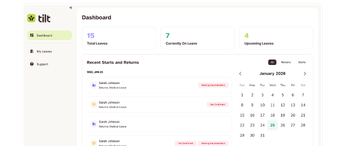
Tilt’s Leave Experience Management platform is designed to help small and mid-sized HR teams manage leave with less manual coordination and greater visibility throughout the process. By bringing structure to leave management, Tilt helps HR teams spend less time chasing updates and more time supporting employees—all while maintaining visibility and control.
Because a better leave tracking process isn’t just about fixing what’s broken. It’s about finding a more sustainable way to manage leave, so your process can keep working for you as your organization evolves.
Ready to see what that could look like for your team?
Take a tour of the Tilt platform or connect with our team to learn more.