Boost Organizational Productivity Through a Transparent LOA Process

Transparency. We all value it, but we’re not always sure why and it’s often not very clear how to achieve it. The implications of transparency in the workplace vary greatly depending on what clarity is being sought after. Transparency around salaries, for example, can have a litany of ripples that an organization must be prepared to address.

When it comes to the leave of absence process, transparency implies a strong sense of cross-functional collaboration, clarity, and confidence that as an employee on leave my employer prioritizes my well-being. Beyond that, it instills trust that my employer is putting me in a position to have a successful and empathetically supported journey in my time of need.

A transparent leave process, of course, does much more than give your employees the warm fuzzies. The positive ripple effects it can have across your organization can be tremendous.

Transparency In Your Leave Process Boosts People Ops Productivity

The problem most People Ops leaders have with relying on traditional methods for LOA administration is that multiple processes and systems are often involved, and none of them work together. 

Your HRIS has important employee demographic data that’s required to build accurate leave plans, your leave tracker has specific leave data that has to be manually (and regularly) updated and securely stored, your insurance carrier’s platform lives an entirely separate orbit, and the state programs your employees apply for live in a different technological era altogether.  

Add to that the fact your payroll system has employee-specific payment details that require real-time leave information and your email inbox has a smattering of digital paper trails and folders trying to keep track of who said what when.

Keeping these separate systems working in harmony is vital for effective LOA support, but can make your team feel like those old-timey switchboard operators, frantically trying to keep process connectivity so the support signal isn’t lost.

Simplifying your leave processes into a transparent, simple-to-use, single-source-of-truth solution should:

  • Talk with your HRIS 
  • Build accurate leave plans for your employees
  • Automatically track leave data (and updates with any changes), 
  • Provides direct access to real-time pay details for payroll, 
  • Guides employees through complicated STD and state benefits processes 
  • Provide answers to employee questions as they arise
  • Adapt to changes in a leave journey
  • Securely store sensitive information 
  • Creates a window into an employee’s leave so that People Ops, Payroll, the employee, and their manager have the transparency necessary for successful leave administration at a fraction of your teams’ bandwidth burden. 

Transparency in your LOA process frees your team to focus on all the other tasks they’re responsible for while empowering you to deliver a better experience for employees.

Transparency In Your Leave Process For Better Workforce Planning

Increasing the productivity of your People Ops team through a transparent LOA process would be a worthwhile boost if that was the only benefit to your organization it provided. Fortunately, that’s only the tip of the productivity iceberg.

When thinking about the ways a leave of absence impacts your organization it’s understandable to focus primarily on the employee needing leave and the resources your team has to allocate in order to effectively support that employee.

But an LOA also leaves a human-sized crater in your workforce that the employee’s manager must fill in order to keep his team on track for their own goals and objectives. If the employee’s manager isn’t in the loop throughout the leave journey they’re forced to workforce plan with their hands tied behind their back.

A lack of transparency negatively impacts an employee’s manager and the organization in a few ways.

Without transparency into real-time leave data: managers can’t effectively reallocate resources or hire temporary employees to fill gaps.

If managers can’t properly fill the productivity gaps: the remaining employees may feel overworked, and burnout and resentment can fester.

If burnout and resentment fester: employee engagement and productivity suffers, leading to dissatisfaction and employee turnover.

If employees aren’t productive: business objectives aren’t met and clients aren’t receiving from your organization what they’re promised.

The phrase “ripple effect” gets used quite often in the blogosphere, but in this instance, a lack of LOA process transparency can truly be detrimental to your organization’s productivity in the short AND long term.

Set your organization up for successful, transparent leaves, and keep your organization firing on all cylinders no matter if one LOA pops up on the horizon (like a parental leave) or if three appear out of the blue (say for bereavement, caregiver, or disability).

How to Make Your LOA Process More Transparent

Your LOA process can only be as transparent as the tools you have in place to facilitate your leaves of absence. Run an audit of your existing tools, platforms, spreadsheets, and systems that your team has to manage in order to support a single leave.

Are they working in harmony? Or is your team required to manually take data from one and put it into another (in the spirit of transparency we’ll save you a click and tell you it’s the exact same old-timey switchboard gif as above…it was just too relatable to use only once), relentlessly cross-checking for accuracy while communicating as frequently as possible to keep the impacted parties informed?

It may be possible to achieve some form of transparency using manual processes and outdated systems, but your odds of success are slim, your risks of inaccuracies great, and your anxiety over compliance risk well-founded.  

Your best bet may be to refine your existing processes to squeeze as much transparency as possible at the expense of even more of your team’s bandwidth than they’re already providing. 

Or your best bet may be to seek a dedicated leave management solution that can provide your org with transparency, your employees with easy-to-use leave support, and give a productivity boost that will be felt as much in your company’s culture as in its bottom line.

About Tilt

Tilt is leading the charge in all things leave of absence management through easy-to-use tech and human touch. Since 2017, our proprietary platform and Empathy Warriors have been helping customers make leave not suck by eliminating administrative burdens, keeping companies compliant, and providing a truly positive and supportive leave of absence experience for their people.

Related Posts

Essential Materials for Managers to Ensure a Successful Employee Leave Experience

A manager may seem like a tangential component to a leave of absence, but there’s no denying that they play a vital role in leave efficacy. The more informed a manager is on the ins and outs (and do’s and don’ts) of leave, the higher the likelihood that your employees will have a positive leave experience and return feeling supported and engaged.

Also having your managers educated on leaves of absence can help keep your organization out of legal hot water.

Below we’ve compiled some materials you can provide managers who may be trying to achieve their business objectives and are faced with an employee who has requested a leave of absence. 

Please note that leave laws are always changing, so it’s a best practice to stay current on the latest leave laws (bookmark this page for Tilt’s free quarterly Leave Law Reports). 

Tilt Tip: We’ve written these materials below “to the manager,” so feel free to copy and paste or modify them with your organization’s voice, tone, etc…

1. Understand Family Medical Leave Act (FMLA)

The federal Family and Medical Leave Act (FMLA) gives your employee the right to take 12 weeks of unpaid, job-protected leave from work for medical or family obligations without jeopardizing their employment. An employee can take FMLA for: 

  • The birth of a child and to care for the newborn child within one year of birth;
  • The placement of a child for adoption or foster care and to care for the newly placed child within one year of placement;
  • To care for a spouse, child, or parent who has a serious health condition; 
  • A serious health condition that makes an employee unable to perform the essential functions of their job.

During FMLA leave, employer-paid health benefits remain the same. Your employee is also guaranteed a return to the same or comparable position in terms of pay, location, job content, and promotional opportunities.

As a manager, you can not ask your employee to disclose any medical information about their need for FMLA leave. Your employee is also NOT able to participate in any work activities and you should not contact your employee for work-related reasons.

2. Ways Managers Get Into FMLA Trouble

Managers may fail to recognize that FMLA leave has been requested. Employees don’t have to say “FMLA” to request FMLA time off. Distinguish between FMLA absences and ordinary sick days.

Be a great listener, supportive, and helpful – don’t decide if your employee qualifies or not. Some managers share with employees that they think FMLA leave shouldn’t be taken, even though it’s a legal right. This can get you into a lot of trouble. Refer your employee to your People Ops to get the support they need.

Managers sometimes disclose serious health conditions of others to co-workers. This is not your place (and it’s illegal) to share this information. It’s okay to say they are on extended leave but do not share information with other employees about this employee’s medical or family condition, even to say they are on “medical leave.”

Employers legally can’t require employees to work during FMLA leave. Employers are allowed to contact employees but should keep any conversations brief and not result in any work being done by the employee on leave.

To sum it up: read up on the FMLA and partner with the People Team. It’s that easy!

3. Ask Your Employee To Share Their Knowledge With The Team

Alright, your employee is going out on leave. Plan ahead sooner rather than later. Ask your employee to provide the team with some need-to-knows about their work responsibilities. 

No matter the format (shared doc, bulleted list, email, etc.), ask your employee to set themselves and their teammates up for success with a knowledge transfer plan that lets people know about upcoming projects, in-progress work, deadlines, etc. They’ll be a real hero.

Please help support your employee in creating and providing the team with a comprehensive coverage plan for their work responsibilities. Make sure that each person who will be covering some aspect of the employee’s day-to-day responsibilities has been prepped and has access to everything they’ll need to provide effective interim coverage.

4. Return to Work Best Practices

Returning to work after a leave of absence can be challenging for employees. It is important for managers to support their employees during this time to help ease the transition back to work. Here are some best practices to help employees adjust back to work after taking a leave of absence:

Communicate with the employee: Prior to the employee’s return to work, reach out to the employee to connect and see how they are doing, understand if they’re on track to return when expected, and ask if there’s anything the company can do to help support them when they return to work. In this connection, indicate that you will find a time once they have returned to work to discuss their schedule, be transparent and clear about their role and responsibilities, review any changes that may have occurred during their absence, and address any concerns or questions they may have.

Re-Onboard: Once the employee has returned to work, provide a re-onboarding to the employee to ensure they are up-to-date with the latest developments in the company. A lot can change while someone is out on leave. This will help them to get reacquainted with the company culture, mission, vision, and values, and help to instill their place in the organization.

  • In preparation for this discussion, take note of the major milestones (i.e. product releases) that occurred while the employee was out. 
  • Introduce new team members.
  • Acknowledge any redefinition of roles and introduce new teammates

Support: Be supportive of the employee and their needs during the transition period. Understand that they may need some time to adjust to their work environment and get back up to speed with their job responsibilities. It is essential to listen to their concerns and help them address any issues they may be facing.

Training: Offer training if needed to refresh their knowledge and skills. This will help the employee to feel more confident in their role and reduce any anxiety they may be feeling.

Offer flexibility: Returning to work can be stressful, and employees may need some flexibility to help ease them back into the work routine. Consider offering a reduced workload initially, to help them get back into the swing of things.

Ensure a safe and supportive work environment: Make sure that the employee feels comfortable and supported in their return to work. Ensure that they have access to any necessary accommodations or resources they may need to perform their job.

  • Should the employee request an accommodation in order to perform their job, be sure to escalate the request to your HR team.

Monitor progress and provide guidance: Set up continued 1:1s to check in with your employee and see how their transition back to work is going. This will help you keep an eye on the employee’s progress and offer guidance as needed and will help the employee feel more confident and supported as they transition back into their role.

Follow-up: Check in regularly with the employee to ensure that they are adjusting well and to address any issues that may arise. This will also help to show the employee that they are valued and supported.

Recognize the employee’s contribution: Acknowledge the employee’s return and their contributions to the team. Recognizing their efforts can help boost morale and make them feel valued and appreciated.

Overall, it is important to ensure that employees do not begin working prior to their return date. Upon their return, be understanding and supportive of employees who are returning from a leave of absence. By following these best practices, managers can help their employees transition back to work smoothly and successfully.

5. Check In On The Team During an Employee Leave

Supporting your team through your employee’s leave is crucial. It’s best practice to check in on folks who are handling the responsibilities for your employee who is on leave every two weeks. Whether that’s another co-worker stepping in to cover a key project, a stretch assignment, or a temp-hire taking on the workload, it’s a good idea to regularly check in and chat about:

  • if they have everything they need to successfully fulfill the work tasks
  • successes and any roadblocks they’re facing
  • how you can help them excel at their new responsibilities

Checking in regularly will ensure nothing slips through the cracks and makes the leave and return easier on your employee and team.

6. Thank the Team for Stepping Up In an Employee’s Absence

Saying “thank you” is underrated and often overlooked.

If your team or specific employees stepped up during their teammate’s leave, give ’em a kudos! Cheers for peers do wonders and teamwork makes the dream work ya’ll.

Set Managers Up for Success Through Leave of Absence Education

A manager being educated about leave can be the difference between an employee feeling empathetically supported during their journey and an employee looking for employment elsewhere as soon as possible.

Managers are also responsible for keeping their ship headed in the right direction while one (or more) of their key members are taking time away from work, so it’s vital that they have the tools at their disposal to ensure the remaining employee are supported to avoid resentment and burnout.

Successfully administering a leave of absence is no small feat. They’re complex, unique, and undoubtedly human. Managers are human too, and while they may be experts at their craft the odds are they are leave-of-absence novices. 

Help managers be a positive force in an employee’s leave of absence by giving them the materials they need to be knowledgeable of today, so that you aren’t dealing with the consequences of a poor leave experience tomorrow.

About Tilt

Tilt is leading the charge in all things leave of absence management through easy-to-use tech and human touch. Since 2017, our proprietary platform and Empathy Warriors have been helping customers make leave not suck by eliminating administrative burdens, keeping companies compliant, and providing a truly positive and supportive leave of absence experience for their people.

Related Posts

Why You Should Shed Manual Leave Tracking Yesterday

With time-machine technology still confined to the realm of science fiction, we’re well aware that if you’re reading this today you can’t enhance your leave-of-absence tracking yesterday since yesterday already happened. That said, technology does exist that makes leave of absence tracking and administration so easy you’ll think you’ve been teleported to the future.

While spreadsheets, Google calendars and email reminders are a step up from a pen-and-paper approach to leave management, manually tracking your employee leaves puts People Ops leaders and their organizations at a disadvantage when it comes to effectively supporting employees and meeting business objectives.

Manual Leave Tracking is Bad for Business

A suboptimal leave of absence process has a ripple effect that extends beyond the People Ops teams trying to administer the leaves and the employees looking for support in their time of need away from work. 

A lack of insight into workforce planning: When an employee takes a leave of absence (whether planned like a pregnancy or unplanned like a bereavement) a gap in productivity presents itself. With manual spreadsheets or siloed systems, managers don’t have the real-time information needed to appropriately shift talent around where needed to fill the gaps. 

Operational inefficiencies: When leave dates change or employees don’t return due to a poor experience your organizational output takes a hit. Additionally, if the employee’s teammates aren’t sufficiently supported in their absence, or aren’t properly trained to cover the responsibilities of the employee on leave, operational output suffers. Not to mention the operational inefficiencies manual leave tracking has on your own operations.

Compliance concerns: Manual leave tracking is also rife with compliance pitfalls. From inevitable human error entering leave data to sensitive information falling into the wrong hands, manual processes for your leave tracking are more than inefficient, they can be the source of costly compliance concerns. 

Reputational damage: Reputational damage is also at stake. A poorly handled leave of absence can be the reason your organization is in the headlines for all the wrong reasons, and if you aren’t able to effectively workforce plan when a leave (or multiple leaves) request pops up, your customers’ satisfaction could suffer. 

Modern leave tracking is a boost to business: Tilt’s modern leave management software takes the manual processes typically associated with leave management and automates them under one secure digital roof. Tilt’s platform gives real-time insights into an organization’s workforce so People Ops and managers alike have a single source of truth for effective workforce planning. 

Our team of in-house leave law experts informs our tech and keeps you in compliance, while our personalized leave plans ensure your employees are supported effectively and efficiently throughout the leave journey. 

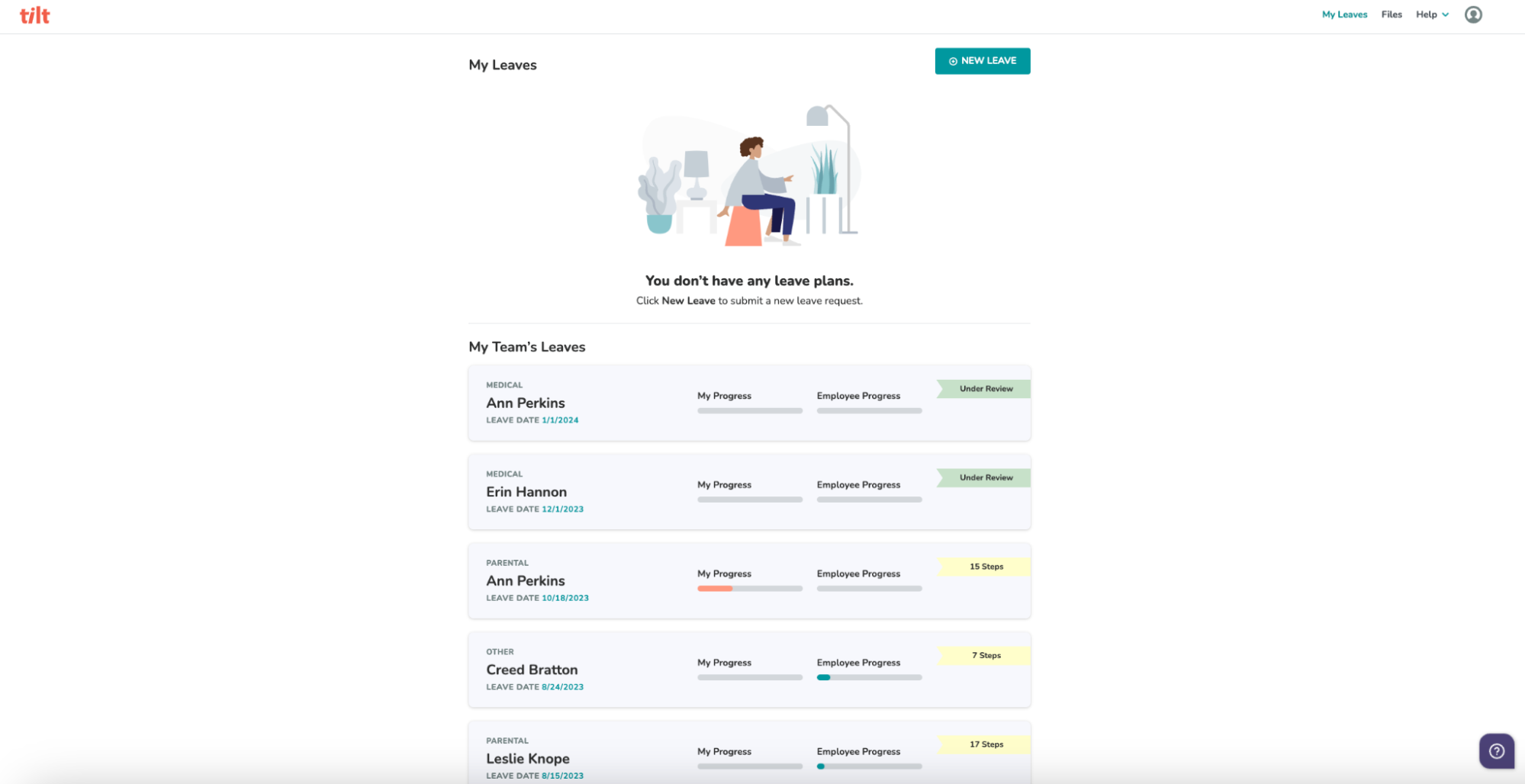
From the HR dashboard you get a window into all things leave for your organization:

LOA Tracking With Spreadsheets is an Administrative Nightmare

If the original reason the phrase  “ain’t nobody got time for that” was spoken was because a People Ops leader was frustrated with manually administering leaves of absence, we wouldn’t be surprised. Manual leave tracking is a burden many People Ops pros bear, but shouldn’t have to.

Time wasted: Tilt’s leave management software can save you anywhere from 10-20 hours a leave, meaning your manual processes aren’t just putting you at compliance and reputational risk, they’re also hindering your productivity and the productivity of your team. It’s time that could be spent driving other team objectives forward and helping your organization meet its goals. 

No version control: We touched on it above, but Tilt provides a secure, single source of truth for all of your leave data. If you’re using Excel or Google Sheets to manage leaves you aren’t alone, but you are at risk of version control concerns and inaccurate data should an audit be required.

Lack of transparency: Manual leave tracking siloes your information by nature. Tilt gets data directly from your HRIS so the information in your system is the information in our system. Further, we provide payroll and the employee’s manager with access to Tilt so all appropriate parties are given the information they need to be successful.

Modern leave tracking automates and simplifies leave tracking: This customer who was formerly tracking leaves manually has this to say:

Tilt has been one of the best products we have ever implemented at our organization and we love to see how Tilt will grow over the years. We have an easy-to-use dedicated space to track all types of our company leaves. Our payroll team and the leave of absence team no longer have to use Excel files to constantly track an employee's leave. In addition, now managers are more attuned to their employees' leave time frames as well as staying compliant with what they can and can't say to an employee requesting a leave or is on leave.
Melissa B
Sr. Benefits Coordinator

Employee Experience Suffers With Old Leave Management Process

At the end of the day, a leave of absence is all about the employee needing to take time away from work to address something significant in their life. Sometimes those events are positive, sometimes they’re planned, and sometimes they’re neither.

Confusing processes: When an employee needs a  leave of absence there’s a good chance a significant life moment has happened, or is about to happen to them. This is why having a clear and simple leave plan for employees to follow is a must. Every leave is slightly different, Every state is slightly different. Every employee is slightly different. Manual processes can’t accommodate all scenarios effectively and the result is a frustrating and confusing experience for employees. 

A lack of trust: A lack of clarity, transparency and compliance confidence can breed a lack of trust within your workforce that they’re going to get the support they need when they take a leave. If you’ve been in the game long enough, you likely know of employees who go on leave and are never to be seen again because of how they felt their leave was handled by their employer.

Pay accuracy uncertainty: A major blindspot caused by manual leave tracking is payroll. Overpayments and underpayments may be a nightmare for People Ops and payroll to navigate, but they can be a living nightmare for employees if they aren’t certain how much they’re getting paid, by when, and where the money is coming from.

Automated Pay Calculations and Breakdowns

Tilt Makes Leave Easy for People Ops; More Human for Employees

It’s not uncommon for professionals in any discipline to hold tightly to the systems and processes they’re familiar with, but the ineffectiveness of relying on manual processes to manage leaves has got to go.

From personalized leave plans for employees, to HRIS data syncing for accurate information, to freedom from time spent updating spreadsheets, Tilt’s leave management software means no more manual tracking for you, nothing but positive experiences for your people, and there’s no time machine necessary.

About Tilt

Tilt is leading the charge in all things leave of absence management through easy-to-use tech and human touch. Since 2017, our proprietary platform and Empathy Warriors have been helping customers make leave not suck by eliminating administrative burdens, keeping companies compliant, and providing a truly positive and supportive leave of absence experience for their people.

Related Posts

5 Ways “WorkTech” Empowers Employers to Embrace Humanity in the Digital Era

“The promise of tech is often that it will eliminate, or make easier, the things that we simply don’t want to do. The things that make us feel less human.” – Aaron Delgaty, PhD., Practice Leader of Experience Research @ The Starr Conspiracy

As the proliferation of technology marches onward and our lives become more intertwined with SaaS, Apps, and Portals, employers are feeling the heat to find ways for employees to feel their humanity isn’t lost in the digitization evolution. 

WorkTech integrates collaboration, productivity, and People Ops processes with the aim of enhancing the employee experience through the application of technology in the workplace. While no two tech solutions are created equal, in the world of People Ops they typically have these two similar characteristics when viewed from 10,000’:

  1. They impact the burden (hopefully in a positive way) of the People Ops pro managing the technology for the organization.
  2. They impact the lives of the employees who are being asked to use the technology.

While that may seem reductive, People Operations leaders find themselves in a unique situation when it comes to WorkTech in that perhaps unlike other areas of a given business, any WorkTech solution introduced into a People Ops process has to be extremely mindful of characteristic number 2. 

With the right WorkTech solution, digitization doesn’t have to come at the expense of humanity, and in some cases, creates a sense of humanity where it was previously seriously lacking. 

Below we break down five ways WorkTech can help employers embrace humanity in the digital era to demonstrate how the right tech can make all the difference to People Ops and the employees they serve.

And it’s not for a lack of effort on your part. You’ve likely either inherited inefficient and ineffective legacy systems to manage your LOAs, or you simply don’t have the bandwidth to keep up to date on leave laws, administer your policies consistently, guide employees through all the programs they have to apply for, and answer the multitude of urgent leave-related questions that your employees may have at a moment’s notice.

LOAs…they’re a lot, and unfortunately if you’re relying on having to manually update spreadsheets while coordinating between disparate and outdated systems (looking at you state departments and some…not all…STD carriers) only to provide a cold and cloudy user experience to employees is a rocky foundation to build your employee experience empire upon.

Tilt Recap: Leaves are complex, and traditional approaches to managing them put People Ops leaders at a disadvantage for their successful administration, thus putting your employee experience at risk when they need it most.

1. WorkTech Automation for Mundane Tasks

Let’s take one particularly human process that every organization and People Ops team has to navigate, the leave of absence process. Where a manual leave of absence process is an administrative dumpster fire for you to manage, it can be a cold, confusing, and sometimes intimidating process for your people.

Automation through modern LOA management software allows you and your team to focus on more meaningful and creative aspects of your work by automating repetitive and mundane tasks, removing human error, and keeping you compliant. This not only increases your efficiency at a critical job function but also frees up your team’s time to do more meaningful and impactful work.

Similarly, your employees’ lives are made easier by streamlining an otherwise arduous process while being supported during a very complex, human time in their lives. A major element of leave of absence support is being able to answer questions that employees may have about during their leave, so in this case, the right WorkTech solution should also have an element of easy-to-access human support as well.

2. Data-Driven Decision-Making Made Easier With WorkTech

In the contemporary workplace, WorkTech catalyzes data-driven decision-making, revolutionizing how employers manage and optimize their workforce. By harnessing the power of data analytics, organizations gain insights into various facets of employee performance, engagement, and satisfaction. This analytical prowess allows employers to make informed decisions, tailor strategies, and address challenges with precision.

Using the same example as above, workforce analytics from modern leave management software can help uncover patterns related to turnover and trends in leave requests over time, enabling your organization to identify areas of improvement or allocate resources more efficiently. More on that in a minute. 

The introduction of artificial intelligence and machine learning in WorkTech is beginning to bear fruit as well, equipping employers with real-time analysis, and empowering them with a dynamic and responsive framework. This data-centric approach not only enhances operational efficiency but also supports a human-centric culture of continuous improvement.

3. The Importance of HR Tools with Transparency

Transparency in your WorkTech tools is essential for fostering a positive workplace culture and nurturing employee trust. When your processes and data are transparent, employees feel more informed and empowered, which leads to increased job satisfaction as employees are given the clarity needed to feel fully supported.

Further, leveraging the leave of absence example one more time, transparency with your leave data (which should be accurate thanks to automation) gives your organization a window into workforce planning that they simply couldn’t have if you’re using a spreadsheet. Spreadsheets are great, but WorkTech they are not.

With the right LOA WorkTech solution, not only do employees stay informed about what they need to do on a leave, People Ops can easily see all leaves happening at any given time across the org, and managers can more effectively fill in the gaps. That means less employee burnout (good for humanity), business continues to thrive (good for humanity), cross-training opportunities may emerge (good for humanity), and the employee returns to work feeling supported and re-engaged (good for humanity).

Transparency can be a scary thing to some organizations, but the right tech solutions can make it easy. 87% of employees want their organizations to be transparent, and WorkTech can help.

4. HR Collaboration Made Possible Through Tech

People Ops Tech (or HR Tech) is really a subset of WorkTech overall. Where People Ops tech focuses on managing your human resources…well…humanly, WorkTech additionally aims to improve productivity and collaboration within the workplace. This is both a boost for employee well-being and your organization’s bottom line.

WorkTech’s collaborative tools stand as the cornerstone of a dynamic and interconnected workplace, redefining how teams collaborate across distances and time zones. In an era marked by globalized workforces and the rise of remote work, these tools play a pivotal role in breaking down physical barriers and fostering a culture of seamless collaboration.

Platforms like virtual team spaces, project management tools, and instant messaging applications facilitate real-time communication and cooperation among team members. The ability to share documents, conduct virtual meetings, and engage in collaborative editing enhances teamwork, ensuring that every member feels actively involved and contributes to collective goals.

With the advancement of virtual and augmented reality, expect WorkTech solutions to offer immersive workplace experiences that transcend physical boundaries in the near future.

5. How WorkTech Plays a Role in Organizational Inclusion

A truly diverse and inclusive work environment demonstrates empathy towards situations it may not fully understand. And it’s more than about being a good human to your humans, it’s good for business and good for retention as well, as Gartner research finds that in a diverse workforce, performance improves by 12%, and intent to stay by 20%.

WorkTech empowers employers to champion diversity and inclusion through targeted initiatives, creating workplaces that celebrate and embrace differences. Utilizing technology, organizations can implement inclusive hiring practices, ensuring unbiased recruitment processes and fostering diverse talent pools. Data-driven tools assist in tracking diversity metrics, enabling organizations to measure and improve their inclusivity efforts.

Moreover, WorkTech supports the development of inclusive digital environments, where employees feel valued and respected. From fostering open communication through inclusive collaboration platforms to utilizing AI for detecting and mitigating unconscious biases, technology plays a crucial role in shaping a workplace culture that appreciates diversity.

By leveraging WorkTech for diversity and inclusion initiatives, employers not only enhance organizational resilience but also tap into a wealth of varied perspectives, driving innovation and creativity. Ultimately, these initiatives go beyond compliance, fostering a workplace where individuals from diverse backgrounds thrive, contributing to a richer and more vibrant professional community.

WorkTech For a More Human Work Experience

The right WorkTech has the power to revolutionize your workplace, empowering your organization to cultivate a humane and employee-centric environment top to bottom. WorkTech champions automation, data, transparency, collaboration, and inclusion with its emphasis on continuous learning, enabling growth for individuals and the organization as a whole. 

Data-driven decision-making ensures strategic and informed choices, while automation streamlines processes and removes frustration and confusion. Transparency delivers insights and fosters a sense of trust, and the commitment to diversity and inclusion promotes a harmonious workplace. 

Together, these elements forge a work environment prioritizing holistic development and employee satisfaction. WorkTech is not just a tool; it’s a catalyst for a progressive, nurturing and human work culture.

About Tilt

Tilt is leading the charge in all things leave of absence management through easy-to-use tech and human touch. Since 2017, our proprietary platform and Empathy Warriors have been helping customers make leave not suck by eliminating administrative burdens, keeping companies compliant, and providing a truly positive and supportive leave of absence experience for their people.

Related Posts

Is Your LOA Process A Silent Saboteur of Employee Experience?

Shhhhh…hear that? If you need to turn down the volume on that episode of Schitt’s Creek you’re streaming in the background go ahead, but when it’s nice and quiet and you listen ever so closely you’ll hear it. It’s the subtle sound of employees grumbling over the experiences they’ve had while taking a leave of absence at your organization.

And it’s not for a lack of effort on your part. You’ve likely either inherited inefficient and ineffective legacy systems to manage your LOAs, or you simply don’t have the bandwidth to keep up to date on leave laws, administer your policies consistently, guide employees through all the programs they have to apply for, and answer the multitude of urgent leave-related questions that your employees may have at a moment’s notice.

LOAs…they’re a lot, and unfortunately if you’re relying on having to manually update spreadsheets while coordinating between disparate and outdated systems (looking at you state departments and some…not all…STD carriers) only to provide a cold and cloudy user experience to employees is a rocky foundation to build your employee experience empire upon.

Tilt Recap: Leaves are complex, and traditional approaches to managing them put People Ops leaders at a disadvantage for their successful administration, thus putting your employee experience at risk when they need it most.

Where Traditional LOA Processes Fall Short on Employee Experience

We don’t need to sell you on the importance of employee experience. You wouldn’t be in People Operations if the employee experience wasn’t near and dear to your heart, but there is much debate and many philosophies around the best ways to achieve your employee experience goals.

A prevailing philosophy on this front requires focusing on the foundation of how employers are addressing employee well-being. There are countless reasons why an employee might need to take a leave of absence. Still, whether it’s welcoming a new member into the family or saying final goodbyes to one, odds are that your employee needs to take time away from work because a major, and very human, life event has occurred. 

These defining employee moments hold a tremendous amount of sway in the psyche of your employees, and if employees aren’t feeling supported properly throughout their journey it can turn those low grumbles into loud roars if antiquated processes aren’t modernized.

If you’re manually managing your LOAs, or likely providing your employees with:

  • A level of service limited by inaccurate and outdated information 
  • On-the-fly leave law information
  • Antiquated technologies that siloes information
  • Blindspots in workforce planning
  • Uncertainty about pay
  • Data security risks
  • People Ops support with a bandwidth stretched far too thin
  • A solution that doesn’t guide them with empathy or alleviate the many pain points they can face throughout a leave

The old way of managing leaves is more than just a thorn in your side, it’s setting the leave and your overall employee experience up for failure and can contribute to resentment in your employee population, 

Tilt Recap: Traditional methods of manually updating spreadsheets, coordinating across separate systems, and navigating confusing processes to manage LOAs puts a tremendous strain on People Ops’ bandwidth and can’t deliver the level of service required to provide a positive leave experience for employees.

How Modern Leave Technology Boosts Your Employee Experience

If you’re looking to turn those negative employee experiences surrounding LOAs into positive ones, a modern leave management software might be exactly what you need.

The right leave management software:

  • Replaces your manual processes with automation
  • Keeps you compliant with the latest leave laws 
  • Empathetically guide employees throughout the entire leave journey
  • Provides human support when employees need extra care
  • Emphasizes transparency so People Ops, the employee on leave, and their managers have one source of truth, and that source is accurate and available on demand.
  • Delivers a positive experience so employees return feeling supported and engaged
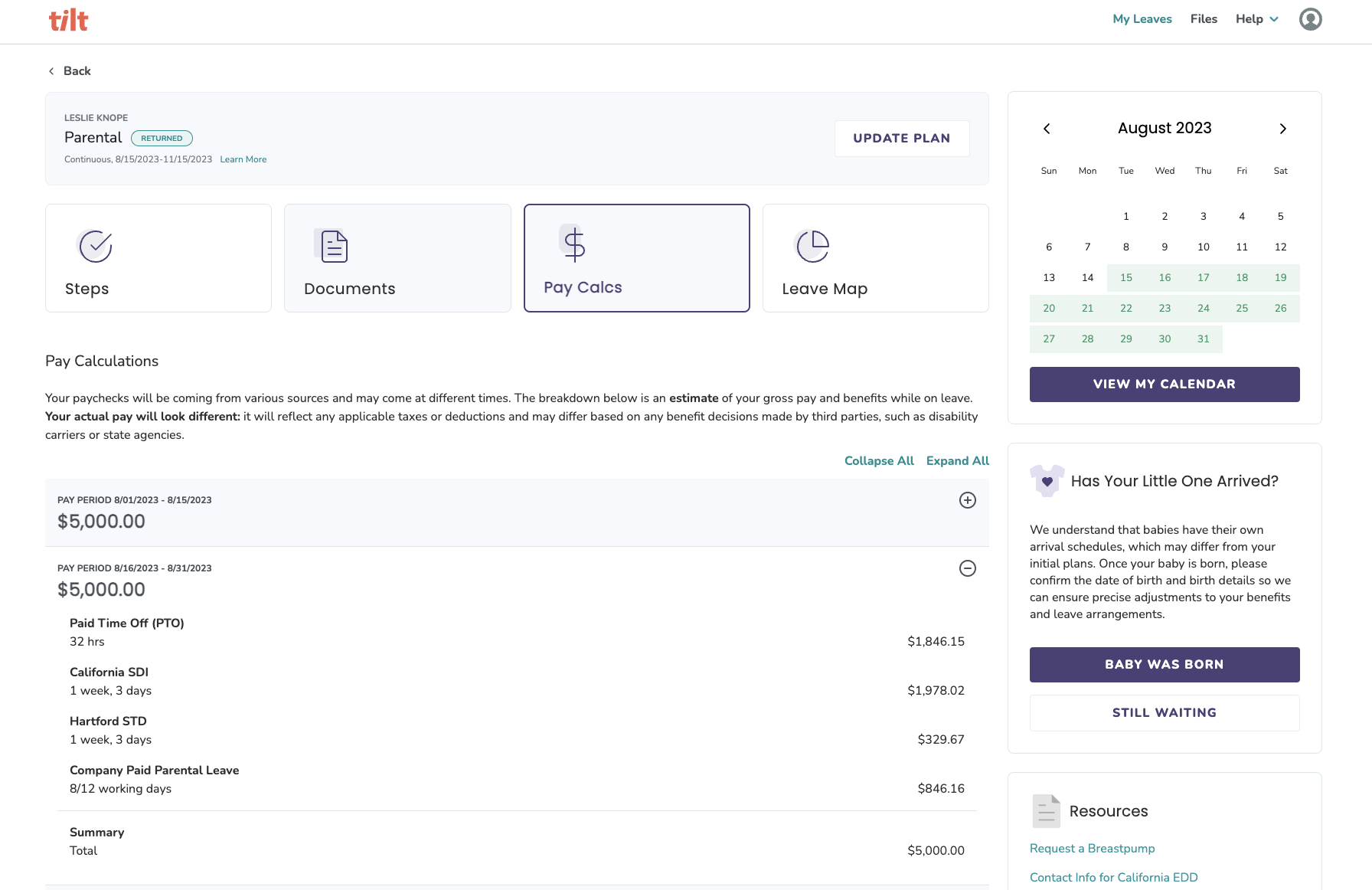
  • Clear and comprehensive pay calculations that break down how much an employee can be expected to receive and from what sources (i.e. company benefit, state program or STD provider).
  • Alleviates People Ops administrative burdens without removing visibility into the process
  • Provides safe and secure storage of sensitive information and documentation

The right LOA management software can turn your least favorite to-do into your biggest ally in your quest to keep employee engagement strong in the wake of the often unpredictable world of leaves of absence.

Leaves don’t have to be hard for you or your employees to navigate, but the traditional processes being used must be reevaluated for modern times and modern needs. Building a strong employee experience foundation starts with ensuring your employees trust that when their lives demand attention and they must pull away, their employer has the tools in place to make that transition as seamless and supported as possible.

Tilt Recap: Approach the employee experience as the foundation of your organization’s health and the tools you have in place for leave of absence support can either put a crack in that foundation or solidify it for years to come. Adopting modern technologies that match modern workplace philosophies is not only in the best interest of your employees but frees People Ops up to spend more time improving the employee experience elsewhere.

About Tilt

Tilt is leading the charge in all things leave of absence management through easy-to-use tech and human touch. Since 2017, our proprietary platform and Empathy Warriors have been helping customers make leave not suck by eliminating administrative burdens, keeping companies compliant, and providing a truly positive and supportive leave of absence experience for their people.

Related Posts

How to Cultivate Employee Happiness for Unmatched Customer Satisfaction

“Employee happiness” is one of those ambiguous terms that most C-suites worry about but don’t quite understand how to influence. After all, every organization is unique in structure, workforce population, business objectives, and virtues, so when it comes to cultivating happiness in the workplace there are numerous factors to consider and potential levers to pull.

We can assume that leadership cares about the well-being of its employees because they’re good humans, but there are tangible business benefits to fostering a happy workplace as well.

To put it plainly, happy employees are more creative, provide better service, improve customer relations, and are more likely to stay with their current employer. Happy employees are your organization’s not-so-secret key to pushing your business outcomes to new heights. More concretely, companies with happy employees outperform their competition by 20%.

The Do’s and Don’ts of Employee Happiness Initiatives

While cultivating employee happiness often rests on the shoulders of those in People Ops, it requires a holistic approach with buy-in from everyone throughout an organization. We’d be remiss for even insinuating that higher salaries wouldn’t have a positive effect on employee happiness, but most organizations can’t just throw that kind of cash at the problem, and further the happiness boost tends to be temporary

Along those lines…

Don’t: Rely on surface-level frills

Employee happiness can be a tricky nut to crack because what makes one employee happy might not factor into another employee’s happiness whatsoever. Furthermore, surface-level frills can add some pizzazz and attract talent initially, but they don’t necessarily equate to a happier work culture and long-term retention.

Kombucha on tap? Ping pong tables in the breakroom? While most employees would agree that these are all nice perks to have, they won’t turn a sour work culture sweet on their own because it’s been shown that employees really feel valued when their employer cares about their well-being. Often, these are not tangible things but are scarce resources like time, energy and true support of their life outside of the office. Your employees won’t care about having nap pods if they do not feel valued as humans. 

Tilt Recap: Frills can be a component of a happy culture, but do not make a happy workforce.

Do: Focus on the foundational

Fortunately, there are foundational considerations that if properly addressed can do wonders to bring your employee happiness quotient skyward for the long haul without breaking the bank or your bandwidth. One such example of a foundational benefit that directly impacts employee happiness and customer satisfaction is the leave of absence process your employees experience when life happens and they need to step away from the office.

A leave of absence is a defining experience for your employees. Lance Haun from The Starr Conspiracy describes employee experience as “the perception of the quality of all the experiences at work, and our perceptions are driven by defining moments in that experience.”

In that light, a positive leave experience can strengthen an employee’s resolve to continue great work for your organization when they return. A poor experience, on the other hand, can have the opposite effect leading to turnover, potential fines, and work gap breakdowns. All of which can cause a negative ripple effect from organization-wide morale to failing to deliver on promises to your customers.

An arcade machine can’t paper over a poor defining experience for your employees. 

Tilt Recap: The foundational support of employees as humans is the building block to cultivating happy employees. How employees are supported during a leave of absence is a great example of this.

Do: Promote buy-in throughout the organization

Employees want more than human-centric benefits, they want the confidence to know that they are encouraged to take advantage of them. For example, at Tilt we use RTO (responsible time off), and we encourage its use by “leaving loudly.” If someone in leadership needs a mental health breather they announce it to the organization.

As Lorena Martinez, a former employee survey implementation consultant at Great Place to Work puts it:

“People look up to their bosses when they encourage their team to consistently take full advantage of benefits and wellness opportunities.”

Benefits need to be easy to access, accessible to all eligible employees, and be encouraged by leadership. Your employees need to trust that when they need one of the benefits provided they’ll get the support they need when they need it. 

Tilt Recap: Employees won’t feel confident they can use company benefits if there isn’t positive reinforcement to do so from leadership.

Connecting Employee Happiness to Customer Satisfaction

Disengaged employees can cost organizations up to $550B a year; a statistic that on it’s own should be enough to strike fear into the hearts of any leadership team, and yet according to a recent Gallup poll workers are experiencing staggering rates of both disengagement and unhappiness. 60% percent of people reported being emotionally detached at work and 19% as being miserable.

Let’s continue with our leave of absence example to see a practical application of how an improved foundational experience for employees leads to both employee happiness and greater customer satisfaction.

The traditional way People Ops pros manage a leave of absence requires confusing processes, manual tracking, and interpreting befuddling leave laws. Employees may have questions you don’t know the answer to or don’t have the bandwidth to respond promptly to.

Sometimes employees return to work after a poor leave experience so soured on the experience that they only return long enough to find another organization. At Tilt, we’ve also heard from several customers that a lot of times after their employees take a leave of absence they don’t even come back.

Better Leaves = Better Workforce Planning + Happy Employees + Satisfied Customers 

An employee who is satisfied and happy with their organization is more motivated to embody the products and/or services you provide, which boosts the likelihood they’re serving customers with more enthusiasm. It’s also why organizations with happier employees earn 147% more per share than competitors. 

A more modern approach to leave of absence focuses on the foundational elements of employee happiness. Are their managers in the loop so they can workforce plan in real time? Are leave dates and updates to a leave journey being accurately recorded and easy to access? Are employees given a soft landing when they return to work so they aren’t overwhelmed or confused about what happened while they were away?

Blind spots in workforce planning might mean a department will be understaffed for a critical deadline. This can have a ripple effect as employees who are already at capacity may be asked to do even more to fill the gap, increasing the potential for inexperienced employees trying to support your customers on the fly and can lead to burnout, which can lead to turnover and the cycle continues.

Tilt Recap: Happier employees lead to lower turnover rates and a higher quality of customer support. Improvements to foundational functions like how you administer a leave of absence can have a major impact on happiness and customer satisfaction.

Employers Can’t Afford to Have Unhappy Employees

Cultivating employee happiness starts with how employees perceive their employer will show up in a time of need. Whether it’s leave of absence support or one of the countless other ways your employees expect their People Ops teams to show up for them, the impact felt within your organization and in turn your customers can’t be denied. 

Whether your employees have defining experiences that are positive or negative in many ways is up to you and the way your organization embodies the importance of employee happiness from top to bottom.

About Tilt

Tilt is leading the charge in all things leave of absence management through easy-to-use tech and human touch. Since 2017, our proprietary platform and Empathy Warriors have been helping customers make leave not suck by eliminating administrative burdens, keeping companies compliant, and providing a truly positive and supportive leave of absence experience for their people.

Related Posts

How Tech Can Elevate Employee Engagement and Productivity After Coming Back From Leave

There’s a reason why a leave of absence is described as “a journey.” It may start with a leave request, but from that moment on no two leaves have the same trajectory. They’re as unique and individual as the employee who requested it and the circumstances of the leave can change at a moment’s notice.

Whether a caregiver leave turns into a bereavement leave, or an employee moves states mid-leave, the way in which People Ops pros are able to effectively and efficiently support their employee through every twist and turn of the journey can strengthen or shatter the bond they have with their employer.

And while it’s intuitive to view a leave as “over” once the employee is set to reintegrate back into the workforce, an oft-overlooked, yet vital step on the path to a successful leave is that transition back into the workforce. It’s important to plan as much for this stage of a leave as it is any other so that the employee doesn’t return feeling overwhelmed, lost, or left behind.

Can Tech Really Improve Employee Productivity After Returning From Leave?

If it couldn’t this would have been the mother of all misleading headlines, but there’s no click bait here. Tilt’s modern leave management software does a tremendous amount of heavy lifting for HR and People Ops teams when it comes to administering a leave from start to finish.

Tilt’s platform makes providing your peeps with a consistent, empathetic, and simple solution to the complex world of leave transparent and easy for everyone. The impact Tilt has on their engagement and productivity when they return is woven into the fabric of their employee experience.

Tilt and the Employee Experience

Leaves of absence are a formative human experience in most employee’s lives, and by leveraging Tilt’s technology to provide comprehensive, easy-to-follow leave plans makes it plain as day to your employees that above all else their organization cares about them as humans.

Customized & Personalized Leave Plans

A single leave requires a level of support that can tax the bandwidth of the most robust of People Ops teams, but from the jump Tilt educates employees on everything they need to know, everything they need to do, and when they need to do it to remove all confusion and ambiguity around a leave.

But don’t take this blog writer’s word for it, here’s what some employees using Tilt have had to say about it:

“The experience I had with Tilt was OUTSTANDING! The only thing I had to focus on was getting better.
D. Ellington
Customer Support Specialist @ Bamboo Health

Tilt’s ability to make leave a positive experience for your employees demonstrates a level of appreciation that is felt concretely for each employee taking a leave of absence.

“I am so impressed with the service I've received with Tilt. Before my leave, during my leave, preparing for my return and after my return to work Tilt did a phenomenal job at assisting me. Providing me with guidance and knowledge every step of the way. So amazing.”
D. Darling
Candidate Experience Representative @ Checkr

Appreciation can go quite a long way in the hearts and minds of your employee population. In fact, most humans attribute the feeling of being appreciated to a strong sense of worth, which is why 69% of employees say they’d work harder if they were better appreciated. 

When an employee takes a leave of absence, give them a positive experience with Tilt. Let them know they’re appreciated, and watch them return to work more engaged and more productive.

Tilt Recap: Tilt gives your employees the gift of a positive employee experience when taking a leave of absence. Employees feel supported every step of the way and return more engaged and productive.

The Art of Workforce Planning And Leave Management

When an employee requests a leave of absence there is a natural tendency, and perhaps rightly so, to think predominantly about that employee, how their life may be impacted the a potentially major life event, and how they’ll be affected as a human being moving forward.

As an employer, however, the show must go on, and now it must go on with a gap in your workforce. Blindspots in your leave of absence management process can lead to mismanagement of your human talent now being asked to help cover the gap, missed deadlines, and unfulfilled promises to customers.

Tilt’s leave management software automates any updates to leaves (like start and stop dates, for example) in real-time, and provides an employee’s manager with on-demand access to their direct report’s leave journey. Tilt’s transparency gives you in People Ops, the employee, and the employee’s manager a single source of truth from which your organization can then strategically workforce plan.

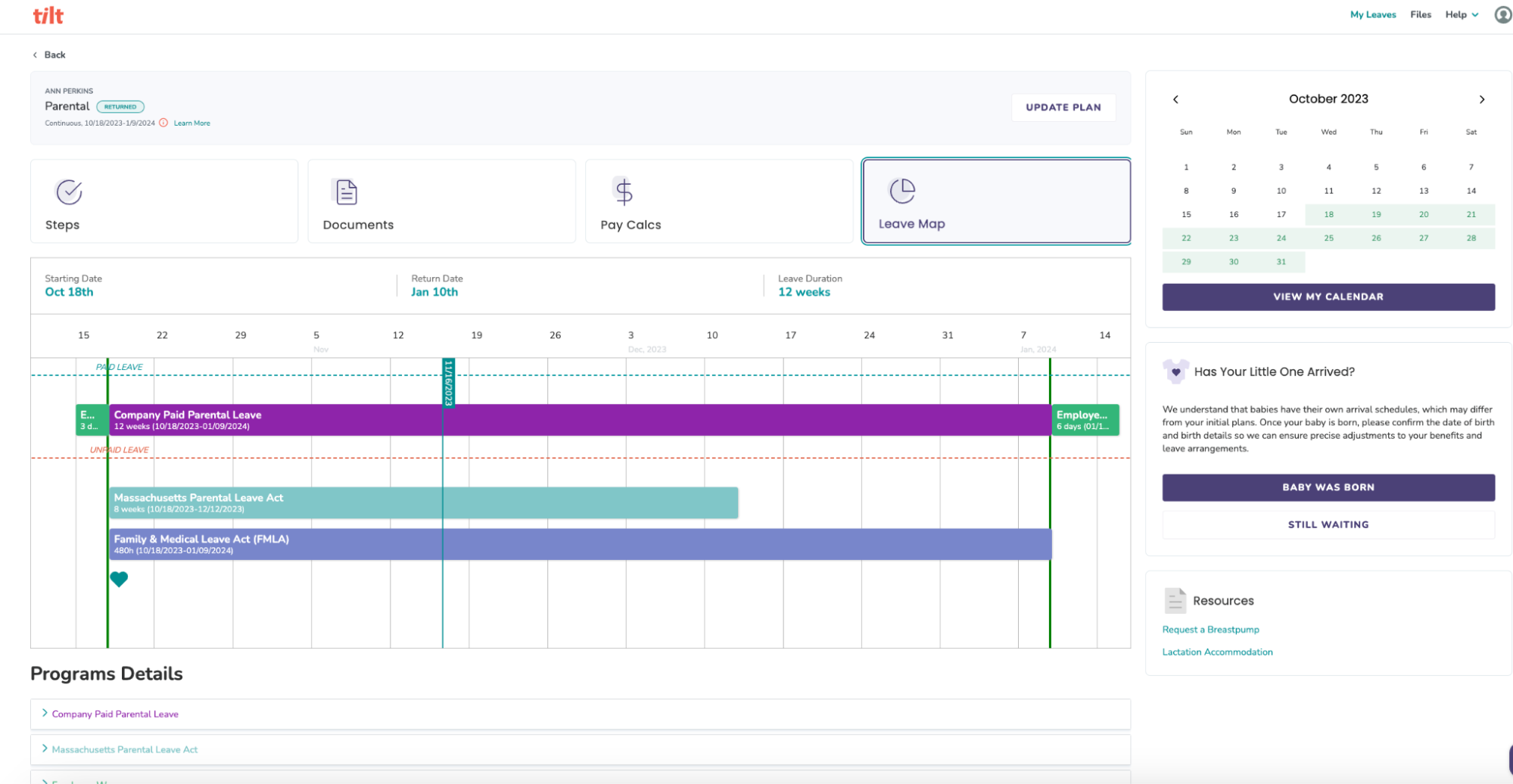
Integrated leave maps show all concurring employee benefits

With Tilt, an employee returns from a leave and recognizes immediately that their team has had the insights necessary to be properly staffed in their absence, that their colleagues aren’t suffering from burnout or have resentment toward them, and that a plan has been put in place to ensure their successful reboarding because yes, Tilt gives managers tips on how to do exactly that.

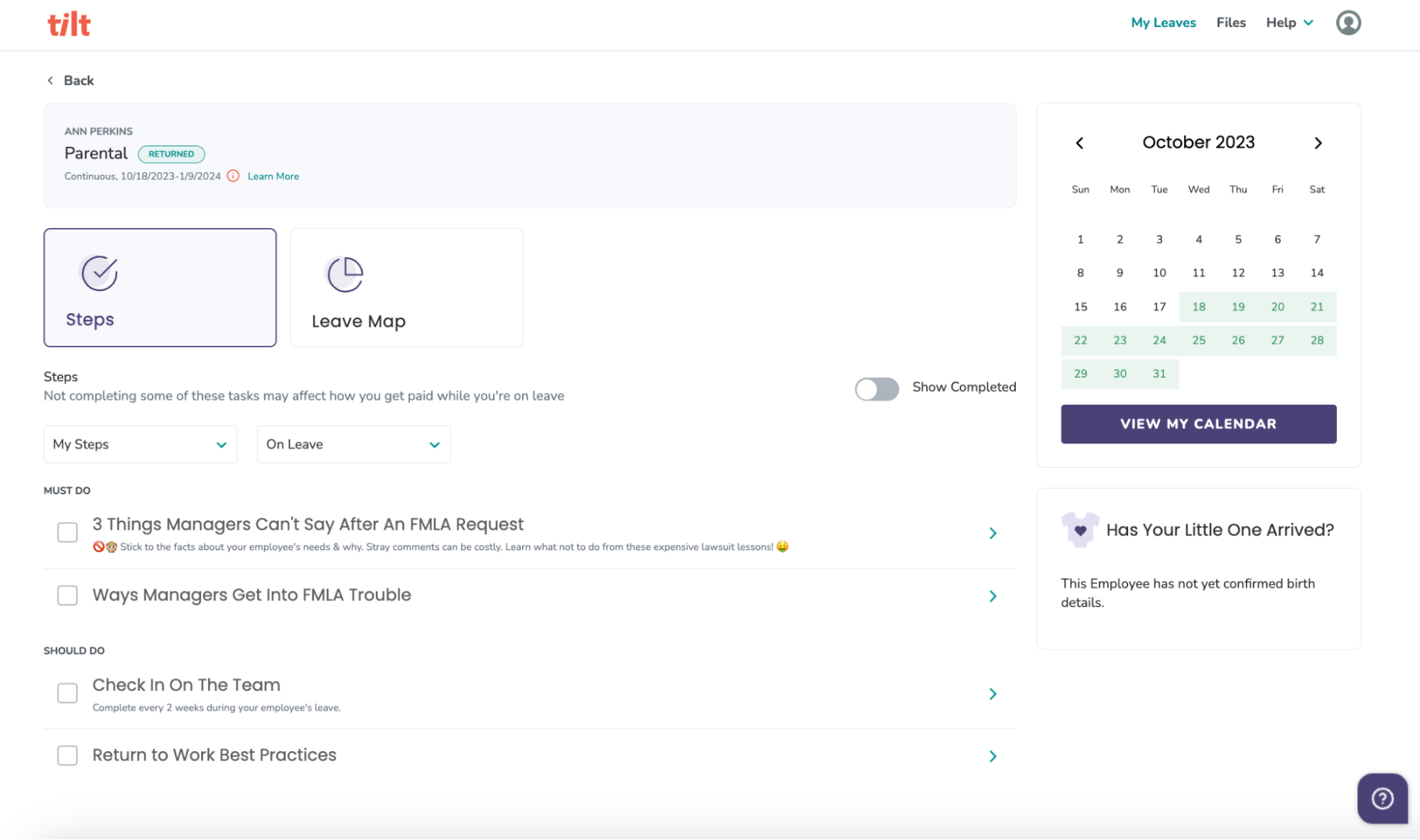
Tilt's Manager Dashboard Keeps Managers in the Know

Tilt gives People Ops holistic access to every leave within your organization, and managers are able to see every leave currently happening on their team. Further, Tilt provides details about their specific leaves, tips on what to say and what not to say (which can absolutely impact an employee’s leave experience), and yes, guidance on how to handle an employee returning to work like thanking the team who stepped up in the employee’s absence and return to work best practices.

Informed Managers: The Secret to Leave Efficacy

TIlt Recap: Tilt’s technology makes workforce planning a seamlessly transparent experience, giving people leaders and decision makers the information needed to properly workforce plan in an employee’s absence. This allows the business to power forward without burning out your remaining workforce and providing a soft spot to land for an employee’s return and be productive once again.

Tilt Elevates Employee Productivity When Returning From Leave

Planning for an employee’s return to leave can be an afterthought in the constant swirl of directions you’re being pulled in on a daily basis as a People Ops leader. Tilt’s technology gives you the foundation necessary to support your employees from request to reintegration, and elevates the employee experience in one of their most defining work moments.

You simply don’t have the bandwidth to support all employees in the way that’s necessary using traditional methods of managing a leave of absence. Those spreadsheets may have been familiar, or comforting even, but they’re holding you back from truly providing the employee experience that matters to your people.

With Tilt, your employee engagement and productivity won’t waver, transparency won’t get cloudy, and your bandwidth will be freed.

About Tilt

Tilt is leading the charge in all things leave of absence management through easy-to-use tech and human touch. Since 2017, our proprietary platform and Empathy Warriors have been helping customers make leave not suck by eliminating administrative burdens, keeping companies compliant, and providing a truly positive and supportive leave of absence experience for their people.

Related Posts

Tactics for Small HR Teams to Spark Joy in the Workplace

Nimble. Agile. Small but mighty. Flexible. Efficient. Punching above their weight. Dynamic.

These words and phrases are often used to describe small teams within an organization that are asked to do a lot with a little, or in some cases nothing at all. And while hearing descriptors like this ad nauseam might diminish their meaning over time, it doesn’t take away from the fact that if you’re a small HR Team or a team of one (we see you, fam), you’ve got a tremendous amount of responsibility and minimal bandwidth, so embodying those buzzwords will likely suit you well.

Among the many day-to-day tasks you’re charged with is maximizing overall happiness in the workplace. It’s an undertaking as critical to business success as it is ambiguous to tackle. In fact, organizations with high job satisfaction rates witness 31% more productivity and 37% higher sales.

Satisfied employees are more productive employees, So how can “small but mighty” HR teams spark joy in the workplace effectively, efficiently, and in ways that matter most to your people? Let’s dive in.

How Small HR Teams Can Drive Joy and Boost Workplace Productivity

Nurture workplace recognition: Workplace recognition can take a variety of forms, to the extent that some employees may be happier and more productive not being recognized at all and are just allowed to do what they do and not be bothered.

However, numbers don’t lie, and all signs indicate that workplace recognition has a strong correlation to employee productivity. Recent findings show that 78% of employees would be more productive if they were recognized more frequently. 

There’s a strong business case for it too. Developing a recognition program does more than just give your employees all the feels, it can help your organization better identify rising stars within your organization and help develop their careers accordingly. Similarly, it has the power to strengthen relationships across the organization, as well as up and down it. 

Since you can’t be everywhere at once, tap team leaders within your organization and have them regularly think about the following questions:

  • Were there any highlights or major accomplishments this week?
  • Did I learn something new from my team?
  • Did my team do something that went above and beyond?
  • What conversation or experience stuck with me this week?
  • How did the projects we are working on progress this week?

This approach allows you to leverage individuals within your organization who are in the know about to whom recognition should be bestowed on a frequent basis. Be thinking more weekly/monthly and less quarterly/yearly.

Enhance the leave of absence experience: Want to know what makes employees really happy? Knowing that when life’s biggest moments happen their employer makes it easy to transition from work, to real life, and back to work again.

An easy leave process signals to employees that your approach to work-life balance is more than just boilerplate lingo on a job description. Have employees return to work happier and more engaged, delivering their best work possible. 

Doing this on your own might be a tall order as leaves of absence are intricate, complex, and rife with compliance risks. If you’re running a skeleton HR crew (or a solo one), seek out modern leave software solutions to ease your burdens, improve workforce planning, reduce burnout, and cultivate a happy, supported, and productive employee population.

Be visible: We aren’t recommending you buy a bunch of reflective clothing (though you do you if that’s your vibe), but there’s no denying that HR visibility plays a pivotal role in fostering this happiness within your organization. 

When HR professionals are accessible and visible to employees, it enhances communication, trust, and transparency within your organization. As an HR and People Ops leader, you’re the embodiment of your company culture, so your visibility allows employees to feel seen and connected, which strengthens their sense of belonging. When employees feel like they belong, you guess it, they’re happier and more productive!

Another aspect of being visible that brings joy to your employees is that your visibility helps facilitate the resolution of issues promptly. Employees expect responsiveness from their employer when an issue is raised, so proactively addressing concerns as they arise contributes greatly to a positive and supportive company culture. 

Hire happy people: We all have that one friend who continues to make the same mistakes over and over and wonders why the results don’t change (if you don’t think you have a friend like that…have a seat…). Well, the same can be said for hiring patterns. While it’s not an exact science, it’s certainly not rocket science to see it takes less effort for a small HR team to keep people happy who are naturally happy than it takes to extract happiness out of curmudgeons (what a word, right?) who happen to be highly skilled in their role.

Another thing that brings employees joy is being around colleagues who are joyous. Just like we learned in high school chemistry class, “like dissolves like.” Meaning, two objects that are similar to one another are more likely to bond.

The importance of hiring happy people can’t be overstated when it comes to cultivating joy in the workplace. Day after day, year after year, work can wear down even the most dedicated of professionals. This is why it’s vital to have a workplace filled with as many happy employees as possible because when the inevitable down days arrive, it’s the joy that you’ve been cultivating within the walls that will lift your employees up when they need it most.

Why Are Happy Employees More Productive?

You know that old saying, “The beatings will continue until morale improves?” Well as fun as it is to laugh at such a paradoxical concept, a surprising number of organizations still approach workplace productivity with this mindset, albeit a much more watered-down and legal version of it.z

Employers of choice know that productivity in the modern workplace is established on a cultural foundation of joy and happiness among its employees. Here’s why:

Happy Employees Are More Motivated: Happy employees are more likely to feel a sense of purpose and satisfaction in their jobs. Having a sense of purpose is a significant driving force behind motivating employees to perform at a high level, whereas Job satisfaction leads to increased productivity as employees feel engaged and committed to their roles, driving them to excel in their objectives. 

Purpose + Satisfaction = Happy & Motivated Employees

If you ever forget that, just remember P+S=H&ME. Actually, feel free to forget that…let’s move on.

Happy Employees Contribute to a Positive Work Environment: It’s a bit reductive to say that a positive work environment contributes to employee happiness because it’s a bit of “which came first, the chicken or the egg?” Taoist philosophy would say that employee happiness and a positive work environment arise mutually. 

Wherever you see a positive work environment, you see happy employees. Wherever you see happy employees, you see a positive work environment. The two are interdependent, which is why a workplace that fosters collaboration, communication, and a supportive culture tends to grow happier employees with lower stress, high morale, and increased productivity.

Happy Employees are More Creative and Innovative: According to a recent study that links creativity to joy, more than half of adults who do creative activities describe themselves as optimistic (55 percent) and happy (53 percent). The correlation between joy and creativity in the workplace can’t be denied either, as creative employees tend to be open to new ideas, take risks, and contribute positively to problem-solving and innovating.

Happy Employees Are Committed: If you’ve been around long enough, you know how rare it is an employee to be happy in your work environment, which is why establishing a culture of joy is so critical. Happy employees are more likely to stay committed to their jobs and the organization, partially because of all the reasons listed above, but also due to the fact that they know the grass is yellower and more itchy elsewhere. 

This reduces turnover, keeps institutional knowledge in-house, and develops employees long-term who tend to be more familiar with their roles, leading to increased efficiency and productivity.

When you foster employee happiness in your organization you’re doing more than just bringing joy to the people you support. You’re cultivating a motivated, satisfied, and engaged workforce who are more likely to excel in whatever it is they’re doing on a daily basis. 

This positive environment reduces their stress, encourages creativity, and promotes effective collaboration. The resulting boost in productivity is accompanied by lower turnover rates, as happy employees are committed to their jobs and the organization. Prioritizing employee happiness not only enhances individual well-being but also contributes to a thriving workplace where innovation, teamwork, and job satisfaction collectively drive a more productive and successful workforce.

Create Joy in The Workplace and Watch Your Organization Thrive

As a People Ops pro on a small team, you’re expected to be nimble, agile, flexible, efficient, and dynamic. While that seems like an awful lot of adjectives for one human to embody, small but mighty teams can easily punch above their weight if focused on the right things and find the right solutions to make their job easier. 

Sparking joy through recognition, better leave of absence experiences, being visible, and hiring happy people can have a tremendous impact on employee joy, motivation, job satisfaction, retention, production, and overall business success.

About Tilt

Tilt is leading the charge in all things leave of absence management through easy-to-use tech and human touch. Since 2017, our proprietary platform and Empathy Warriors have been helping customers make leave not suck by eliminating administrative burdens, keeping companies compliant, and providing a truly positive and supportive leave of absence experience for their people.

Related Posts

Remove Blindspots in Your LOA Process To Improve Workforce Planning

It’s no secret that strategic workforce planning contributes directly to the long-term sustainability of your organization. By effectively and efficiently aligning your workforce capabilities with strategic goals your organization is empowered to foster a culture of continuous improvement and ensure the availability of the right talent when needed.

Another worst-kept secret is how difficult it is to actually workforce plan, and how the way many organizations try to accomplish it puts you at a disadvantage for success. Of course, if your workforce was predictable day in and day out, or year in and year out, workforce planning wouldn’t be the arduous task it is for most HR and People Ops teams.

As strategic workforce planning experts Eq8 points out, the lack of consistency is the primary roadblock to a successful workforce planning strategy. Only 52% of companies take an enterprise-wide approach, while 32% of companies only follow the strategy in some business units, and 8% of companies leave it up to individual business units. Furthermore, companies face challenges such as a lack of tools and technology.

On the People Ops pantheon of inconsistent processes that impact workforce planning is leave of absence management. Siloed systems, manual spreadsheet tracking, and a lack of collaboration with you, the employees you support, and their managers, lead to process inconsistencies and glaring blind spots in your ability to workforce plan effectively.

How Your LOA Process Impacts Workforce Planning

To reach the full potential of strategic workforce planning, Eq8 believes companies must move beyond headcount and incorporate a skills gap analysis, scenario planning, dynamic scenarios, and deeper comprehension of the employees’ skills.

Let’s focus on two of those items listed above; scenario planning and dynamic scenarios. Leaves of absence introduce workforce gaps that sometimes can, and sometimes can’t be planned for. And as Tilt’s COO Kait Feeney puts it, when it comes to leave of absence, plan when you can for the expected and the unexpected.

One leave of absence might be for a parental leave giving you plenty of time to workforce plan for the productivity gap. The next day you might have a caregiver leave request come across your inbox where there isn’t time to plan. The day after that, an employee might request a disability leave for an accident they suffered.

Leave scenarios are varied and thus unpredictable, but they’re also dynamic throughout the leave journey. For example, a caregiver leave may turn into a bereavement leave, or a parental leave starts earlier (or later) than anticipated, or an employee moves states mid-leave.

All of these scenarios (and there are countless instances where leave details change mid-leave) have a direct impact on your organization’s ability to fill in the gaps, keep employee burnout minimized, and deliver on promises to your clients.

Further, you’re charged with trying to administer leaves consistently to all employees, no matter the leave type, and no matter if the leave plan changes mid-course. Because of this, the traditional way of administering leaves of absence makes these scenarios a nightmare when it comes to workforce planning.

Legacy systems and processes simply lack visibility into the valuable insights needed to do workforce planning successfully. Either your leaves are being handled by an insurance carrier where important leave information stays siloed, an insufficient software that doesn’t remove any planning blindspots, or is done manually in-house where leave information is strewn across multiple files, folders, spreadsheets, and internal systems.

The consistency issues and clunkiness you experience relying on legacy systems for leave management creates a disconnect between People Ops, managers, and employees, and makes it nearly impossible to accurately and effectively manage workforce gaps caused by LOAs.

How Dedicated Leave Software Removes Blindposts to Improve Workforce Planning

Just like leaves of absence and snowflakes, no two leave-of-absence software are the same, so it’s important to make sure you choose software that provides a consistent leave experience to employees while delivering transparency to key stakeholders tasked with keeping operations running smoothly.

The right dedicated leave software brings transparency into the leave of absence experience by removing data silos, syncing with your HRIS for real-time information, automating updates to leaves as they happen, should provide a crystal-clear window into all leave details.

This way People Ops and managers trying to navigate leave gaps have the most accurate, on-demand information on when their workforce will ebb and flow due to LOAs.

More granularly, an effective leave management software should provide a consistent and automated approach to your LOA process by providing:

Accurate Tracking and Reporting: Leave management software allows you to toss the manual spreadsheets in lieu of accurate, efficient, and automated tracking under one safe and secure digital roof. This data can be used for generating comprehensive reports on workforce availability during specific periods.

Real-time Visibility: By providing real-time information on upcoming leaves, dedicated software helps organizations anticipate and plan for potential gaps in workforce availability. This visibility allows better decision-making when assigning tasks or projects.

Integration with your HRIS: Integration with your HRIS means that leave software will ensure that data related to all leaves are synchronized across the organization. This integration minimizes the risk of discrepancies and enhances the accuracy of workforce planning.

Automation of Processes: As alluded to earlier, the automation of your leave administration processes reduces your administrative burden and ensures consistency in the application and approval of your leaves. This efficiency allows your team to focus on strategic workforce planning (or literally anything else you’d rather do than manage leaves manually).

Capacity Planning: By understanding the expected workforce capacity during leave periods whether they’re long or short, planned or unplanned, organizations have the information needed to make informed decisions about hiring temporary staff, redistributing tasks among existing employees, or adjusting project timelines.

Employee Engagement and Retention: Providing a transparent and supportive process for your employee leaves of absence has a strong effect on employee satisfaction and retention. High retention rates positively impact workforce stability and reduce the need for extensive workforce planning to address turnover. Conversely, low retention rates due to poor leave experiences would have the opposite effect on workforce planning.

Communication and Collaboration: Modern leave management software should also make communication easy, facilitating collaboration between your team, employees, and managers. Clear communication helps in managing expectations and ensures a smooth transition during leaves of absence.

Remove Workforce Planning Blind Spots With Modern LOA Software

Bringing transparency and collaboration into your LOA process requires a modern technological solution that not only supports you and your employees by making leave of absence easy but provides a single source of leave-data truth that can empower your organization to handle the uncertain seas of leave gaps with the insights needed to workforce plan effectively.

The removal of these blindspots reduces the likelihood of overworking employees trying to cover for their colleagues on leave and allows leadership to strategically workforce plan at scale no matter how many leave requests may pop up, or how many times the leave may change mid-journey.

About Tilt

Tilt is leading the charge in all things leave of absence management through easy-to-use tech and human touch. Since 2017, our proprietary platform and Empathy Warriors have been helping customers make leave not suck by eliminating administrative burdens, keeping companies compliant, and providing a truly positive and supportive leave of absence experience for their people.

Related Posts

Optimize Workforce Planning Through Modern Leave Management Software

Workforce optimization (WFO) can sometimes feel a bit like Whac-a-Mole. Solving for one efficiency gap only to have another one poke its head up where you least expect it. While smashing objects with a mallet might seem like a cathartic solution to any problem, that behavior is typically frowned upon in an office environment and is rarely effective at improving WFO. 

The more realistic way to achieve WFO requires a more intricate approach. One that involves employing a variety of strategies and practices with the aim of improving both employee and organizational efficiency while reducing operational costs through the effective use of data.

The Academy to Innovate HR talks about WFO this way:

The objective is to streamline the processes between every department and employee to maximize results. For example, in Formula One (F1), all teams have pretty much the same setup and cars. The teams that usually come on top are the ones that are able to optimize all the teams, cars, drivers, mechanics, engineers, and departments to win.

When one element of an F1 team isn’t firing on all cylinders (pun intended) it can slow down the entire operation, and in some instances can cause the mission to crash and burn.

HR and People Ops teams play a pivotal role in an organization’s ability to workforce plan and optimize output, and just like in F1, if you’re trying to succeed but have blindspots in your process you’re fighting for second place. And in the words of racing icon Ricky Bobby, “If you ain’t first, you’re last.”  

How Leaves of Absence Cause Workforce Planning Blind Spots

Traditional methods for managing leaves of absence involve manual, non-scalable processes that make the accurate tracking of your leaves cumbersome and clunky. And while we could (and have) wax poetic ad infinitum on how modern leave management software like Tilt can optimize your personal workflow, when it comes to optimizing your organization’s workforce, a lack of automation and transparency in your leave management process puts your leaders behind the wheel of a car with mud on the windshield.

HR teams managing leaves without a comprehensive platform that puts all impacted parties on the same page leads directly to leave data disconnects in your process.

Without real-time updates to things like leave start and stop dates (because those can shift like the wind blows) and education around leave benefits, it becomes nearly impossible for managers to effectively and efficiently plan for gaps in their workforce. This can lead to employee burnout trying to pick up the slack, missed deadlines, and unsatisfied clients.

How Modern Leave Management Software Improves Workforce Optimization

Modern leave management software like Tilt removes workforce planning blindspots so that your organization can take every twist and turn caused by a leave of absence at the apex.

Optimizing your workforce planning to handle the unpredictable nature of leave (i.e. when they occur, the type of leave, and the duration) requires sophisticated software that automates your tracking and provides the level of transparency required to plan your WFO effectively. 

Tilt’s HR dashboard is your data center for all things leave at your organization.

You have complete access into real-time data for all leaves occurring within your organization at any given time. You can dive into any particular leave as well to get more specific information for an individual leave.

Say goodbye to the blindspots manually updating spreadsheets used to cause for good:

Managers also get a dashboard in Tilt that provides real-time information on their employees’ leave of absence throughout the entirety of their leave journey.

From educating them on the benefits that apply to the leave to providing the most up-to-date details on leave dates, this dashboard gives them the accurate information needed to make informed workforce planning decisions to meet their business objectives.

Tilt gives you and your employee population the ability to navigate leave gaps with ease and optimize your workforce planning efforts by increasing visibility and accuracy into every leave. With every team member on the same page, you’ll be in pole position before the race even gets started.

Benefits of Tilt’s Workforce Planning Insights

Trying to leverage your legacy systems and processes for your leave of absence management solution can have a negative impact on your business operations for myriad reasons.

When it comes to optimizing your workforce in the wake of a leave of absence (or 5), your organization is driving blind if you don’t have a modern solution to maximize the output of your employee population.

With Tilt, you can reap the benefits of automation and clarity with simple-to-use software that boosts your organizational output with ease. 

Increased efficiency and productivity – With Tilt, you’re able to have a comprehensive, real-time snapshot of employee gaps and leave statuses. This gives your org the power to manage customer demands effectively and gives you the insight needed to determine if there’s a need to cross-train existing employees or to hire temporary staff.

A more efficient workforce is a more productive and happy workforce. 

Lower costs and increased savings – When your employees request leaves, Tilt helps you avoid understaffing (and overstaffing) where you may lose business on bad customer service or fail to complete deliverables.

Having the appropriate amount of staff to meet your business goals reduces burnout, increases employee satisfaction, and boosts your retention rates to avoid costs associated with replacing employees.

New opportunities – Not only does Tilt free up time and lower your operational costs, but it also creates opportunities for cross-training existing employees. With transparency into workforce planning, you and the other leaders in your organization can leverage leave data from Tilt to create internal career movement as new opportunities appear with gaps. 

Introducing Tilt’s leave software into your leave management process gives you the level of automation and transparency that provides real-time guidance and actionable insights for your organization’s WFO goals. 

A better leave management solution is a better workforce management solution. See how Tilt can make your leave experience a positive one, your employee’s leave experience a supported one, and your workforce planning an optimized one.

About Tilt

Tilt is leading the charge in all things leave of absence management through easy-to-use tech and human touch. Since 2017, our proprietary platform and Empathy Warriors have been helping customers make leave not suck by eliminating administrative burdens, keeping companies compliant, and providing a truly positive and supportive leave of absence experience for their people.

Related Posts

Join us February 20th, 2025 at 11AM MST – Tilt Live Demo | Register Now>>