Navigating Leave Gaps: HR Strategies to Alleviate Employee Burnout

You can put down your compass and there’s no sense in having Google Maps try to guide you, because when it comes to optimizing workforce planning in the wake of employee leaves of absence, minimizing employee burnout requires a special kind of navigation.

So what is employee burnout exactly? And why is it more important than ever that employers take its impact on employee wellbeing and operational effectiveness seriously? “Burnout” is a term that can mean a lot of different things to a lot of different people, for some so let’s just take the medical definition and go from there:

“Burnout is a psychological syndrome emerging as a prolonged response to chronic interpersonal stressors on the job. The three key dimensions of this response are an overwhelming exhaustion, feelings of cynicism and detachment from the job, and a sense of ineffectiveness and lack of accomplishment.

The significance of this three‐dimensional model is that it clearly places the individual stress experience within a social context and involves the person’s conception of both self and others.”

In other words, if your employees have been engaged to the max for a prolonged period of time without organizational support, and they don’t have the individual skills to manage that stress, burnout becomes an eventuality, not a potentiality. 

Therefore it shouldn’t be surprising that 40% of employees cite burnout as a reason to leave an employer, but the common approaches to minimizing employee burnout tend to focus on the individual, their work-life balance, and making self-help stress mitigation accessible.

While holding walking meetings may be beneficial in the short term, strategies that focus on the symptom and not the root cause are akin to sitting in a leaking boat and trying to tape up the holes as new ones form.

Eventually, you’re going to sink.

The data backs this up as well, as nearly 70 percent of professionals in a recent Deloitte survey stated that they feel their employers are not doing enough to prevent or alleviate burnout within their organization. 21 percent of respondents say their company does not offer any programs or initiatives to prevent or alleviate burnout.

So how does your employee leave of absence process affect your organization’s susceptibility to burnout? How can a more modern approach to leave of absence management help solidify the foundational support your organization provides?

Is Your Leave of Absence Process Leading to Employee Burnout?

It may be intuitive to assume that having robust leave-of-absence policies would lead to a reduction in employee burnout, not an increase. And to be crystal clear, you should absolutely fight tooth and nail to provide the most robust leave policies to your people, but an employee leave of absence is unlike most employee benefits in that the ripple effect of an employee taking leave extends beyond the employee taking leave and you in People Ops trying your best to administer it.

The single leave of absence, say for a disability, parental, or bereavement leave, creates a gap in workforce productivity in that employee’s wake. Where there’s a gap in productivity,\ due to an employee taking leave, that employee’s manager and the colleagues who remain are often left filling in that gap. 

If you’re manually administering leaves of absence today, or you’re currently using a hodgepodge of systems and spreadsheets for tracking and administering your leaves, your organization is likely stuck trying to navigate a needed shift in workforce planning without the necessary visibility to do so.

When you and an employee’s manager don’t have the same visibility into their leave of absence (which can have details like start and end dates change at a moment’s notice), you run the risk of workforce planning blind.

The ramifications of workforce planning without proper visibility range from becoming susceptible to overburdening the employees left to pick up the slack of the employee on leave, and to hurting the bottom line by not delivering on promises to clients.

“Leave coverage is extremely important,” says Tilt COO Kait Keeney, “because the employee needs to focus on what matters most, while others in their work orbit need to continue the essential work of the business. The only way to ensure things don’t go totally sideways is a solid leave plan and process.”

The policies you have in place to support your employees who need to take time away from work when life happens hardest are one very important part of the employee burnout equation, but if your organization isn’t in a position to effectively navigate workforce gaps when a leave pop up, your organization is still at risk of inducing employee burnout to the others.

Leave of Absence Strategies to Alleviate Burnout

It might seem reductive to put it this way, but one of the most effective ways to bring visibility into your workforce planning, and to reduce the potential for burnout when a leave is requested, is to remove the blindspots you have.

Cool, so…like how do you do that?

Well, the truth is that the traditional way of managing leaves of absence makes workforce coverage a casualty of capacity. If you had the time to accurately and regularly update employee leave data in your spreadsheets, and if you could streamline communications compliantly (friendly reminder that managers are NOT leave experts and can communicate their way into fines for your organization) to ensure that you, the employee and the manager were always in the know, then you could make a valiant attempt to provide the visibility necessary to workforce plan, mitigate burnout, and keep your organizational objectives on track.

Doing that well for a single leave of absence is a daunting task, and as we all know, leaves of absence are unpredictable in their nature and occurrence. You might have to workforce plan for the gap created by one leave of absence today, and three tomorrow.

Dedicated Leave Management Software: An effective way to remove workforce planning blindspots and create visibility into your leave of absence process is with dedicated leave management software.

The right dedicated leave management software does more than alleviate your administrative burdens so you can focus on other elements of the job you enjoy. It also can create a connective synergy between People Ops, the employee, and the employee’s manager, giving everyone real-time information on a given leave so that workforce planning can be implemented with confidence and efficiency.

A proper dedicated leave management software automates leave tracking in real-time for better visibility into your organization’s workforce needs. It also can remove data inconsistencies due to manual data entry, and consolidate any siloed systems into one source of truth that your organization can work from to workforce plan, keep burnout low, and continue delivering to your clients without disruption.

Hire Temporary Workers: Just like leaves of absence, no two organizations are alike. As such, it might not be so easy for you to shift workers around or cross-train employees to cover gaps. That’s where temporary workers might be your ally in covering workforce gaps due to leaves of absence.

“If you want to have a successful leave experience using temporary or part-time workers can work really well,” says Kait. “It’s a great way to build a pipeline of future FTEs and support the employee on leave, and also avoid the teammate gripes or resentment that may brew if others feel they’ve just inherited a whole bunch of work without any support.” 

If you are in a position to cross-train employees, it can be a growth opportunity for others to gain new skills, see different sides of the business, and help out.

Have a Reboarding Plan: A large focus of this article has been on the burnout employees may face trying to fill in the workforce gaps due to a leave of absence, but the employee on leave can experience burnout when they return as well if the workload hasn’t been effectively dispersed in their absence.

“Having a re-onboarding plan is very important,” adds Kait, “especially for those extended leaves when someone has been out for a long time. Just like you would onboard a new hire, have a plan for welcoming employees coming back from leave. ‘ICYMI docs,’ are helpful for when employees return so that they can digest in their own time and ask questions as needed. It isn’t just this ‘hey, welcome back…’ followed by an overwhelming verbal diarrhea of all they missed while they were out.”

There’s a chance your employee has just gone through a leave journey that has changed their life both inside and outside of work forever. Being empathetic to their experience and providing a soft and supported environment for them to land after a leave of absence can do wonders to mitigate a sometimes whiplash-like experience of being thrown back into the fire.

Your Leave of Absence Approach is Foundational to Employee Support

Whether you cross-train employees or leverage temporary/part-time workers to fill in workforce gaps due to a leave of absence, effectively managing your leaves of absence using modern technology creates the visibility required to effectively and efficiently move the necessary pieces in place so that employee workloads aren’t overflowing and managers are able to deliver on their organizational goals.

Operational inefficiencies due to a lack of visibility into leave of absence details can overstress your workforce, leading to a boost in burnout levels and ultimately a potential retention reckoning.

Invest in the right tools to make the seamless navigating of leave gaps a foundational part of your employee support process, cross-train and be prepared to hire temporary employees if necessary, and be mindful of employees returning from leave and their susceptibility to burnout.

About Tilt

Tilt is leading the charge in all things leave of absence management through easy-to-use tech and human touch. Since 2017, our proprietary platform and Empathy Warriors have been helping customers make leave not suck by eliminating administrative burdens, keeping companies compliant, and providing a truly positive and supportive leave of absence experience for their people.


Related Posts

How Sauce Labs Leveled Up Their Leave With Tilt

A Fully Scalable Leave Management Solution

Sauce Labs is a testing platform and solution that allows its customers to deliver seamless experiences for every device, browser, and operating system. And that commitment to providing seamless experiences is just as important internally, especially for Saucers that are navigating major moments in life that may need them to take a step back from the business. 

With that commitment in mind, Chelsea Leppo took stock of Sauce Labs’ existing leave of absence management solution and realized there was an opportunity to enrich the experience being provided to Saucers. Sauce was allocating a chunk of their People Team budget for a solution that wasn’t able to scale with their business, nor provide the service level their employees needed. Chelsea sought out a solution where their leaves could be administered easily and with consistency, and perhaps most importantly, she needed Sauce employees to get top-tier support when working through a major life event.

“Our previous solution was not able to scale with our business, especially as our location and employee needs became more complex as we’ve grown. We now feel so comfortable with Tilt managing our leaves and have a great relationship with our Customer Success Manager (CSM) and Leave Success Manager (LSM), Taylor and Sabrina. We know when we reach out to Tilt, they have it covered, and follow through for us as Admins and for our employees. We now can place more energy and focus into other areas of the business, thanks to all the time saved by Tilt."

Modern Leave Management Customer Support

Speaking of Taylor and Sabrina, Chelsea knew that nailing the x’s and o’s of managing leaves with an empathetic touch was critical for managing leaves successfully, but the relationship with her dedicated Tilters has made a huge impact in making Sauce’s LOA experience a seamless one.

“I love that whatever I bring to (my Customer Success Manager) Taylor to adjust, like adding a new step to the employee checklist, or if we’re introducing a new step in our process, it gets taken care of. Everything we’ve brought to Taylor to assist with is handled with ease. I appreciate that Taylor proactively engages with our team.

Tilt's Emphatic Approach to the Employee Experience

Sauce Labs’ dedicated Leave Success Manager, Sabrina, has been a complete game changer as well.

“I just have to give major kudos to Sabrina. The level of support Sabrina has provided to our employees has been amazing. I appreciate her customer focus, especially in her quick responses; both to me and our Saucers Sabrina has completely exceeded expectations!"

Sauce Labs wasn’t only looking for a strong bond with their vendor and a solution that took the burden of managing leaves off their plate. Sauce wanted to deliver a leave solution to their employee population with a modern look and feel that aligned with a cutting-edge tech company like Sauce Labs.

“Being in the tech industry, our employees expect the tools and platforms we use to be top notch, especially when we are committed to supporting our customers with delivering seamless experiences for their customers! Our previous solution didn’t align to our employee expectations, and as a growing business, we needed a solution to offer more efficiency, better reporting, and generally more of an updated and intuitive feel to the platform for both Admins and employees.”

More Time To Focus on What Matters

Now that Chelsea’s not worrying about leaves, she can focus on the parts of her job that really light her fire. She loves the front-facing aspects of being a People Ops pro like ensuring new hires get the red-carpet treatment at Sauce Labs out of the gate, and being a trusted internal contact to help with their inquiries. She knows a thing or two about what it’s like to have a successful partnership from the jump.

“My experience implementing Tilt was great. From the get go, I felt very happy with the level of support I was receiving. I had full confidence that everything was going smoothly from end to end. It was the combination of everything really. The people, the platform, the pricing (we were paying double for our previous vendor). I’ve been able to build a really good relationship with the Tilt team and appreciate everything they do to support me, our people and our process.

Now that Chelsea has Tilt, she knows her people are getting the best leave experience. We love that Sauce Labs has leveled up their leave with us, and knowing that we make Chelsea’s life easier while decreasing her budget spend is the special sauce we can’t get enough of.

Our confidence is sky high that we don’t have to worry about the leave process at all because we know Tilt is handling it.

About Tilt

Tilt is leading the charge in all things leave of absence management through easy-to-use tech and human touch. Since 2017, our proprietary platform and Empathy Warriors have been helping customers make leave not suck by eliminating administrative burdens, keeping companies compliant, and providing a truly positive and supportive leave of absence experience for their people.

Related Posts

7 Tips to Successfully Reintegrate Employees After A Leave

Updated on October 27, 2025

The Deep End Test: Do Your Employees Feel Supported When They Return?

You’ve walked an employee through a major life event—a new baby, a serious illness, or a complex family matter. You delivered every ounce of administrative support to get them out the door compliantly. Now, they’re back. And if their first week feels like being thrown into the deep end without a lifeline, every bit of goodwill you built evaporates.

The employee’s return is your final, most sensitive touchpoint. It’s the moment that determines if your leave management process truly built trust or just managed forms. A successful return requires more than a desk cleanup; it requires a structured, supportive plan. Here are seven ways to guarantee your returning employees feel valued, integrated, and ready to succeed.

1. Communicate Openly and Simply

Transparent communication is the cornerstone of a successful return. Your goal is to eliminate uncertainty and build trust immediately by:

  • Regularly communicating updates, changes, and expectations that occurred during their absence.
  • Actively listening to their concerns and providing a platform for them to express challenges.
  • Establishing clear channels for communication, such as one-on-one meetings.

This demonstrates your willingness to address uncertainties, facilitating a smoother transition back into their work routine. By maintaining candid communication, you create a positive and supportive foundation for reintegration.

2. Prepare a Structured Welcome Back Plan

Returning employees may feel a mix of emotions: anxiety about catching up, nervousness about being out of the loop, or simply overwhelmed.

Help ground your employee’s experience by providing a structured roadmap. This roadmap should:

  • Outline steps and expectations for the employee and their team.
  • Guide managers on implementing a gradual increase in workload for a comfortable readjustment.
  • Incorporate training sessions for new processes, tools, or major changes.

A well-prepared plan demonstrates commitment to the employee’s success and helps them feel more in control of their return to work.

3. Assign a Point of Contact

Since HR cannot have intimate knowledge of every team’s daily flow, generously assign a dedicated point of contact or mentor to help the employee. This designated individual serves as a go-to resource, offering supportive guidance throughout the return-to-work process. Ensure this point of contact is well-versed in your company procedures, culture, and any recent updates.

Empowering a well-informed internal advocate establishes a support system that contributes to the returning employee’s engagement.

4. Reintroduce Employees to the Team

Reintegration through reintroduction is one of the easiest ways to help an employee feel valued and reaffirm their sense of belonging. Teams can implement this by

  • Organizing a casual reintroduction meeting or team-building activity.
  • Working with their manager to create an event that helps the employee reconnect with colleagues and reestablish camaraderie.
  • Providing an opportunity for the returning employee to share their experiences (if they’re comfortable doing so) and goals.

This intentional effort to reintegrate the employee strengthens relationships and contributes to engagement and motivation.

5. Offer Flexible Post-Leave Return-to-Work Arrangements

An employee’s needs when returning to work can vary widely based on the type and duration of their leave of absence. Honor those diverse needs by providing flexible arrangements upon their return like:

  • Adjusted work hours for a period.
  • The ability to work remotely, if the role allows.

Accommodating potential challenges demonstrates you value both the personal and professional aspects of your employees’ lives. Your willingness to be supportive in this area helps establish a positive workplace culture.

6. Collect Feedback From Returning Employees

The smartest way to improve any HR process is to listen to the source. Gain insights by regularly checking in with employees to gather feedback on their reintegration experience. This is a must for continuous improvement.

Establish a continuous feedback loop that is a two-way street. Be prepared for adjustments based on the feedback, which may range from modifying workload to potential changes in policies themselves.

A collaborative, iterative process ensures that your employee’s evolving needs are considered, contributing to a more seamless and tailored reintegration.

7. Promote Employee Assistance Programs (EAPs)

Employee Assistance Programs (EAPs) are invaluable resources for addressing personal and emotional aspects of life, which is crucial during reintegration after a leave of absence.

Clearly communicate the availability of your EAPs, as many employees are unaware they exist. Seek opportunities to expand your EAP offerings where necessary, such as:

  • Counseling for postpartum depression.
  • Mental health support for employees returning from a mental health leave.

By promoting the use of your EAPs, you demonstrate your organization’s commitment to the holistic well-being of your employees as they reintegrate into the workforce and beyond.

Support Your Leaves of Absence Through The Final Step

A leave of absence is only successful when your employee not only returns to work but does so in a way where they feel truly supported, included, and re-engaged in their role. By implementing these tips into your reintegration process, your team can better equip those in need and ensure the supportive work culture you are building.

Ready to put these practices into use? Meet with a member of our team today to see how Tilt can be your HR team’s greatest ally.

About Tilt

Tilt is leading the charge in all things leave of absence management through easy-to-use tech and human touch. Since 2017, our proprietary platform and Empathy Warriors have been helping customers make leave not suck by eliminating administrative burdens, keeping companies compliant, and providing a truly positive and supportive leave of absence experience for their people.

Related Posts

The Leave Journey Made Easy: Choosing the Right LOA Software for End-to-End Support

Theoretically, the simple promise of technology is to meet a human need or solve a human problem. Of course, as many of us experience daily, when the theory of technology’s promise gets put into practice results may vary wildly. In some instances, technology can be found to be the source of both human needs and problems.

While the intended and unintended ripple effects of technology on the world are well beyond the scope of this humble blog, there is something to be gleaned from approaching technology with a healthy understanding that choosing the wrong technology to meet your human need or solve your human problem can have adverse consequences.

To put this in more practical terms, how many of us have used software at work that promised to solve a specific operational pain point only for it to not deliver on its promise and in some cases make things worse? 

If you raised your hand on that question, we feel you (but we can’t see you so you can put your hand down now).

As Leave of Absence experts Tilt knows just how important it is to get leave of absence management right, and how having the wrong technology at your disposal to try to meet the needs of you and your people puts you at a tremendous disadvantage to be successful in this quest.

As Tilt’s COO Kait Feeney puts it, “You can’t rely on ‘Leave it to Beaver’ solutions when we’re living in a ‘Modern Family’ world.

How to Choose the Right Leave of Absence Software

Based on the very broad definition stated at the top, the right leave of absence software should meet a human need or solve a human problem, right? Well in the case of leave management software, it should really do both.

It should solve the human need for an automated, compliant, and holistic approach to LOA administration for HR, and solve the human problem of employees enduring poor leave experiences when life’s biggest moments happen.

LOA Software that doesn’t fully address these needs leaves HR and People Ops teams in the uncomfortable position of relying on technology that isn’t delivering on its promise, and in some cases making an already tricky situation worse.

Tilt solves your biggest administrative headache by delivering a seamless LOA experience to your employees while automating and tracking the entire journey end-to-end. The human aspect of a leave of absence is a hard enough experience, it’s time a solution came along that actually delivered on its promise to make leaves not suck.

What Does End-to-End LOA Support Look Like?

Tilt’s approach to end-to-end LOA support means from the moment an employee requests a leave of absence to the time they’ve been successfully reintegrated back into the fold, your employees are guided empathetically through their tricky and sometimes tumultuous leave of absence experience. 

Tilt is your solution for a consistently administered, compliant, and human LOA experience. Tilt removes ineffective and inefficient spreadsheets, provides 1-1 support for your people, and provides a simple-to-follow, step-by-step roadmap to a successful leave.

Comprehensive Leave Plans Personalized For Every Leave

Tilt’s end-to-end support for employees starts when a leave request is entered into Tilt. Our platform pulls in information directly from your HRIS to build your employees’ personalized leave plans so all you have to do when a request comes in is kick back and relax. 

As Chelsea Leppo, HR Generalist at Sauce Labs puts it, “Our confidence is sky high that we don’t have to worry about the leave process at all because we know Tilt is handling it.

Your employees can be confident too, because while our software spells out every step they need to take along their LOA path, our Leave Success Managers are at the ready to support them should they have any need (we’ll even get on the phone with your carrier or state departments to clear a potential roadblock) and send reminders for upcoming deadlines.

I just have to give major kudos to Sabrina (LSM),” says Chelsea.The level of support Sabrina has provided to our employees has been amazing. I appreciate her customer focus, especially in her quick responses; both to me and our Saucers Sabrina has completely exceeded expectations!

While our software and Empathy Warriors (a lil’ nickname for our LSMs) cover the various and evolving needs of your employees throughout a leave journey, you have needs too. From FMLA tracking to secure file storage to payroll, Tilt’s technology automates your LOA management process end-to-end while giving you a window into all aspects of every leave so you have one platform to go to for all leave information in real time.

HR Dashboard For Complete Visibility

Within the HR dashboard, you’ll have access to all elements of each leave within your organization (and yes, the data is exportable) so you can see payroll details, file upload status, and check the progress of your employees as they continue through the steps of their leave plan.

All you have to do to access all this information is…well…nothing. By pulling in the latest data from your HRIS and responding in real time to any mid-leave adjustments that may occur, our software keeps you in the know while freeing up your precious time to focus on literally anything else. 

Tilt also keeps your employees’ managers in the loop as well, giving them their own dashboard that educates them on the details of their direct report’s leave of absence and provides tips on what they can and can’t say to employees, as well as guidance for a smooth reintegration back to the team.

No More Manager-Induced Maydays

True end-to-end support can’t be achieved if managers are left out of the process entirely. Tilt knows managers are two things:

  1. Managers are busy
  2. Managers are not leave of absence experts. 

With our manager dashboard, Tilt makes it easy for managers to stay updated on the status of their direct report’s leave of absence. With this level of visibility, managers have the information needed to shift their workforce planning as necessary, maximizing their departmental output and reducing the potential for burnout.

It also helps ensure that when an employee returns from a leave of absence, they’re provided a soft landing with a plan for reintegration success. That’s true end-to-end support.

Can Leave of Absence Software Keep Me Compliant?

The right software can. The wrong software could seemingly be making your life easy, only to expose your organization to potentially costly risks.

Tilt’s approach to keeping you compliant goes beyond the accurate tracking and storage of leave data. Our in-house team of leave law experts ensures that you and your employees are always in a position to act in accordance with the latest laws and regulations. 

No matter the leave type and no matter the state, Tilt has you covered for all leave of absence potentialities. 

Tilt also factors in the scaling of your leave requests. For example, if your solution promises to submit paperwork for state benefits on behalf of your employees, for example, you’re removing the employee from the equation and run the risk of duplicate submissions, clerical errors, and relying on human bandwidth outside of your organization to submit vital (and sensitive) paperwork.

In other words, if your leave requests spike, or rise over time, if you’re relying on a 3rd party to file paperwork on behalf of your people, you’re relying on a manual process and losing visibility into that process.

Tilt empowers your people to submit paperwork by walking them through everything they need to do not only because it’s the most compliant approach to leave administration, but also because it reduces the risk of delays at the hands of humans outside of your organization, eliminates glaring process blind spots, and scales as easily as your leaves do.

Tilt Makes The Leave Journey Easy

Tilt’s technology quite simply delivers on its promise to create an easy LOA management experience for HR and a supported LOA journey for your people. Through automation and humanization, Tilt provides end-to-end leave support in a way that actually meets you human needs and solves your human problems.

No more relying on tech that causes more issues than it resolves. No more manual processes clunking up your workflow and exposing you to risk.

With Tilt’s Leave of Absence software, you can bring your leave management dreams to reality. No more administrative nightmares, no more payroll overpayments, no more missed deadlines, no more poor leave experiences.

Get Tilt and give leave some love.

About Tilt

Tilt is leading the charge in all things leave of absence management through easy-to-use tech and human touch. Since 2017, our proprietary platform and Empathy Warriors have been helping customers make leave not suck by eliminating administrative burdens, keeping companies compliant, and providing a truly positive and supportive leave of absence experience for their people.

Related Posts

What Your LOA Process is Signaling to New-Parent Employees

Hey, what’s your sign…that your employees aren’t getting the support they need when they need to take a parental leave (or any leave of absence for that matter)? 

Is it the not-so-subtle frustration they’re experiencing when trying to figure out what they have to do and by when? Are you picking up on their confusion and uncertainty around payroll? Are you fielding complaints because their manager isn’t respecting their rights as required by law? Are you finding it nearly impossible to provide a consistent experience for all new-parent employees?

If you’re managing leaves manually you’re likely relying on a process framework composed of spreadsheets, insurance carrier 1-800 numbers, analog-era state department systems, and rogue email threads and document storage. 

The old way of administering leaves is signaling to your employees that despite your best efforts and intentions, the tools at your disposal are limiting the support you can provide them in their time of need, leading to a poor leave of absence experience that can have dramatic consequences on your employee population and your operations overall.

What To Look For When Employees Aren’t Getting Proper Leave Support

The best way to determine if your process isn’t serving the interests of your employees is to identify and document the signs of a poor employee experience. Signal type and strength may vary, of course, but if your parental leave process isn’t hitting the mark and you want to implement change, you’re going to need to look for the signs.

Some signs will be blatantly obvious. 

If you’re noticing that employees aren’t returning to work after a parental leave, or they return only to be out the door the second a new opportunity arises, your process is likely signaling to your employees that their lives outside of work isn’t a priority. Most organizations today tout an emphasis on work-life balance, but providing amazing parental leave policies only to have the actual leave experience be cold and confusing is sending mixed signals to your people.

Another blatantly obvious sign is when your organization commits employment violations (most likely due to a manager misstep, more on that here) or you’re ensconced in legal battles or paying fines. The lack of a consistent, repeatable process exposes you to compliance risks and potential accusations of preferential treatment…a huge leave-of-absence no-no.  

But not all signs are so obvious. If your LOA processes are sending strong signals to employees that your capacity to support them isn’t hitting the mark, you may receive weak signals from your employee population which are just as important to pay attention to and address. Our friends at Beekast define weak signals as such:

Weak signals refer to subtle indicators that suggest physical or psychological exhaustion for employees within a company. They are unpredictable and may largely depend on an individual’s mental and physical health status.

Every parental leave is different because not only is every human different, but every new parent experience is different. From adoption to pregnancy complications, becoming a new parent can take a tremendous toll on one’s life physically and emotionally. If you’re leave process isn’t easy, comprehensive, and empathetic, be on the lookout for weak signals from employees as much as the obvious ones

Why is it important to pick up on weak signals? In the 1970s, Igor Ansoff (AKA the father of strategic management) stated that weak signals act as early warning signs that can predict a trend or an opportunity. Weak signals may be subtle to detect, but can give employers the insights needed to take proactive measures to address any issues and improve employee engagement.

Improving Your Parental Leave Administration Process

This isn’t an article to point out where HR and People Ops leaders are falling short when supporting employees needing parental leave. If anything, it’s an article that underscores how your current process isn’t putting you in a position to successfully support and administer a leave of absence, of all types, and how the signals your employees are receiving from their employer could be causing reciprocal signals of dissatisfaction you must be mindful of if you want a happy workforce (read: reduced turnover and increased workforce capability).

Step one is to evaluate your current process and identify gaps or pinch points that are causing frustrations for you and your employee population. Gaps may include payroll discrepancies or managers acting out of pocket, and pinch points may include any process that requires manual effort on the part of any stakeholder in the process.

Whether it’s a parental leave or a bereavement leave or any leave in between, the complexity and evolving nature of a single leave of absence makes siloed systems and manual processes a major impediment to a successful experience.

Dedicated leave management software can take your LOA process signals from a cry for help to a beacon of light. Simple, streamlined, and automated, dedicated leave software gives you the superpower to administer leaves consistently, empathetically and compliantly so that the only signal you’re receiving from your employees is one of gratitude and enthusiasm to return to work.

About Tilt

Tilt is leading the charge in all things leave of absence management through easy-to-use tech and human touch. Since 2017, our proprietary platform and Empathy Warriors have been helping customers make leave not suck by eliminating administrative burdens, keeping companies compliant, and providing a truly positive and supportive leave of absence experience for their people.

Related Posts

The Impact of Leave Transparency on Employee Retention

The importance of employee retention as it pertains to the success and continuity of your organization is no great secret. Preserving your people for the long haul is widely considered a vital ingredient for your stability and growth recipe.

Ambiguity arises, however, when determining the most effective approach for your organization to initiate the preservation process, and how to do so when your employees are still in love with your workplace, not when they’ve got one foot out the door.

In the competitive landscape of talent acquisition, the retention of skilled and experienced employees is essential for maintaining operational efficiency, preserving institutional knowledge, and nurturing a positive workplace culture. High turnover not only results in significant costs but also disrupts team dynamics, potentially impacting overall productivity.

While mileage may vary depending on the role being filled and your hiring market, estimates for how much it can cost to replace an employee can reach up to 3x-4x of the lost employee’s salary. And while that may be a big blow to your bottom line, it again does not include the loss of said institutional knowledge or impact to your company culture.

As new trends sprout and HR and People Ops teams look to adapt, there’s an easy and effective (and oft-overlooked) differentiator you can implement in your organization to help keep employees feeling supported and your retention numbers high.

You probably guessed it based on the title of this blog, but your employee’s leave of absence experience speaks volumes about how your organization steps up when your people need it most, and the more transparent your process is from start to finish the more engaged and productive your employees will be when they return.

The alternative to a clear and transparent leave process is a cold and confusing one, leading to disengagement, distrust, and the potential for your employees to return (or not return at all) only to be looking for greener pastures.

So what does transparency in your leave of absence process look like and how does it contribute to a more positive employee experience and better retention?

What Does A Transparent Leave of Absence Process Look Like?

Before tackling this question, it might help to run a brief analysis of the current process most HR and People Ops pros are trying to navigate as you administer a leave of absence.

Between manually tracking leaves on a spreadsheet and fielding questions you aren’t positive the answer to, confusing state department and STD carrier requirements, ambiguity around leave laws, company policies and procedures, and payroll clarity, you’re being asked to facilitate a remarkably complex situation for your employees with a wide range of inefficient, antiquated, and isolated systems.

Quite simply, the old way of managing leaves of absence puts you at a disadvantage in your pursuit of empathetic and transparent employee support at scale.  

A transparent leave of absence process ensures open communication and understanding between your team and the employees you support, and the process begins with clear and accessible leave policies, outlining the types of leaves available, eligibility criteria, and the procedure employees must follow to request and ultimately take a leave.

Tilt Tip: Leaves of absence are a little like snowflakes. They’re all slightly different, and if your employees live in different states, different regulations may apply that you and your employees must adhere to. 

A transparent leave process should involve all relevant stakeholders and address the 7 C’s (not to be confused with the 7 seas):

  1. Comprehensive information about leave policies
  2. Clearly defined steps throughout the leave journey
  3. Communication channels and expectation clarity 
  4. Continually updated leave of absence details (i.e. hours used, return to work dates)
  5. Comprehensive calendar of leave journey
  6. Compliance with the law
  7. Calculation of payroll from all sources

If today you’re managing leaves of absence either manually or with a network of disparate systems (or with a Frankenstein-ing of spreadsheets and systems), there’s a good chance your employees aren’t getting the support they need despite your herculean efforts to do so. 

Modern, dedicated leave management software, on the other hand, is the most efficient and effective way to ensure your employee’s leave journey is a transparent and empathetic one.  A transparent process where the confusion is eliminated and communication is clear fosters trust, reduces ambiguity and promotes a supportive workplace culture. 

Regular communication between you, your employees, and their manager ensures that all parties are well-informed, facilitating a smoother transition during the leave period and a seamless return to work afterward.

How does Leave of Absence Transparency Lead to Better Retention?

As demonstrated above, a single leave of absence has many moving parts that touch several individuals within your organization. In order to ensure everyone is on the same page, operation disruptions are minimized and the leave is well-executed from the time a leave plan is created, experienced, and completed, transparency is vital.

A transparent leave of absence process may differ from your other retention strategies because of the very nature of the event. Leaves are human.

They can be cause for celebration, recovery, mourning, and beyond. They can also pop up in your employee’s life out of the blue, and they’re relying on you to be prepared for all potentialities and to help them when life happens the hardest.

“We all need support from time to time, through both the good and the inevitable bad times. A well-executed leave plan supports the person and the business. Balancing humanness with operational realities can ensure success for all the people impacted by a leave of absence.”Kait Feeney, Mother of 4 & Tilt COO

When your leave policies, processes, and communication approach lean into transparency employees aren’t left in the dark about what they need to do, when they need to do it, where they need to go to do it, and how to do it. Additionally, they’ll know exactly how much they’ll get paid, and from which entity (i.e. company top-up, STD carrier, or a state benefit).

Managers should have appropriate transparency and information on their employee’s leave as well.

Appropriate transparency means they should be informed of the leave their employee is taking, including any job protections they may need to be aware of, and be aware of legal dos and don’ts when it comes to their behavior and communication with the employee taking leave.

When an employee feels their leave is not only being supported, but that everything is on the level with HR, their manager, and their payroll department, then they only have to focus on one thing…their leave.

A transparent leave helps ensure that when they come back from a leave of absence, they feel like their employer had their back every step of the way, and they can return to the fold re-engaged and not enraged and looking to be another turnover statistic.

Speaking of returning to work…

Returning to Work After a Leave: The Secret Sauce of Retention

Transparency is a key component of leave efficacy throughout every step of the leave journey, but perhaps the most overlooked part of the leave process is re-onboarding.

Returning to the workplace after a leave can be a traumatic experience for some employees. Open, transparent communication during the re-onboarding process can pay immense dividends when it comes to retaining employees who have taken a leave.

“Having a re-onboarding plan is very important, especially for those extended leaves when someone has been out for a long time,” says Kait, “Just like you would onboard a new hire, have a plan for welcoming employees coming back from leave. “ICYMI docs,” are helpful for when employees return so that they can digest in their own time and ask questions as needed. It isn’t just this “hey, welcome back…” followed by an overwhelming verbal diarrhea of all they missed while they were out. 

If employees or managers (or both) aren’t on the same page as to when an employee is returning from leave, or what environment they’re returning to, it can have serious consequences.

Employees may return to their team and feel left behind and uncertain about their future at your organization. Perhaps they sense that their role has been marginalized, or that important projects they once were a part of (or in charge of) have been handed off to someone else unbeknownst to them.

A poor leave of absence experience can have employees returning lost, angry, confused, or dejected. All of which can lead to distrust and dissatisfaction and can contribute directly to turnover.

Leave Transparency Doesn’t Have to be Hard

While it’s true that leave transparency doesn’t have to be hard, if you’re using antiquated methods and means to administer your leaves it most likely will be very hard. Very hard for your to manage as an HR and People Ops leader, and very hard for your employees to navigate successfully.

The best modern leave management software can quickly and simply consolidate all aspects of a leave process and create a holistic and transparent leave journey at scale, for all leave types, no matter the state your employees reside.

Providing a better leave experience starts with transparency, and is a differentiator in your quest to boost retention numbers and establish continuity in your workplace productivity. With a modern solution, you can achieve transparency with ease, all while automating what has previously been your tremendous administrative burden.

About Tilt

Tilt is leading the charge in all things leave of absence management through easy-to-use tech and human touch. Since 2017, our proprietary platform and Empathy Warriors have been helping customers make leave not suck by eliminating administrative burdens, keeping companies compliant, and providing a truly positive and supportive leave of absence experience for their people.
Related Posts

How a Dedicated Leave Solution Enhances Employee Benefits and Organizational Integrity

All you Marie Kondo fans out there know a thing or two about organizational integrity. When it comes to organizational integrity in your home, Kondo advises you to start the process of tidying up by quickly and completely discarding whatever it is in the house that doesn’t spark joy.

As it pertains to how HR and People Ops leaders influence business operations, organizational integrity refers to your ethical and moral foundation, emphasizing honesty, transparency, and consistency in your actions, decisions, and interactions.

The common thread of these seemingly different definitions of organizational integrity is the emphasis on what sparks joy, and the positive impact that removing elements that don’t spark joy has on your daily experience.

One element of your experience in the workplace that certainly doesn’t spark joy within you or the people you support is administering a leave of absence. Multiple systems, cluttered processes, and an overabundance of complicated leave laws cause unnecessary confusion and frustration for all parties involved.

Having competitive leave policies does little to establish organizational integrity if you and your employees are swimming in a tangled mess of spreadsheets, siloed communication channels, and Google searches for the latest regulations to follow.

Tidy up your leave of absence process by using dedicated leave management software like Tilt to remove your administrative burdens, ensure compliance, and spark joy in your employees.

Providing your people with a more human way to experience leaves of absence establishes your organization’s moral foundation by demonstrating honesty, transparency, and consistency when your employees need it most. 

Here’s how Tilt turns one of your most complex tasks as an HR and People Ops leader into an automated and stress-free dream so your employees can feel the full effects of your benefits and establish a bond of trust with your organization.

Tilt Removes the Clutter From Your Leave Process

From policy education to guiding employees through state benefit application processes to tracking FMLA hours to collaborating with STD carriers, Tilt’s software automates the leave journey by putting the entire leave of absence process under one safe and secure digital roof. 

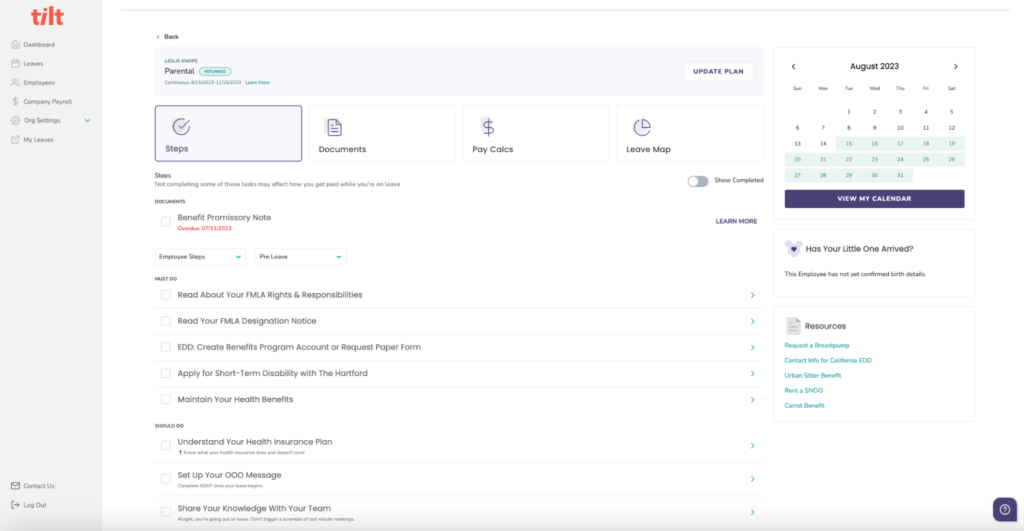
You, your employee taking leave, and the employee’s manager, all have a window into a personalized leave plan that shows exactly when their leave starts and stops, which benefits apply when, and what steps need to be taken at any given time throughout the journey. 

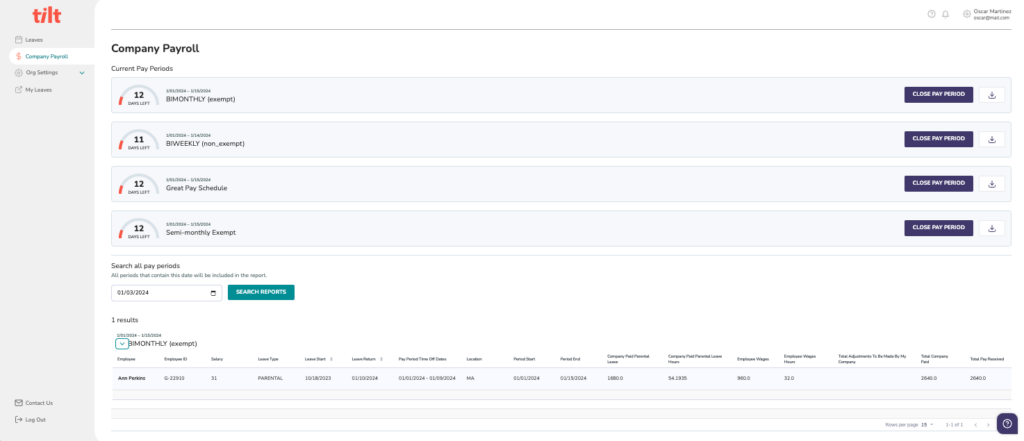
On your end, Tilt’s HR dashboard provides a streamlined view of every leave in your organization at any given time and since Tilt is receiving information from your HRIS, you can rest assured that relevant demographic data is accurate and updated in real-time.

Tilt's HR Dashboard - Your Single Source of LOA Truth

Tilt’s HR dashboard is a simple-to-use, real-time, all-encompassing, and joy-inducing alternative to a messy nest of manual spreadsheets, document storage folders, and calendar reminders. 

Tilt automates leave eligibility too, so when a leave request enters Tilt, our HRIS connection allows us to determine eligibility and begin the leave plan personalization process right out of the gate.

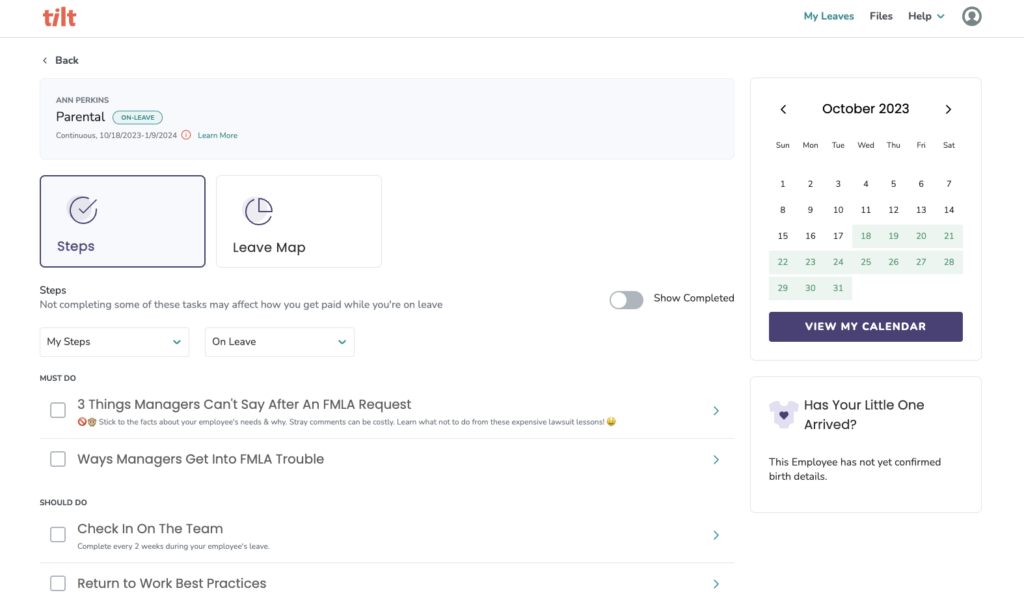
Our leave plans take what would otherwise be a massive undertaking on your part to provide clear and consistent guidance, and makes it streamlined and easy for employees to follow all without you having to lift a finger.

Accurate & Personalized Leave Plans for Every Employee Taking Leave

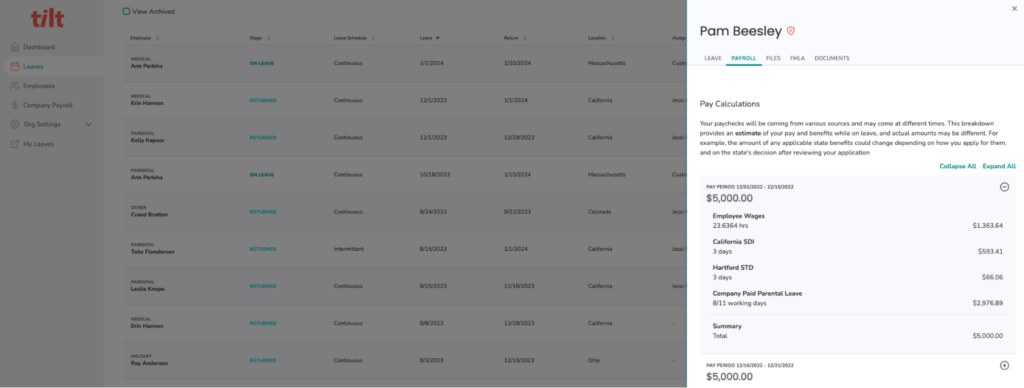
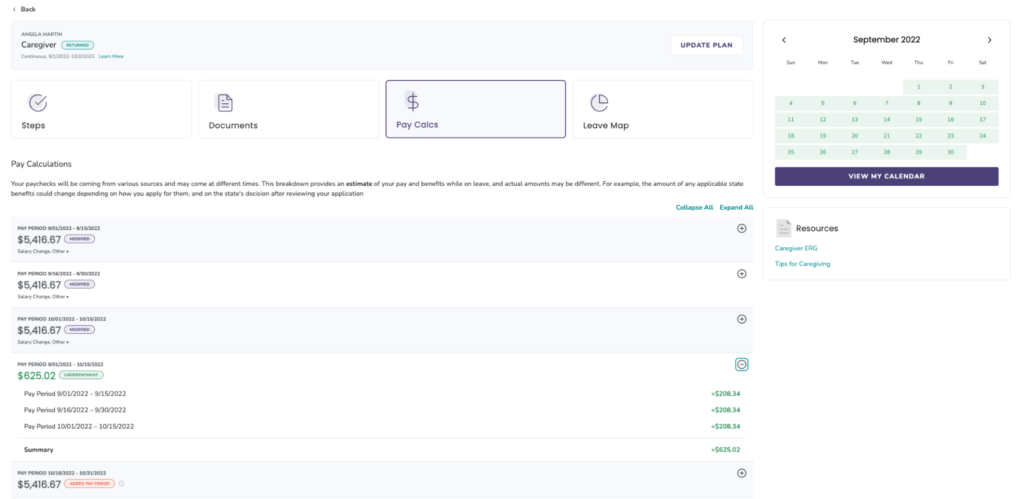
Payroll also has access to Tilt so they can get a detailed breakdown of how much an employee should be paid by your organization during a given pay period. Tilt even auto-adjusts payment calculations should a change to your employee’s leave occur mid-pay period, and those adjustments are reflected in your employee’s leave plan as well.

Calculating Payroll for a Leave Has Never Been Easier (Because Tilt Does it for you)

A good way to erode foundational trust between your employees and your organization is to muck up the money part of a leave of absence, so give your leave of absence payroll process the Kondo treatment with Tilt.

Our software removes the need for back-and-forth pay calculations and the risk of over or under-payment. Tilt solves this problem by making it transparent to all necessary parties how much the employee is getting paid and from what source.

Easily Keep Payroll Under Control

Tilt Instills Compliance Confidence and Clears Communication Static

We’ve established how Tilt makes the process of utilizing your leave benefits easy through our platform, but what about when your employee has a question about a state benefit, or there is confusion coming from your STD carrier, or some part of their leave journey goes sideways (say a caregiver leave turns into a bereavement leave)?

The old way of managing leave would require lengthy email threads and Google searches, where a lack of clarity and fast answers may cause employees to feel a wide range of emotions from unsupported to uncertainty about what needs to be done.

Tilt software has a secret. It’s backed by the world’s most empathetic humans* who live and breathe all things leave. Every employee of yours who takes a leave of absence is paired with a dedicated, 1-1 Leave Success Manager (AKA LSMs, AKA Empathy Warrior) who is your employee’s primary point of contact should any question arise.

With Tilt’s leave management solution your cluttered inbox (as it pertains to leave…sorry we can’t unsubscribe you from all those mailing lists you never signed up for) is a thing of the past.

As for complex or unique leave law situations, our LSMs are supported by our in-house team of leave law experts which means from the mundane to the obscure, you and your organization can rest assured that all leaves are being consistently administered in accordance with the latest leave laws.

Tilt gives you compliance confidence and your employees clearer communication by removing leave law uncertainty and providing dedicated support to every employee.

Provide A Better Leave Experience With Tilt

Tilt’s approach to leave management ensures you’re delivering consistent, holistic support to your people when they need it most. Our software provides a major boost to your employee’s benefits experience and establishes your organization as an employer of choice that they can trust has their back in their time of need.

Create the kind of organizational integrity Mare Kondo would be proud of by implementing Tilt and once and for all removing the aspects of leave management that don’t cause joy.

About Tilt

Tilt is leading the charge in all things leave of absence management through easy-to-use tech and human touch. Since 2017, our proprietary platform and Empathy Warriors have been helping customers make leave not suck by eliminating administrative burdens, keeping companies compliant, and providing a truly positive and supportive leave of absence experience for their people.
Related Posts

5 Employer Turnover Mistakes Hidden in Plain Sight

Nobody is perfect (sorry, mom). We all make mistakes and (some of us) then try to learn from those mistakes so we don’t repeat them. When it comes to employee turnover, however, there are countless moments in an employee’s lifecycle that could make or break their experience to the point of no return. 

There are some obvious reasons why an employee might leave your organization, such as better pay, a new job title, or having disagreements with management. While there is only so much in your control when it comes to helping ensure your organization offers competitive salaries and benefits, provides opportunities for career advancement, and trains managers, there are some other perilous pitfalls that are in your control and are hiding in plain sight.

Here are some scenarios you should be aware of, and what you can do to shore up these gaps in your talent retention strategy.

1. When a poor leave of absence experience has talent headed for the exit

In the dynamic landscape of human resources, managing employee leaves of absence (LOA) is a critical function that directly influences talent retention. A poorly handled LOA experience can inadvertently become the exit ramp for valuable employees, sending them hurtling toward the job boards.

As an HR leader within your organization, it’s imperative to recognize the profound impact that mishandling leave situations can have on employee engagement, morale, and ultimately, organizational stability.

When an employee faces a challenging period, whether due to health issues, personal reasons, or unforeseen circumstances, the manner in which their leave is managed can either fortify their connection to the company or sever it altogether. A lack of communication, insensitive handling, or bureaucratic roadblocks during the LOA process can leave employees feeling undervalued and disengaged.

The repercussions can extend beyond the absence itself and their effects often resonate in the post-leave period. Talented individuals who endure a negative LOA experience may harbor lingering discontent, fostering a toxic work environment that erodes team cohesion. 

As HR professionals, it’s crucial to view each LOA as an opportunity to showcase the organization’s commitment to employee well-being.

If your processes are currently confusing, manual, and frustrating for all parties involved, perhaps look into dedicated leave management software that prioritizes empathy, clear communication, and streamlined processes. This puts you in a position to not only retain your talent but also bolster your reputation as an employer of choice.

It’s not insignificant that a poor leave of absence experience is a leading indicator of the following turnover pitfalls as well.

2. When work-life balance looks good on paper but not in practice

Nothing is more disenfranchising to an employee than when an employer makes a promise they can’t deliver on. Here are some examples of this that are playing out today:

  • Offering a remote work option only to then require employees to return to office life.
  • Having fantastic leave policies but making it a nightmare to actually take a leave of absence
  • Providing amenities in the office for employees to take breaks and enjoy, but having a culture that doesn’t encourage their use.

“Work-life balance” can’t just live as words in a job description. It needs to be encouraged and reinforced as an integral fiber of your company culture. Employees can tell when work-life balance is just buzzword lip service and when their employer really means it. 

Despite your best efforts to foster an empathetic and supportive company culture, again there is much that occurs beyond your control. So identify the areas you can control and implement processes and systems that remedy the situation. 

This is another example of where leave management software can make all the difference. Not only does it make your life easier administratively, it also gives employees the belief that their employer truly cares about work-life balance and not only walks the walk but talks the talk.

3. When ineffective workforce management causes burnout

Ineffective workforce management can be a breeding ground for burnout, jeopardizing both employee well-being and organizational productivity. When people leaders fail to allocate resources efficiently, overburdening individuals or neglecting workload distribution, it leads to increased stress and fatigue.

The absence of clear communication (more on that shortly), inadequate training, and insufficient support exacerbate the problem. Employee exhaustion and reduced production efficacy become inevitable when workforce planning isn’t prioritized, which in turn results in high turnover rates and decreased job satisfaction. This begets continued high turnover rates and decreased job satisfaction, which begets…well you get the picture.

The ripple effect is felt in a variety of ways detrimental to organizational success, from compromised team dynamics to compromised quality of work and client dissatisfaction. 

Proactive, collaborative workforce management, on the other hand, gives management the power to establish balanced workloads, open communication, and skill development, all of which are crucial to mitigate burnout and foster a resilient (and retainable) workforce.

This is another opportunity to leverage the powerful capabilities of leave-of-absence software. A more modern solution to LOA management creates a holistic window into workforce planning for HR leaders and people leaders alike, leading to better planning, better productivity, and happier employees.

4. When unclear communication leads to workplace breakdowns

Just like in every other avenue of life, unclear communication serves as a potent catalyst for relationship breakdowns in the workplace, fostering misunderstandings and eroding trust. When messages lack clarity or intention, confusion festers and assumptions arise, creating a workplace environment ripe for conflict.

Misinterpretations, unmet expectations, and unresolved grievances may accumulate over time, poisoning the foundation of relationships which of course can lead to an uptick in turnover.

The absence of transparent dialogue amplifies feelings of frustration and isolation, escalating minor issues into insurmountable challenges.

The impact of communication breakdowns can vary wildly depending on what exactly is being poorly communicated. Failing to communicate an employee’s promotion might not have the same negative impact as failing to inform an employee of the steps they need to take when applying for state benefits on their leave of absence journey.

Small communication mishaps are an inevitable part of running a business. We all try our best but as we mentioned up top, nobody is perfect, and that is especially true when trying to communicate with your peeps during critical moments in their employee lifecycle, such as (you guessed it) when a major life moment happens and they’re relying on you to guide them through the LOA process when they need it most.

5. When the wrong people are hired to fill in the gaps

You can’t bat a thousand when it comes to hiring candidates, but there are external factors that certainly influence your stats. A prime example of one of these influences is when People Ops have pressure to hire someone quickly to fill a gap.

Hiring the wrong individual in this scenario can straight up wreak havoc on employee turnover.

Misaligned skills, values, or work styles (or a sweet concoction of all three…) can contribute to dissatisfaction and employee disengagement. Incompetence or cultural misfit disrupts team cohesion, triggering resentment and frustration within your organization, resulting in a negative environment that may lead to even more turnover as talented employees seek environments where their skills are valued and are supported by an aligned team of individual contributors. 

Since the right leave management software can reduce workforce planning blind spots, especially for long-term leaves of absence, empowering your people leaders to properly plan and fill in gaps as needed, removing the pressure on you to deliver new hires faster than you can properly vet them.

Transforming Turnover Mistakes Into Retention Wins

The cost of recruitment, onboarding, and lost productivity compounds the financial and administrative toll of employee turnover. Your employee’s leave of absence experience can act as your canary in the coal mine, revealing other turnover pitfalls that may be hidden in plain sight. 

Better leaves, an emphasis on living your work-life-balance message, smarter workforce planning, clearer communication, and putting yourself in ap position to hire the right people to fill in gaps can help turn retention rate regression into an undeniable organizational strength leading to happier employees, more productivity, and becoming an attractive landing spot for potential candidates.

About Tilt

Tilt is leading the charge in all things leave of absence management through easy-to-use tech and human touch. Since 2017, our proprietary platform and Empathy Warriors have been helping customers make leave not suck by eliminating administrative burdens, keeping companies compliant, and providing a truly positive and supportive leave of absence experience for their people.
Related Posts

What Your Employment Retention Strategy Is Overlooking

The short answer: slides. And we aren’t talking about those things in your PowerPoint deck, we mean actual, literal slides that people can use in your office to get from place to place. Ever seen someone on a slide having a bad time? Would you resist the urge to come back into the office after that sweet remote work life if your office had slides?

We understand that slides might be unreasonable to install in your office (and a liability issue), but if you’re looking for a competitive differentiator for attracting and retaining talent you have to look beyond the basics.

Employees know that in today’s landscape, a competitive salary alone does not make a culture, nor does a fridge full of booze and the booch (AKA Kombucha).

For the first time en masse, HR and People Ops pros are being asked to think outside the box when it comes to employee retention, and in doing so they’re looking outside the workplace.

More specifically, it’s becoming increasingly obvious that the connection between a positive leave of absence experience and employee retention (and equivalently a negative experience and turnover) is causing employers across the country to shift extra focus toward evolving the way in which they administer and support an employee’s leave of absence.

Why A Poor Leave of Absence Experience Leads to Turnover

While the phrase “if you love something, let it go” certainly wasn’t about employee leaves of absence (though can anyone prove it wasn’t?), the same rule certainly applies.

A leave of absence can take a wide variety of forms, they can be planned (i.e. having a baby) or they may be unplanned (i.e. a debilitating accident). They can live in states that have programs to help offset financial strains, they may involve going through an STD carrier, they may change halfway through from a caregiver leave to a bereavement leave…you get the picture.

No two leaves are identical, and yet HR and People Ops teams are required to deliver timely, consistent support to all employees whenever a leave request crosses their inbox. Unfortunately, most teams are stuck using antiquated, siloed systems that make everything from employee education to FMLA tracking to secure file collection and storage a nightmare. 

The manual administration of leaves of absence puts HR and People Ops teams at a significant disadvantage when it comes to empathetically supporting people needing to step away from work, and the expectation from employees is that after countless hours of being there for the employer when times are tough, that their employer will make things easy for them when real life is hardest.

An employee retention strategy that doesn’t emphasize caring for your employees and making it easy for them to attend to life’s most challenging moments is an employment retention strategy that will find you on the less-than-fun slide (see what we did there?) toward filling vacancies once held by your top talent.

How to Leverage Better Leaves For Boosts In Retention

While it’s not hard to see why a bad leave of absence experience can lead to turnover, how do you make that experience not suck to actually boost retention?

A good rule of thumb when evaluating HR processes is that if the process is a cluster[bad word] for you to manage, it’s probably going to be a cluster[same bad word] for your employees to experience.

So step one is to evaluate your processes and see where the pain points and support gaps are. If you’re using a manual process to manage a leave you’re likely reading this and saying…

“I use a spreadsheet to track all the leaves in my company…where aren’t my pain points and support gaps?”

There are so many moving parts to a single leave of absence that you’re likely to find two of the biggest pain points are automation and scalability. Leaves can be unpredictable, so you never know walking into work if you have zero new leave requests to attend to or 50. And while we hope you never have to support 50 leaves at once, your process needs to be scalable in the event it happens.

Once you’ve evaluated your systems and process, it’s time to identify whether or not some changes need to be made. This might be the time you start looking at dedicated leave management software and solutions (like Tilt, an unabashedly shameless plug) that work with your HRIS, your Carrier, State departments, automate leave tracking, payroll and provide seamless guidance and support to your people when they need it most…at scale…for all leaves…for all states.

The right dedicated leave management solution gives you a real-time, holistic window into all of your leaves without you having to lift a finger, and it gives your employees empathetic expertise and guidance for a successful and supported leave of absence.

The result is an employee who truly feels that their employer has their human-ness in mind. An employer who knows that sometimes things happen in life that require work to be put on hold. An employer who makes the process easy to step away, so that when it’s time to come back they are engaged, refreshed, and thankful for the support they were given when life threw a curveball.

How Modern People Leaders Retain Employees

Bonuses and breakroom Bocci Ball are nice-to-haves (as are slides), but it’s the foundational fibers of your employee experience that have the biggest impact on employees who stay, and those who look for greener pastures.

The way in which you care for your employees’ lives outside of work says everything about how they’re going to feel about their lives inside office walls (even if those walls are in your remote workforce’s living room).  

Differentiation isn’t about dangling the shiniest new perk and hoping your competition doesn’t follow suit, it’s about laying the groundwork for a more human work experience, and there is nothing more human than a leave of absence.

If you don’t have the right system in place to help your employees take a leave of absence, you’ll be perpetually overworked and overstressed trying to get leave right, only to see them walk out the door when they return.

A better leave experience is absolutely essential to boost your employee retention numbers, and that starts with removing antiquated systems that don’t serve you or your employees when a leave is needed, and seeking solutions that support your employees and ease your burdens.

About Tilt

Tilt is leading the charge in all things leave of absence management through easy-to-use tech and human touch. Since 2017, our proprietary platform and Empathy Warriors have been helping customers make leave not suck by eliminating administrative burdens, keeping companies compliant, and providing a truly positive and supportive leave of absence experience for their people.
Related Posts

Beyond Salary: Competitive Hiring through Innovative Benefits Strategies

In today’s dynamic and competitive job market, HR and People Ops leaders know that attracting and retaining top talent goes beyond traditional salary offerings. We’re witnessing in real-time a transformative shift in the realm of talent acquisition, where prospective employees are increasingly prioritizing a comprehensive compensation package over a singular focus on monetary rewards.

This paradigm shift underscores the pivotal role of innovative benefits strategies in securing and maintaining a competitive edge in the race for top-tier talent.

Much of this shift can be attributed to the evolution of employee priorities themselves, so understanding the nuanced dynamics of what truly matters to them becomes imperative. Research consistently highlights a desire for a holistic work experience that balances financial considerations with non-monetary factors. For example, the Los Angeles Business Journal shares that providing employees with a more holistic experience increases their satisfaction by 15%.

The intricacies of designing and implementing innovative benefits strategies that not only align with organizational goals but also resonate with the diverse needs of today’s workforce can provide both obstacles and opportunities for HR and People Ops leaders. Those who take advantage of those opportunities will begin to reap the benefits when it comes to both attracting and hiring top talent and keeping them happy long-term.

Innovative Benefits Strategies Elevate Your Hiring Hit Rate

First, let’s talk about what we mean by “a holistic work experience.” The term “holistic” gives people a funny feeling sometimes, but in the case of an employee’s work experience, it essentially boils down to an approach that considers the whole person and their overall well-being in the workplace.  

Successful organizations embrace innovative benefits, and today’s innovative benefits must be holistic in their application. Every organization is different and has an employee population with different needs. Finding out what matters to them, from the source, is the best way to understand how your strategies need to evolve to meet the demands of the future of the workforce.

To demonstrate how viewing your benefits through this holistic lens of considering the whole person, we’re going to focus on one such strategy that has proven to positively impact employees across an organization and help make your organization a more desirable landing spot for top-tier candidates: Modern Leave of Absence Management Software

Incorporating modern leave-of-absence management software is the perfect example of considering your employees as a whole person, one who faces real-life ups and downs outside of the 9-5. 

By successfully and seamlessly supporting an employee who needs to take time away from work, you not only promote a healthier and happier work environment within your walls today, but you send out a bat signal to all potential candidates that you don’t just view employees as a cog in a machine, but as a real human with real demands outside of work that may require putting deadlines and KPIs on the backburner temporarily.

How Modern Leave Software Is Your Competitive Hiring Edge

Keep in mind that not all modern leave management software is the same, so let’s take Tilt’s approach which is to leverage technology and empaths to make the leave of absence experience as human and easy as possible for all parties involved. 

Why is this important? Well, you may offer the most robust leave policies as part of your benefits strategy, but when the rubber meets the road and an employee actually needs to take a leave, the experience they have on that journey can make or break the employee/employer relationship. 

There’s a reason why some employees don’t come back after a leave of absence, or if they do, their experience was so subpar that they return only to collect a paycheck while they look elsewhere for employment.

If their leave of absence experience doesn’t meet their expectations, you can quickly find your strategy of providing big benefits go up in a big puff of smoke as the experience of taking one is cold, confusing, and difficult for employees to navigate.

The reason this happens is the experience for HR and People Ops leaders to administer, track, and manage a leave of absence is cold, confusing and difficult as well. Antiquated systems, manual processes, changing leave laws…today’s leave management requirements are too complex and compliance-risk-ridden to be done the old way. 

Tilt’s leave management software solution turns this cold, confusing and difficult process into a warm, streamlined, and simple journey for all parties involved, making Tilt an innovative and indispensable benefit for employers and employees alike.

There is finally a single solution that takes your benefits strategy into the modern age of holistic employee support, and it’s used at your employee’s most critical life moments.

The way an employer responds to an employee’s critical life moment serves as a defining moment in the employee’s life cycle at your organization. As Lance Haun of the Starr Conspiracy puts it, “These defining moments are touchstones, so be thoughtful and think about what that experience is like for them.”

A solution like Tilt is the difference between simply having a benefits strategy and having an innovative benefits strategy.

Underneath the Hood of Modern Leave Management Software

Now that we’ve established that a holistic approach to leave management is a prime example of leveling up your benefits strategies, let’s see how it works.

1. No more manually managing spreadsheets

Tilt’s software eliminates the need to manually update spreadsheets when it comes to tracking your organization’s leaves of absence. Everything you need to know about all your leaves is automatically updated in your HR dashboard in real-time.

Tilt's HR Dashboard - Your Single Source of LOA Truth

2. HRIS sync

Tilt automates the transfer of employee data through your HRIS so you can rest assured your leave management process involves working from the latest and greatest demographic data from your employee population.

3. Automated payroll

Payroll calculations can be messy when it comes to leaves of absence, and nothing causes more stress for your employees taking leave than confusion around how much they’re getting paid, when they’re getting paid, and through what sources (your org, your STD carrier, state programs, etc…).

Tilt automates pay calculations for employees so they’re always in the know, as is your payroll team. Tilt also auto-adjusts payroll calculations should any changes occur mid-pay period such as leave start and stop dates or salary rate.

Easily Keep Payroll Under Control

4. Step-by-step customized leave plans

When a leave is entered into Tilt a personalized leave plan gets built for your employee without you or them having to lift a finger. These leave plans provide step-by-step guidance on everything they need to know about their leave and everything they need to do (and by when).

Accurate & Personalized Leave Plans for Every Employee Taking Leave

5. 1-1 human support for employees

Even the most straightforward leave of absence an employee can take has the potential of taking a real-life detour. For some, this may be the first leave of absence they’ve ever taken, which can be a scary experience on its own.

Tilt has an in-house team of Leave Success Managers (AKA Empathy Warriors) who get assigned to every single one of your employees taking a leave.

They’re your employee’s best friend when it comes to navigating a leave, and they’re there to answer any questions they may have, work with state departments and insurance carriers if necessary, and pretty much be an extension of your team dedicated to the success of your employee’s leave journey.

6. Secure file storage

Compliance is a major component of leave of absence management, and Tilt has made that easy too. Want to know a quick way to get employees questioning the capabilities of their employer? See what happens when sensitive information gets mismanaged. Tilt safely provides one single source of truth for all sensitive leave documentation by making direct uploads to our platform simple and secure.

Tilt Safely & Securely Stores All Sensitive Leave Documents

7. Leave law expertise

Leave laws change all the time, but you can’t be expected to stay current at all times for all states (though if you like geeking out on leave laws like Tilt does, you can bookmark our Leave Law Report page to stay in the know). Tilt’s in-house team of leave law experts removes any doubts that not only is our platform primed with the most current leave laws, but should you or your employees have any questions, Tilt has the expertise to help when needed.

Innovative Benefits Strategies Don’t Have to Be Hard

When looking to incorporate innovative benefits strategies into your organization, it’s best to do so by viewing the employee as a whole person, and finding opportunities to make the quality of work life (and “life” life) easier for you and the employee you’re supporting.

Tilt takes your benefits strategy to a new level by leaps and bounds, making everyone’s lives easier and more supported every time a leave request comes up. The reason your employee leave experience might be bad today isn’t that you’re not putting in the effort to make it great, it’s that you’re trying to accomplish an extremely difficult and modern task with antiquated tools and technologies. 

Attract and retain top talent by focusing on providing more than amazing benefits, but by having the best tools available to make utilizing those benefits a breeze. And there’s no more important opportunity to leave a lasting positive impression on your people than coming through with holistic support when they need it most. 

Tilt is the type of innovative benefit that tells prospective employees that you’ll be there for them and their colleagues if life suddenly takes a turn for the worse, if new life is being welcomed into the family, or if mental stress is just too much to bear and they need to step away.

Benefits come in all varieties, but the truly innovative ones take the entire employee experience to heart and will accelerate your organization toward being an employer of choice for years to come.

About Tilt

Tilt is leading the charge in all things leave of absence management through easy-to-use tech and human touch. Since 2017, our proprietary platform and Empathy Warriors have been helping customers make leave not suck by eliminating administrative burdens, keeping companies compliant, and providing a truly positive and supportive leave of absence experience for their people.
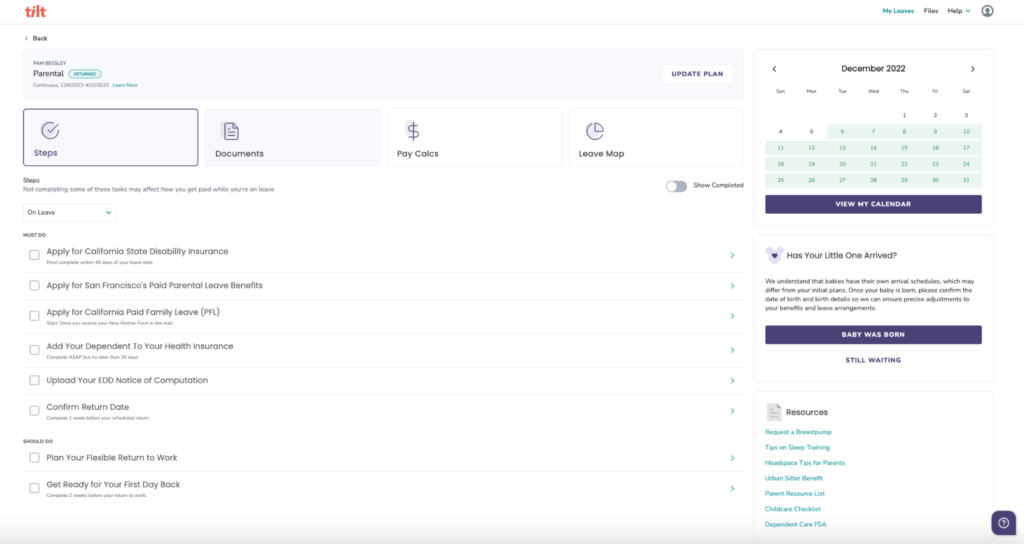
Related Posts

Join us February 20th, 2025 at 11AM MST – Tilt Live Demo | Register Now>>