How Employee Data Transformed The Way HR Manages Leave

They say data is the new oil, but for HR, bad data is more like quicksand. One wrong move and suddenly payroll is a mess, compliance is a gamble, and employees are knocking on HR’s door (or inbox) with confusion, or worse…complaints.

HR leaders have always been the backbone of workforce management, but managing leaves of absence has historically been a complex, manual process prone to errors and inefficiencies.

Today, the landscape has changed, and employee data is playing a larger role than ever.

Leveraging modern software and robust employee data in leave management has revolutionized how HR teams operate, eliminating manual tracking, recognizing trends, improving compliance, and ensuring accurate pay and benefits calculations.

Let’s explore how this transformation took place and what it means for HR leaders navigating today’s evolving workplace.

The Evolution of Leave Management

In the past (and likely the present for many HR leaders out there), managing leave required a cumbersome combination of spreadsheets, email chains, and manual data entry.

HR teams were responsible for collecting employee details, determining eligibility, and manually updating systems to reflect leave status changes. This approach was not only time-consuming but also left room for costly errors.

Especially with how quickly details of a leave of absence can change.

Did an employee move to a PFL state?

Did an employee’s caregiving leave turn into a bereavement leave?

Did an employee give birth 2 weeks earlier than expected?

With the recent rise in more advanced HR technology, organizations began to recognize that leave management required more than just a tracking system. It required seamless data connections with existing HR platforms which has ushered in the new era of employee data-powered leave management.

Why Employee Data Matters in Leave Management

Employee data is the key to making informed decisions about leave eligibility, compliance, and pay calculations. Consider the critical data points HR teams need to manage leave effectively:

  • Employee working location (to determine state-specific leave laws)
  • Date of hire (to verify eligibility for company leave policies)
  • Salary and pay history (to ensure accurate pay calculations during leave)
  • Leave balance and history (to track entitlements and remaining leave)
  • Required forms and documents (i.e. medical certifications)

Without this data, HR teams are left scrambling to piece together information from various sources, increasing the likelihood of miscalculations and compliance risks.

The connection of leave management software with HRIS platforms ensures HR teams have real-time access to accurate employee data, reducing administrative burdens and improving accuracy.

Leave of Absence and Workforce Planning

Employee data is also the key to making informed workforce planning decisions, including how organizations prepare for and manage leaves of absence. HR teams can analyze key trends in leave requests, ensuring that they have the right coverage in place to prevent operational disruptions.

By analyzing patterns in leave frequency, seasonality, and department-specific trends, you can proactively plan for staffing needs, reducing the likelihood of being caught off guard. Predictive workforce planning ensures that businesses don’t just react to leaves; they anticipate them, creating a more resilient workforce strategy.

Employee Experience and Leave Trends

The understanding of leave trends plays a vital role in shaping a positive employee experience. When HR has access to leave trends, they can refine policies to better support employees. For example:

  • Identifying an increase in caregiving-related leave requests may signal the need for enhanced family leave options.
  • Recognizing seasonal leave trends can help organizations create proactive strategies to maintain productivity.
  • Understanding the impact of various leave types on employee well-being allows HR to tailor support programs accordingly.

Organizations that use employee data to shape their leave policies foster a culture of trust and support, ultimately boosting retention and overall job satisfaction.

The Rise of Seamless Connections

As companies scale and their workforces become more complex, the need for automation and connectivity becomes even more critical. When leave software and an HRIS are working together, HR teams no longer need to manually enter leave data or track leave requests in separate systems or worry that changes to a leave aren’t being updated automatically.

Instead, a harmonious connection between your HRIS and leave software enables:

  • Automated employee data syncing: Ensuring accurate eligibility decisions and pay calculations.
  • Leave data updates: Keeping HR systems and your leave management platform in sync to reflect leave requests, start dates, and changes.
  • Reduced administrative workload: Eliminating repetitive data entry tasks, allowing HR teams to focus on strategic initiatives.

The Cost of Managing Leave Without Data

When leave data isn’t properly managed, the financial risks can be significant. Payroll errors, non-compliance fines, and unnecessary overtime costs add up quickly. The following pitfalls are far too common and can leave organizations and their employees reeling:

  • Payroll Overpayments/Underpayments: Inaccurate leave tracking can lead to employees being overpaid while on leave, costing the organization thousands of dollars or requiring a claw-back. Similarly, if an employee is underpaid, it may impact their livelihood, potentially causing the relationship with the organization to fracture.
  • Compliance Risks: Failure to comply with state and federal leave laws can result in legal action and hefty penalties.
  • Operational Disruptions: Without accurate leave forecasting, organizations may struggle with unexpected staffing shortages, leading to decreased efficiency and increased workload for remaining employees.

By leveraging accurate and real-time leave data, HR teams can minimize these risks, ensuring that workforce planning, employee experience, and financial stability remain intact.

The HR Perspective: From Chaos to Confidence

An HR team like yours might be managing multiple leaves and leave types across several states at once.

It’s a living nightmare to try to accomplish this successfully with traditional leave management methods, and most HR leaders have this feeling of “there has to be a better way,” or worse, “it’s only a matter of time before this chaotic approach bites is in the (you know what).”

Tilt’s HR software turns that chaos into a repeatable, automated, seamless experience for HR and employees alike. By connecting directly to your HRIS, Tilt’s platform makes a significant impact on HR teams. Tilt customers have reported that the ability to automatically sync leave data has:

  • Reduced time spent on leave management by 50%
  • Decreased manual errors in payroll and compliance tracking
  • Improved employee satisfaction by providing clear, accurate leave information

By removing the manual burden of leave management and ensuring data accuracy, HR can focus on more strategic initiatives that drive organizational success.

By always knowing who is on leave and what leaves are upcoming, Tilt gives HR the visibility needed to workforce plan and keep operations running smoothly and the workload properly dispersed.

Tilt’s approach focuses on balancing flexibility with compliance. HR can customize Tilt to match their specific leave policies while ensuring compliance with regulations. This prevents HR teams from being burdened with excessive manual processes while still allowing for personalized employee experiences.

Elevating HR With Data-Driven Decisions

The transformation of leave management through employee data isn’t just about reducing administrative work, it’s about empowering HR teams to focus on what truly matters: supporting employees. When HR’s leave management system has access to accurate, integrated employee data, they can:

  • Provide employees with a seamless leave experience
  • Make confident, data-driven decisions
  • Ensure compliance without unnecessary manual oversight

With Tilt, HR teams have a unique opportunity to leverage technology that removes the complexity of leave management. By embracing a data-driven solution like Tilt, you and your team can move from reactive problem-solving to proactive, strategic workforce management.

In an era where employee experience and compliance are more critical than ever, leveraging employee data to manage leave isn’t just an improvement; it’s a necessity to keep your head above water (or quicksand).

Tilt is leading the charge in all things leave of absence management through easy-to-use tech and human touch. Since 2017, our proprietary platform and Empathy Warriors have been helping customers make leave not suck by eliminating administrative burdens, keeping companies compliant, and providing a truly positive and supportive leave of absence experience for their people.

Related Posts

The Power of HR’s Voice in Leave Software Evolution

They say the best way to predict the future is to create it.

HR leaders are the architects of workplace transformation. Every policy adjustment, every new process, and every technological improvement you champion contributes to shaping a better future for employees.

Nowhere is this more evident than in leave management.

Modern leave software solutions have evolved significantly over the last few years, and that evolution is driven, in large part, by HR professionals who deserve and demand more intuitive, efficient, and supportive systems.

Customer feedback is a crucial driver of innovation in product development, and the best leave software providers actively listen, prioritize, and implement user insights to refine their platforms.

Let’s explore how HR leaders can contribute to shaping leave software, the balance between their requests and a software provider’s long-term product vision, and the critical role customer-facing teams play in delivering meaningful updates.

HR’s Role in Improving Leave of Absence Software

As an HR professional, you live at the intersection of company needs and employee well-being, and the crisscrossing of traffic is getting more hectic by the year.

You are the first to recognize inefficiencies, gaps, and areas where software solutions can better serve your teams. But how do leave management software providers translate your feedback into product innovation?

“I’ve seen firsthand how a lack of transparency and outdated leave management systems can create unnecessary stress for employees and HR teams alike,” says Tilt Product Manager Samantha Gardiner. “That’s why it’s critical for HR leaders to share their insights, because the best solutions are built with their experiences in mind.”

Samantha Gardnier Blog Quote

You don’t have to look far beyond real-life experiences to understand the need for improving leave management. If you’re reading this, you’ve likely watched employees struggle through the complexities of disability leave or trying to navigate parental leave PFL states halfway across the country. They’re worried about pay. They’re worried about their livelihood. And they just wish there was an easier way.

These challenges highlight how essential it is for leave management tools to be intuitive, transparent, and truly supportive.

But HR’s voice in shaping software goes beyond personal stories. It’s about structured, data-driven feedback loops that ensure continuous improvement.

How Leave Software Providers Gather and Utilize HR Feedback

A strong leave software provider employs multiple strategies to gather and act on HR insights:

1. Direct HR Feedback and User Interviews

HR professionals provide invaluable insights through direct conversations. These discussions reveal the challenges of managing leave policies, employee communications, and compliance concerns. By engaging in one-on-one conversations, software teams can uncover pain points that might not be visible through data alone.

2. Employee Feedback and Usage Data

While HR professionals are key stakeholders, employees who take leave also provide essential feedback. Their experiences navigating the system, receiving notifications, and submitting documentation help shape a more seamless process. Additionally, software providers track user behavior to identify friction points and areas for enhancement.

3. Customer Success and Leave Success Team Insights

Frontline teams working with HR and employees gather patterns from real-world use. They collect recurring concerns, flag inefficiencies, and relay common requests to the product team. These insights ensure that the most pressing challenges are addressed efficiently.

Balancing User Requests with Long-Term Product Vision

Not all feature requests make it into production immediately, nor should they. “Sometimes, a request seems like a quick fix,” adds Samantha. “But when we dig deeper, we realize there’s a more effective, long-term solution. Our job is to ensure we’re addressing HR’s real problem, not just their surface-level pain point.”

Some feature requests solve an immediate pain point but may not align with the long-term goal of making leave management more seamless and automated. For instance, you might request a manual email notification button for urgent leave of absence cases. While this seems like a quick fix, the underlying issue may be that employees are missing critical notifications. Instead of adding more manual work for HR, the product team may focus on improving notification timing and clarity for the employees needing leave.

The key to great product development is understanding the “problem behind the problem.” HR professionals can help identify these underlying challenges, and a good product team should leverage this insight to create scalable leave solutions that benefit all users.

Case Study: Transforming Leave Notifications

One prime example of this evolution is how Tilt revamped its leave notification system based on HR feedback.

Originally, Tilt sent multiple emails per leave update. While this kept HR teams informed, it also overwhelmed them with information overload. Larger companies with high leave volumes found themselves sorting through dozens of emails each day. HR professionals voiced their frustration, and Tilt listened.

In response, Tilt introduced a daily leave summary email: a consolidated report that provides essential updates in a single, digestible format.

This improvement significantly reduced inbox clutter while still keeping HR teams well-informed.

Moreover, based on continued feedback, the team is now enhancing this feature further by allowing HR teams to customize the frequency and content of these emails. “This is a great example of how HR feedback directly shapes our product,” suggests Samantha. “We didn’t just implement a fix; we worked with HR leaders to understand what would truly make their lives easier.”

Continuous Evolution: The Feedback Loop

Once a new feature is released, the work isn’t over. A strong software provider continuously collects post-launch feedback to assess its impact.

“No release is ever considered ‘final,” says Samantha. “The best products don’t just launch and move on. They evolve. HR teams help us understand how our solutions work in the real world, and we adjust based on what they tell us.”

For example, after rolling out the daily leave summary email mentioned above, some HR leaders requested additional data points be included. Others wanted the ability to opt out of daily emails entirely. These insights guide future updates, ensuring that each enhancement remains aligned with HR’s evolving needs.

The Power HR’s Voice in Leave Software Development

As an HR leader you should have the opportunity to be more than just an end user of leave software. The right provider will give you the ability to be an active participant in shaping its evolution. Your experiences, challenges, and insights can drive meaningful improvements that make leave management more efficient and employee-friendly.

And not just for you, but for every HR manager who has struggled through a pay calculation spreadsheet, tried to learn about new leave laws, dealt with employees who are confused and just need clear and easy guidance in their time of need.

By engaging with leave software providers through feedback sessions, beta testing, and direct communication with customer success teams, you help ensure that the tools you rely on are truly built for your needs.

Does your leave of absence solution give you the power to make real change?

How HR Can Get Involved in Shaping HR Software

Want to have a greater impact on the future of leave software?

Here are a few ways Tilt makes it easy for your voice heard:

  • Participate in User Research – Tilt conducts regular interviews and beta tests. Sign up to be part of these programs.
  • Leverage Customer Success Teams – Share your experiences and challenges with your Tilt Customer Success Manager. They act as a bridge between HR teams and product teams.
  • Provide Data-Backed Feedback – When reporting challenges, share real-world examples and data points to highlight the impact of specific pain points.
  • Stay Engaged in Product Updates – Keep an eye on new feature rollouts and provide feedback on their effectiveness. Continuous engagement helps shape future iterations.

HR is Poised to Make a Difference in LOA Software

The best leave of absence management solutions evolve alongside HR needs, fueled by thoughtful, structured, and actionable feedback.

Tilt is dedicated to ensuring HR’s voice is not just heard, but actively shapes the future of leave management. Our platform is built on real-world HR insights, ensuring that every update makes leave management more intuitive, strategic, and impactful.

From simplifying compliance to enhancing the employee experience, we believe that HR should have the tools and support necessary to drive meaningful change.

As an HR leader, your voice is instrumental in driving these innovations. By actively engaging with leave software providers like TIlt, you contribute to a future where leave management is seamless, employee-friendly, and a strategic asset to your organization.

Together, with Tilt, we are not just predicting the future of leave management, we are creating it.

Tilt is leading the charge in all things leave of absence management through easy-to-use tech and human touch. Since 2017, our proprietary platform and Empathy Warriors have been helping customers make leave not suck by eliminating administrative burdens, keeping companies compliant, and providing a truly positive and supportive leave of absence experience for their people.

Related Posts

How Nicolet National Bank Simplified Leave Management with Tilt and Paycor Integration

For HR teams, managing leaves of absence can be one of the most complex and time-consuming aspects of employee support, especially when relying on manual processes.

At Nicolet National Bank, Total Rewards Manager Liz Lehman knows this all too well.

With her 29 years of HR experience she’s seen firsthand how traditional leave management systems fall short. But with the integration of Tilt and Paycor, her team has taken a significant step forward in streamlining operations, reducing manual work, and improving visibility.

The Challenge: Manual Processes, No Visibility, and Limited Communication

Before implementing Tilt, managing leaves at Nicolet National Bank meant navigating a web of disconnected systems and spreadsheets.

“All leaves were processed through manual forms,” she explained. “There was no tracking of due dates, no automated tracking of leave used or remaining, and very limited communication with managers or employees on leave.”

This lack of structure created inefficiencies for her team and confusion for employees, especially when it came to syncing leave data with payroll systems.

“Our HR team had to manually update employee time cards,” she said. “It was a slow and error-prone process.”

The Solution: A Strategic Integration to Power Self-Service

Nicolet National Bank turned to Tilt because they were seeking to simplify and modernize the leave management process from start to finish. Once Tilt established its integration with Paycor, it brought even more automation and certainty into their workflow.

“Our goal was to streamline leave, improve reporting, and create more of a self-service process for employees,” she said.

Nicolet National Bank Quote

“Tilt also gave us the potential to eliminate redundant tasks by integrating directly with Paycor.”

The implementation process was “very easy,” she added. After sharing their information, the Tilt team configured the system and ensured it aligned with their internal policies.

The Results: Time Savings and Operational Relief

One of the biggest wins since going live with the Tilt and Paycor integration? No more manual employee data entry.

“I no longer have to manually enter all of the employee info,” she noted. “Tilt has saved me a ton of time on reviewing leave requests, preparing responses, and tracking leave.”

The time savings and reduced admin burden are undeniable. Thanks to the Paycor integration employee data flows directly into Tilt, removing countless layers of HR administrative headaches.

A Step in the Right Direction for Leave Management

For many HR leaders, managing employee leaves is a behind-the-scenes burden that eats up hours, introduces risk, and too often leaves employees without the clarity or support they need during critical life moments.

Nicolet National Bank’s journey with Tilt and Paycor shows there’s a better way.

By embracing integrated, tech-forward leave management, Liz and her team were able to reclaim time, improve accuracy, and create a more responsive process for both administrators and employees.

Instead of being stuck in reactive mode, they’re now able to operate more strategically, with less friction and more confidence.

Nicolet National Bank Quote

“I’ve saved a ton of time on administering leave,” she shared. “And now that the data flows directly from Paycor to Tilt, it’s taken even more off my plate.”

For HR teams still stuck in the weeds of manual processes, Liz’s experience is a powerful reminder: modernization doesn’t have to be complicated, but it does need to be intentional. With the right partners and a commitment to streamlining outdated systems, HR leaders can finally get back to focusing on the work that matters most, supporting their people.

If your team is still navigating leave through forms and files, now might be the time to rethink what’s possible.

Tilt is leading the charge in all things leave of absence management through easy-to-use tech and human touch. Since 2017, our proprietary platform and Empathy Warriors have been helping customers make leave not suck by eliminating administrative burdens, keeping companies compliant, and providing a truly positive and supportive leave of absence experience for their people.

Related Posts

Trust Isn’t a Feature: It’s the Foundation of Great HR Tech

“Trust takes years to build, seconds to break, and forever to repair.”

While this adage might make us reflect on personal relationships, it’s just as applicable to HR technology; especially when it comes to leave management.

Whether you’re an HR leader or overseeing a team of HR pros, when you’re responsible for managing employee leaves you need more than a software provider; you need a trusted partner.

Because when trust is missing in HR tech, the fallout is more than just a few extra headaches. It can mean compliance risks, financial errors, and a hit to employee morale, retention, and operational success.

The Trust Factor in HR Tech

Trust is the cornerstone of effective HR technology. When software claims to have bells and whistles on the website but in practice can’t deliver, or if support for you and your employees is a 1-800 number that makes you want to “press 1 for more options,” it can be maddening for HR leaders everywhere.

You depend on these systems to manage sensitive employee information, ensure compliance, and streamline critical processes. However, when trust in HR tech providers erodes, it can lead to significant consequences.

Factors Contributing to HR Ditching Their Tech

  • Inadequate User Experience: A survey revealed a 6% decline in overall user experience ratings among HR tech users.
  • Insufficient Technology Meeting Needs: Over half (56%) of HR leaders reported that their current HR technology does not meet their organization’s needs.​
  • Implementation Challenges: 36% of HR professionals cited insufficient technology as a barrier to automating and organizing onboarding programs effectively.

Think of it this way: If your car’s GPS gave you directions with a 70% success rate, didn’t sync with your phone, and was unreliable in responding in time when there’s an accident up ahead, how confident would you be about getting to your destination on time?

Now imagine that same hit-or-miss approach when it comes to tracking leave balances, ensuring accurate pay, and staying compliant with ever-changing regulations. The stakes are simply too high to not have reliable tech.

What HR Teams Should Expect From a Trusted HR Tech Partner

Rebuilding confidence in your leave of absence process starts with choosing a partner who understands the nuances of leave management. It’s not just about software; it’s about trust, communication, and ongoing support.

A leave management solution should provide:

  • Compliance Expertise: TrustRadius points out that compliance continues to be a major challenge for HR teams using software. Laws change frequently, and keeping up is exhausting. A strong leave management partner should offer up-to-date compliance data and proactive guidance.
  • A Human-Centered Approach: Employees taking leave are often in vulnerable situations. Whether it’s a new parent, an employee battling illness, or someone caring for a loved one, they need reassurance. An approach that prioritizes the human experience alongside automation fosters trust.
  • Seamless Integration: HR leaders don’t have time to manually track leave data across different platforms. A software that syncs with HRIS systems ensures payroll accuracy and eliminates administrative burdens.

From Vendor to Partner: Rebuilding LOA Trust Step by Step

1. Seamless Implementation: Trust Starts at Onboarding

Have you ever tried assembling furniture without instructions? That’s what a bad HR tech implementation feels like. A reliable leave management provider, for example, ensures a smooth transition from a life of spreadsheets and/or legacy systems into the modern era of leave. With clear communication, proper training, and responsive support, trust begins with how well a vendor sets up HR teams for success from day one.

2. Ongoing Innovation: The Relationship Should Grow

Great HR tech isn’t a one-and-done deal. The best vendors don’t just sell software; they continually refine and improve it. A trustworthy partner listens to customer feedback, adapts to changing regulations, and proactively enhances their platform. If your provider is still operating like it’s 2015, it might be time to move on.

“The goal of our product team is to suss out what are the things that a user wants that actually contribute to the overall goals of the product and are going to make it better,” says Sam Gardinder, Product Manager at Tilt.

3. Reliability: No HR Leader Has Time for Downtime

You need a system that delivers on it’s promises 100% of the time. And while that might be pie in the sky because, well, the real world laughs at the concept of 100%, a reliable provider ensures uptime, data accuracy, and compliance support so HR leaders like you can sleep at night knowing the employees you support are being properly supported.

4. Transparency: No Black Boxes Allowed

HR professionals shouldn’t have to play detective to figure out how their tech is making decisions. Transparency in data collection, system updates, and compliance tracking is non-negotiable. For leave management, employees should know how leave policies are applied, what they need to do to receive benefits, and HR should have full visibility into how the technology operates.

5. Long-Term Support: A Partner, Not Just a Vendor

Trust isn’t built in a sales pitch; it’s proven over time. The best HR tech providers offer dedicated support teams, continuous education, and regular check-ins to ensure their customers’ success. If your vendor disappears after onboarding, they’re not a partner, they’re a transactional headache.

The Cost of Mistrust in Leave of Absence Tech

Choosing an HR technology partner without considering trust is like playing Jenga with your company’s foundation. One misstep, and everything can come crashing down.

If your leave management vendor, for example, can’t deliver, it can have significant financial and legal repercussions for organizations, impacting areas such as employee turnover, productivity, and compliance with labor laws.

Employee Turnover Costs

  • Financial Impact: Replacing an employee can be costly, with estimates ranging from 50% to 200% of the employee’s annual salary, depending on their role and level within the organization.
  • Productivity Loss: When companies experience extended job vacancies, 81% report that it harms their company. This stems from work not getting done, disengaged or unmotivated workers, low employee morale, revenue loss, and delivery time delays.

Legal and Compliance Costs

  • The evolving landscape of federal, state, and local leave policies adds layers of complexity to leave management. Manual systems often struggle to keep up, increasing the risk of non-compliance and associated penalties.
  • FMLA Violations and Litigation Expenses: Employment-related lawsuits can be financially draining. For instance, a workplace discrimination case that goes to trial can cost an employer between $150,000 to $200,000.

Operational Challenges

  • Leave requests are on the rise: More leaves and more policies mean it’s more important than ever for your leave of absence solution to scale with your business.
  • Poor visibility: If you don’t have a holistic view into your organization’s leave it can make workforce planning decisions nearly impossible. If you can’t trust your vendor to give you accurate insights into the leaves ongoing and upcoming, you’re not only driving with an unreliable GPS, you’re doing it blindfolded.

Trust Is the Ultimate HR Tech Feature

Trust isn’t just a nice-to-have; it’s the foundation that makes your department actually work. Because as an HR leader you have enough on your plate without having to worry about whether your HR tech will deliver as promised.

From managing compliance to ensuring employees receive accurate leave entitlements, your leave software solution needs to function as a seamless extension of the team, not create new problems to solve.

When evaluating a leave management provider, it’s crucial to look beyond flashy features (though it should have those, too) and assess their commitment to reliability, transparency, and long-term partnership.

Organizations need a vendor that is proactive, ensures compliance, works seamlessly with your existing HR tech, and delivers ongoing support.

That’s why leading HR teams trust Tilt to manage leaves of absence with confidence. Tilt isn’t just software, it’s a tech-powered, human-supported solution that ensures accuracy, compliance, and a seamless employee experience.

With automated real-time leave tracking and pay calculations, HRIS connectivity, and in-house leave law experts, Tilt eliminates the uncertainty that often comes with leave management.

“We are a trusted partner,” says José Miguel Longo, Tilt Customer Success Manager. “We go as far as partnering with you on helping you make decisions for your business or making sure you’re staying compliant. You can count on us to be as dedicated to this as if we were your employee.”

At the end of the day, trust in HR tech isn’t just another box to check, it’s the glue that holds everything together. HR teams that choose Tilt don’t just get software; they get a partner that’s invested in their long-term success. When HR leaders have a leave management solution they can rely on, they can focus on what really matters: supporting their people and driving strategic initiatives forward.


Tilt is leading the charge in all things leave of absence management through easy-to-use tech and human touch. Since 2017, our proprietary platform and Empathy Warriors have been helping customers make leave not suck by eliminating administrative burdens, keeping companies compliant, and providing a truly positive and supportive leave of absence experience for their people.

Related Posts

Stronger Together: Why HR Needs a Leave Management Partner, Not Just a Platform

HR leaders…you have your hands full.

Between talent acquisition, employee engagement, compliance, and workforce strategy, managing leaves of absence often feels like a separate (and completely derailing) job entirely.

And let’s be honest, leave management isn’t getting any easier. Laws are evolving, employee needs are shifting, and the complexity of coordinating pay, benefits, and compliance across multiple states is enough to make even the most seasoned HR professionals wake up in a cold sweat.

Most organizations turn to one of two solutions to manage leave.

  1. Spreadsheets…oh, those sweet sweet spreadsheets
  2. Software solutions…oh, those frustratingly ineffective software solutions.

Why are spreadsheets and legacy software solutions not easing the burden and supporting employees properly? Leave management is a dynamic, human-centered responsibility that manual processes and outdated tech simply can’t keep up with.

That’s why HR teams don’t just need a platform; they need a true partner. One that doesn’t just provide automation and a dashboard, but one that stands beside them, guiding, advising, and ensuring every leave is handled with precision and care.

More Than Leave Software: HR Needs Expertise In Their Corner

Your leave management software should automate as much of the leave management process as possible. After all, technology has streamlined everything from payroll to performance management.
But leave is different. It’s personal. It’s complex. And it requires a level of human insight that software alone can’t deliver.

HR can no longer be expected to go it alone.

As Tilt COO Taylor McLemore puts it, “Great intention doesn’t always get paired with great execution. And I think we need to give a ton of credit to HR teams because it’s not from a lack of trying to do the right thing the right way. It’s because leave is complex and really hard.”

Blog quote of Taylor McLemore

The reality is that most HR leaders don’t have the tools and expertise at their disposal to navigate the ever-changing landscape of leave laws, unique employee situations, and the intricacies of coordinating benefits.

The modern leave landscape is nearly impossible to manage effectively without help.

That’s where the right software solution and partner make all the difference.

The Evolving Leave Law Landscape: Why HR Needs a True Partner

Leave policies are not static. Federal regulations, state mandates, and company policies are constantly shifting, creating a tangled web of compliance challenges.

When those changes hit, HR leaders can’t afford to rely on a platform that simply automates updates, because if you’ve ever read legislation (our condolences) you know there exists nuance and ambiguity when what you really need is certainty for your employees and organization.

“When the next state that is considering a paid family leave mandate moves that into law, and you have a question, the answer can’t be, ‘I don’t know, just trust the software,’” says Taylor. “The answer is, ‘Our leave experts have vetted how that law influences our approach to managing leave within our policy.’”

HR leaders should be focusing on strategy, culture, and people—not drowning in the details of every new legislative update across the country.

A true leave management partner provides clarity and expert-backed guidance, ensuring compliance without guesswork.

The Human Side of Leave & Why Software Alone Isn’t Enough

For employees, taking a leave of absence isn’t just about paperwork and policies. It’s often one of the most emotional and challenging moments of their lives.

Whether it’s welcoming a new child, recovering from an illness, or grieving a loss, these experiences are deeply personal. And when HR professionals are tasked with managing these leaves, they need a software solution that streamlines the streamlineable, but they also need human support for these human moments.

“Imagine an employee experiencing a parental leave that turns into a bereavement leave. We don’t think that’s the moment for software,” Taylor notes. “We think that’s the moment for humans to step in and extend a hand during what might be one of the hardest, if not the hardest moment of their life.”

HR teams work tirelessly to create a positive employee experience, but without the right support, employees can still feel neglected when it matters most.

A leave of absence is a foundational moment in an employee’s journey. One that can strengthen or weaken their relationship with the company. That’s why having a leave management partner who understands both compliance and compassion is critical.

Beyond Software: Tilt Is Your Leave Management Partner

At Tilt, we believe that leave management isn’t just about compliance and efficiency; it’s about people. We’re not just another software provider because leave management isn’t just another responsibility.

We operate an extension of your HR team to keep you as involved as you want to be while knowing your people are covered. Our blend of technology and human expertise ensures that HR leaders and their teams aren’t left navigating leave complexities alone.

Tilt delivers:

  • Expert Guidance: Personalized leave plans and 1-1 support for HR and employees puts organizations at ease.
  • Compassionate Support: Employees aren’t just case numbers; they’re humans facing major life moments. We ensure they receive the 1-1 care they deserve should they need it.
  • Seamless Compliance: No more second-guessing leave laws; our team of leave law experts provides clear, confident adherence to the latest regulations
  • HR Team Empowerment: We work alongside HR professionals, helping them execute their leave policies with confidence and ease.
  • Optimal Oversight: By syncing with your HRIS and storing all leave data under one digital roof, Tilt provides the control and visibility you need to ensure operations run smoothly and accurately.

This is why Tilt exists. Not just as a tool that removes the burden of leave from your plate, which we’re happy to do and understand is a pretty big win on it’s own, but as a trusted partner in making leave management stress-free, compliant, and supportive for you, your team, and employees alike.

Because when you have the right partner, you’re not just keeping up…you’re leading the way.

Tilt is leading the charge in all things leave of absence management through easy-to-use tech and human touch. Since 2017, our proprietary platform and Empathy Warriors have been helping customers make leave not suck by eliminating administrative burdens, keeping companies compliant, and providing a truly positive and supportive leave of absence experience for their people.

Related Posts

Rebuild Confidence in Your Leave of Absence Process

Whether it’s parental leave, caregiving leave, or disability leave (or any other type of leave), managing leaves of absence (LOA) can feel like navigating an administrative gauntlet for HR professionals.

The stakes are high, and the process is complex.

Many HR teams have experienced frustration with outdated systems, unreliable vendors, and the constant struggle to ensure compliance. If you’ve been burned before, it’s understandable that trust is hard to rebuild.

But the good news? Not all hope is lost…it can be done.

The Trust Deficit in Leave Management

Broken leave management processes don’t just frustrate HR teams, they directly impact employees.

When brands violate customer trust, winning it back is an uphill battle. Once trust is broken, customers are hesitant to re-engage, and brands must work twice as hard to prove they’ve changed.

The same applies to HR software.

If your leave management process has let employees down before the potential to poison the well of good faith runs high.

Employees expect a seamless, empathetic experience during a leave because quite frankly that’s when they need empathy the most. When they don’t get it, they turn to HR for answers and frustration builds.

Software vendors often promise efficiency but fail in execution. HR teams invest in new platforms hoping for a better experience, only to face clunky interfaces, poor customer support, and compliance headaches.

The result? HR professionals feel stuck managing leaves manually or compensating for system failures.

Nobody wins when trust has been broken.

Breaking the Cycle: A New Approach to Leave Management

Rebuilding confidence in your leave of absence process starts with choosing a partner who understands the nuances of leave management. It’s not just about software; it’s about trust, communication, and ongoing support.

A leave management solution should provide:

  • Compliance Expertise: TrustRadius points out that compliance continues to be a major challenge for HR teams using software. Laws change frequently, and keeping up is exhausting. A strong leave management partner should offer up-to-date compliance data and proactive guidance.
  • A Human-Centered Approach: Employees taking leave are often in vulnerable situations. Whether it’s a new parent, an employee battling illness, or someone caring for a loved one, they need reassurance. An approach that prioritizes the human experience alongside automation fosters trust.
  • Seamless Integration: HR leaders don’t have time to manually track leave data across different platforms. A software that syncs with HRIS systems ensures payroll accuracy and eliminates administrative burdens.

From Vendor to Partner: Rebuilding LOA Trust Step by Step

HR professionals often switch leave management providers because they’ve been burned or promises have fallen short of expectations. Maybe their last provider failed to support employees adequately, or compliance gaps left them exposed. Whatever the reason, skepticism is natural.

Rebuilding confidence requires:

1. Listening First

José Miguel Longo, a Customer Success Manager at Tilt, describes the importance of discovery: “It’s about asking the right questions, peeling back the layers, and making sure customers feel comfortable with us.” Transitioning from one system to another is daunting. HR teams need reassurance that their new solution won’t repeat past mistakes.

2. Providing Personalized Support

One-size-fits-all doesn’t work for leave management. Some HR teams need extra guidance, whether through custom training, one-on-one calls, or benchmarking data. For employees, having a human support them as needed through a successful leave is vital. “That engagement with the leave success manager is key,” adds José Miguel. “Customers feel confident knowing someone is there to help.”

3. Ensuring a Smooth Transition

For many HR professionals, switching leave management systems is like handing over the keys to their most sensitive processes. It’s nerve-wracking. “Some HR leaders are still holding on to their trauma from past experiences,” says José Miguel. “It takes time, transparency, and action to rebuild that trust.”

Blog Quote from Jose Miguel Longo

4. Proactively Addressing Concerns

Some HR teams hesitate to fully trust a new system, even after implementation. A proactive partner anticipates concerns and works collaboratively to address them. “We sometimes create custom videos or additional training to help HR and employees feel comfortable using the system. Trust isn’t given—it’s earned,” says José MIguel.

The Payoff: Confidence in Leave Management

The right leave management partner transforms uncertainty into confidence by combining cutting-edge technology with human expertise. Organizations need a solution like Tilt that:

  • Ensures compliance without the guesswork: Built-in compliance support keeps you on top of changing leave laws and regulations.
  • Provides a seamless experience for employees: From clear communication to personalized leave support, Tilt makes leave a stress-free, consistent process for your people.
  • Eliminates manual processes with powerful connections: Two-way integrations and connections with leading HRIS systems ensure accurate payroll and streamlined workflows.
  • Delivers unmatched customer support: Hands-on guidance from passionate leave professionals ensures HR teams and employees get the support they deserve.

HR teams who switch to a trusted leave management provider like Tilt don’t just get a new software, they gain a strategic partner dedicated to making leave management effortless and reliable.

If past leave management experiences have left you skeptical, it’s possible to rebuild confidence with a solution that prioritizes compliance, communication, and employee experience. The right partner turns past struggles into a foundation for future confidence.

Tilt is leading the charge in all things leave of absence management through easy-to-use tech and human touch. Since 2017, our proprietary platform and Empathy Warriors have been helping customers make leave not suck by eliminating administrative burdens, keeping companies compliant, and providing a truly positive and supportive leave of absence experience for their people.

Related Posts

Don’t Overlook These 5 Things When Selecting HR Software

When you’re managing a large workforce, the right system can mean the difference between blissfully streamlined efficiency and total chaos. But with so many options on the market, how do you know which HR software is the best fit for your organizational needs?

Choosing software that looks good on paper but falls short in execution is commonplace. Maybe you’ve been burned before by a vendor that overpromised and underdelivered, or a system that simply couldn’t keep up with your company’s growth.

To avoid making the same mistakes, keep these five critical factors in mind.

1. Data & Benchmarking: Can HR Software Help You Tell a Story?

Data is more than just numbers, it’s a narrative that can help HR professionals make informed decisions and advocate for employees.

“Data has the power to tell a really impactful story,” says José Miguel Longo, a Customer Success Manager at Tilt. “With the right data HR can tell a story to their C-suite team that may say, ‘if we want to keep employees, if we want to keep morale up, if we want to keep employees wanting to come to work for us, then this is how we need to shift the conversation about the way we operate.”

With data, the story HR leaders are painting is grounded in facts.. Without data, the story merely becomes anecdotal to leadership making positive change harder to come by.

The best HR software provides robust analytics that allow you to measure your company’s performance.

Whether your software helps add context to retention rates or leave policy usage, data-driven insights can give you the leverage you need to make strategic improvements.

Jose Miguel Blog Quote

2. Employee Experience: Does Your HR Software Truly Put People First?

Your HR software isn’t just for making your team’s life easier, it likely directly (and sometimes indirectly) impacts every employee in your organization.

If the user experience is clunky, confusing, or outdated, engagement will suffer. A bad employee experience can lead to frustration, inefficiency, and even turnover.

HR professionals know this all too well. Employees expect seamless, self-service functionality, especially when it comes to foundational experiences like the way your leave policies are managed.

“Benefits make or break a company,” adds Jose Miguel. “It’s one of the main reasons why an employee will choose to work somewhere in the first place. If you as a business know why your employees come to work for you and that’s a selling point, then it’s up to you to continue to live up to those promises and strive to make the experiences better.”

When evaluating HR software, ask: Does it make employees’ lives easier? Does it allow them to access their information quickly, submit requests effortlessly, and get the support they need? If the answer is no, keep looking.

3. Compliance & Adaptability: Can HR Software Keep Up with Changing Regulations?

Laws governing leave, benefits, and payroll change constantly. If your HR software can’t keep up it puts your company at risk. Is it the most fun part of HR’s job? No. Is it the least fun part? Yeah, probably.

The last thing any HR leader wants is to be caught off guard by a compliance issue that could have been prevented.

Your HR software should proactively update based on current rules and regulations, and offer built-in safeguards to keep your organization in check. It should also be flexible enough to accommodate different labor laws in different geographical locations. Additionally, the right software should provide visibility into potential risks, helping your team stay proactive rather than reactive.

A reliable system should centralize compliance-related data, making it easy for HR professionals to generate reports, track changes, and ensure that their organization is meeting legal requirements.

Without a system that keeps compliance at the forefront, HR teams may find themselves scrambling to address regulatory shifts, wasting time, resources, and risking legal repercussions.

4. Scalability & Integration: Will HR Software Grow With Your Company?

The software you choose today should still work for your company five years from now. Too often, HR teams find themselves trapped in a system that can’t scale as their workforce expands or their needs evolve.
A robust HR platform should:

  • Connect seamlessly with your existing HR tech stack
  • Offer options that align with your organization’s unique workflows and desired level of involvement
  • Support an increasing number of users, locations, and compliance requirements without breaking down

Outgrowing your HR software doesn’t happen overnight.

It’s a slow buildup of inefficiencies, workarounds, and mounting frustrations. Processes that once worked seamlessly start to feel clunky, reporting becomes unreliable, and integration gaps create more manual work.

When your software becomes more of a burden than a solution, it drains valuable time and prevents HR leaders and the teams they manage from focusing on strategic initiatives. Selecting a system that evolves with your company ensures you won’t be held back by outdated technology when you need to move forward.

5. Vendor Support & Partnership: Will They Be There When You Need Them?

Even the best software can fall short if the vendor doesn’t offer strong customer support. When you’re dealing with complex HR processes, having a reliable partner matters.

HR professionals often come to new software vendors with baggage; previous bad experiences, unmet promises, and a fear of making another costly mistake.

“Oftentimes you have to build that trust from the ground up,” explains José Miguel. “And sometimes you have to ask the hard questions about their traumas. It’s the only way to make sure that they feel confident that we’re not going to repeat what their previous experience was.”

Blog Quote from Jose Miguel Longo

A strong vendor will do more than just sell you software, of course, they will act as a true partner. Look for a provider that:

  • Offers proactive, hands-on support (both for your HR team and employees)
  • Provides training and resources to ensure smooth implementation
  • Goes beyond regularly collecting customer feedback, but actually acts on it.

The right vendor relationship can mean the difference between ongoing frustration and long-term success.

Make the Right HR Software Choice the First Time

Selecting HR software isn’t just another item on your to-do list—it’s a decision that impacts your entire organization. Take the time to choose a platform that empowers your HR team, enhances the employee experience, keeps you compliant, and evolves alongside your company.

By prioritizing data-driven insights, employee experience, compliance, scalability, and vendor support, you can avoid the pitfalls of selecting the wrong software and instead invest in a solution that truly works for your business.

Tilt’s approach to leave management software embodies all these principles.

By prioritizing data-driven decision-making, user-friendly experiences, built-in compliance, seamless scalability, and hands-on support, Tilt ensures that HR teams can manage leave with confidence.

With technology that evolves alongside your business, you can future-proof your leave management processes and free up HR’s time to focus on what truly matters—supporting employees and driving organizational success.

HR software is one of the most critical investments a company can make. It shapes how employees experience work, determines how efficiently HR teams operate, and influences the overall success of an organization. That’s why finding the right solution is so important. It needs to be more than just functional; it must be a strategic asset.

Tilt is leading the charge in all things leave of absence management through easy-to-use tech and human touch. Since 2017, our proprietary platform and Empathy Warriors have been helping customers make leave not suck by eliminating administrative burdens, keeping companies compliant, and providing a truly positive and supportive leave of absence experience for their people.

Related Posts

The Secret to Finding a Leave Management Partner You Can Rely On

Managing employee leave is one of HR’s most complex and high-stakes responsibilities.

Between compliance risks, employee experience, and administrative burdens, HR leaders need a leave management solution from a partner they can trust. One that simplifies the process, ensures compliance, and supports employees.

How hard could it be to find one of those, right?

Below, we explore what HR leaders should look for in a leave management partner, the key factors that set the best solutions apart, and how making the right choice can transform your HR team’s efficiency and impact.

The Challenges of Leave Management

HR teams juggle compliance, efficiency, and employee experience all while handling countless other strategic priorities. Leave management presents unique challenges, such as:

  • Regulatory Compliance: Managing FMLA, ADA, and state leave laws is a moving target. One misstep? That could mean legal headaches and financial penalties.
  • Employee Experience: A smooth leave process reassures employees during pivotal life moments, while a clunky one adds stress and confusion.
  • Administrative Burden: Endless paperwork, tracking spreadsheets, and coordinating with payroll and benefits teams slow even the most efficient HR teams down.
  • Multi-State Complexity: If your team is spread across multiple states, keeping up with ever-changing leave laws can feel like a full-time job itself.

Finding a reliable leave management partner means selecting a solution that alleviates these headaches so HR can focus on supporting their people instead of drowning in compliance concerns.

What to Look for in a Leave Management Partner

1. Technology That Works for You, Not Against You

HR leaders are pros at multitasking, which means efficiency is non-negotiable. The right leave management solution should seamlessly work with your existing HR tech stack and automate the time-consuming, manual tasks that eat up valuable time.

“HR managers are the practitioners of all the things, which means sometimes they have to really dig deep to define what tools will make them more efficient,” says Tilt Customer Success Manager, José Miguel Longo. “They need to be confident that the software they choose will truly support their goals.”

The best leave management platforms should:

  • Automate compliance tracking for federal and state regulations.
  • Create personalized leave plans for all employees needing leave that are consistent with policy.
  • Integrate with payroll and HRIS systems for accurate pay calculations and employee data syncing.
  • Provide self-service tools for employees while giving HR full visibility into the leave process.
Jose Miguel Longo Quote

2. A Human-Centric Approach

Having an effective technology solution for leave in today’s world is a must, but the truth of the matter is that leave management isn’t as much about checking a box as it is about people.

Employees going on leave are often facing major life events, and they deserve a process that feels supportive, not robotic. A true partner offers expert guidance and real human support when needed.

“When an employee says, ‘I’m going on leave,’ there should be a person behind that screen ready to walk them through the process with care if they need guidance at a moment’s notice,” adds José Miguel.

A great leave management partner provides HR managers and their people with:

  • Personalized employee support through every step of their leave journey.
  • Clear communication and reminders to prevent missed deadlines.
  • Assistance for complex cases like ADA accommodations and multi-state compliance.

3. Compliance Expertise You Can Rely On

Compliance isn’t just a necessary admin task, it’s a constantly evolving beast that keeps HR professionals up at night.

Why is that exactly?

Laws frequently change and materialize, requirements shift from state to state, and keeping up with it all is as taxing as it is stressful. The best leave management partners have deep compliance expertise and keep you ahead of the curve.

A strong leave manager partner should:

  • Provide automated compliance tracking for FMLA, ADA, state leave laws, and short-term disability.
  • Offer legal guidance and best practices for handling tricky leave requests.
  • Ensure accurate documentation and reporting to minimize risk.

“HR pros have bigger projects to tackle than worrying about paperwork or deciphering state regulations. A great leave management partner takes that off their plate. That’s a win.”

4. Flexibility to Fit Your HR Team’s Needs

No two HR teams are exactly alike. Some have dedicated benefits managers handling leave, while others rely on a lean, multi-functional crew. The right leave management solution adapts to different structures and needs and can scale as your organization grows..

  • For lean HR teams, automation and expert support free up time for bigger strategic initiatives.
  • For larger teams, seamless system integrations provide oversight and control.
  • Some organizations want a fully managed leave solution, while others prefer a co-managed approach where HR retains some responsibilities.

The right leave solution should allow HR teams full visibility and decide just how involved they’d like to be in the process.

Why HR Leaders Choose Tilt

HR teams need a leave management partner they can rely on. One that delivers efficiency, compliance, and an employee experience that actually feels human. That’s why so many HR leaders choose Tilt. Here’s what sets us apart:

  • Tech-Powered, Human-Supported: Tilt blends automation with real empathy warriors who guide employees through leave if and when they need it.
  • Proven Compliance & Cost Savings: Our platform ensures compliance across all states and for all leave types, reducing risk and financial penalties.
  • Seamless HRIS & Payroll Integration: Tilt syncs with your HRIS to eliminate manual tracking and errors.
  • Scalability for Growing Teams: Whether you’re a one-person HR powerhouse or part of a larger team, Tilt adapts to fit your needs.
  • Success You Can See: Tilt customers report massive time savings, improved compliance confidence, and happier employees.

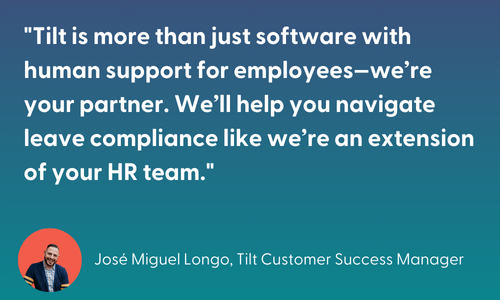
“Tilt is more than just software with human support for employees—we’re your partner,” explains José Miguel. “We’ll help you navigate leave compliance like we’re an extension of your HR team.”

Jose Miguel Longo Quote

Whether you want a fully managed leave solution or a co-pilot to work alongside your existing team, Tilt gives HR leaders the confidence and support they need to navigate leave management with ease.

Why the Right Leave Management Partner Makes all the Difference

When it comes to leave, HR’s ability to provide a great employee experience, stay compliant, and work efficiently is the name of the game. 

The best solutions blend technology, human support, and compliance expertise to deliver impactful results that support employees in a way that moves businesses forward. Not to mention alleviating all of HR’s admin work associated with each and every leave.

With Tilt, you get more than just a platform. You get a partner dedicated to making leave management stress-free, compliant, and, dare we say…kind of awesome (oh, we dare).

Tilt is leading the charge in all things leave of absence management through easy-to-use tech and human touch. Since 2017, our proprietary platform and Empathy Warriors have been helping customers make leave not suck by eliminating administrative burdens, keeping companies compliant, and providing a truly positive and supportive leave of absence experience for their people.

Related Posts

5 Key Takeaways from “Modern Leave Strategies: Fixing the Broken Playbook”

Rethinking Leave Management for a Human-Centered Workplace

Let’s start with a hard truth: leave management is messy.

Too often, it’s seen as a compliance headache or an administrative checkbox. Something HR is required by law to manage, but nobody wants to discuss or deal with.

But more HR leaders are realizing that ignoring the way leave is managed isn’t just risky, it’s damaging to employees, to business success, and to company culture.

Tilt recently held a live panel discussion with experts who live and breathe leave of absence and the consensus was clear:

The system is broken. And it’s time we fixed it.

Moderated by Daniel and Stephen Huerta from Modern People Leader, Tilt’s Founder and CEO Jen Henderson was joined by Justin Clifford, CEO of Bereave, Allison Whalen, CEO of Parentaly, and Jessica Winder, SVP of People at CoLab to talk about exactly that.

If you didn’t get a chance to watch the incredible discussion, you can watch it on demand here.

Below are the 5 main takeaways you might have missed.

1. Leave Management Is More Than Just Checking the Compliance Box

While compliance remains a foundational element of any leave program, it’s only one element of a complicated process.

Navigating evolving laws and state-specific requirements can be complex even for the most diligent HR teams, but the true impact lies beyond legal line items.

Focusing solely on regulations overlooks two equally vital dimensions: maintaining business and career continuity, and honoring the personal, often emotional, life events that prompt a leave. Common events such as welcoming a child, managing a health challenge, or caring for a loved one only scratch the surface.

These pivotal moments in an employee’s life deserve more than administrative efficiency.

“It’s bigger than ‘approve this leave and then just come back to work,’” says Jessica, “so think about it as a whole-person experience, not just here’s your leave and come back whenever you’re ready.”

When organizations reframe leave from a compliance obligation to a human-centered experience, they create space for empathy, stability, and long-term engagement—at the moments it matters most.

2. The Manager-Employee Relationship Shapes the Leave Experience

Managers are the linchpin of the leave experience. but they’re often left without the tools, training, or support to navigate it well.

One story during the discussion made this clear: a woman returning from bereavement leave was met with well-meaning but painful questions about how her “vacation” went. The absence of manager preparation and team communication turned an already difficult moment into a distressing one.

Managers don’t need to be legal experts, but they do need support and partnership from HR.

“The best and most incredible HR leaders in the world still need the partnership of those people leaders and managers, especially in the world of leave,” says Jen.

With the right language, checklists, and clarity, they can confidently navigate sensitive moments with care and professionalism. Justin rightly explained that you can’t SOP grief, but you can SOP the considerations when someone is grieving.

Educating and empowering managers this way transforms them from bystanders into allies, and ensures employees feel respected and understood at every step.

3. Proactive Communication Turns Benefits Into Impact

One of the most persistent challenges in today’s workplace is also one of the simplest to solve: employees often don’t know what benefits are available to them.

This lack of awareness isn’t just unfortunate, it can be seriously costly. Organizations invest significant time and resources into building comprehensive benefits packages, but if employees can’t easily access or understand them, the value is lost on both sides.

The solution lies in proactive, ongoing communication. Benefits shouldn’t be something employees stumble upon digging through an intranet or during onboarding, they should be embedded into the rhythm of everyday work life. Companies seeing the highest engagement are the ones taking intentional steps to bring benefits to the forefront.

Some effective tactics include:

  • Weekly “Did You Know?” Slack messages that highlight timely or underused benefits
  • Email signatures that link directly to leave policies or Employee Assistance Programs (EAPs)
  • Equipping managers with easy-to-use benefit FAQs so they can confidently guide their teams

These small, consistent actions add up. When employees are reminded of their benefits in relevant and accessible ways, they’re more likely to engage with them. And when employees feel supported, the organization benefits too through higher morale, improved retention, and a culture that values well-being.

In short, benefits are only as powerful as the communication strategies behind them. Make them visible, make them clear, and most importantly, make them part of the everyday employee experience.

4. Performance Reviews and Compensation Deserve Intentionality

Leave shouldn’t derail someone’s career, but too often, it does. Despite the best of intentions, outdated processes and unclear policies can unintentionally penalize employees who take necessary time away, particularly during performance review and compensation cycles.

As Allison, puts it, “I would encourage people to think about how to handle performance reviews. You have to explicitly teach managers how to evaluate someone if they’ve been gone six months out of the 12-month period.”

Without clear guidance, managers are left to navigate these situations on their own, often leading to inconsistent or unfair outcomes.

There is also the persistent equity issue: employees returning from leave are sometimes excluded from review cycles altogether, or evaluated unfairly while they’re still ramping back up. Allison referred to this imbalance as the “motherhood penalty” and the “fatherhood bonus.” A reflection of how unconscious bias and outdated frameworks can create unintended disparities.

Closing this gap requires more than good intentions, it requires structure. Forward-thinking organizations are taking steps to ensure fairness and transparency by:

  • Encouraging pre-leave self-assessments and peer feedback to preserve performance insights
  • Setting clear performance review timelines that reflect time worked, not time missed
  • Auditing compensation models, particularly for variable pay roles, to ensure leave doesn’t result in financial setbacks

These thoughtful practices send a clear message: people are valued not just when they’re at their desk but throughout their entire employee journey. When companies align their review and compensation processes with inclusive, equitable principles, they build a workplace where taking leave doesn’t mean falling behind, it means being supported every step of the way.

5. Preparation and Personalization Transform the Leave Experience

One of the most powerful themes to emerge from this conversation is that leave moments are emotional multipliers. How a company shows up during these deeply personal times leaves a lasting impression shaping trust, loyalty, and long-term retention.

Re-onboarding illustrates this perfectly. Often overlooked or treated as a checkbox, it’s actually a key opportunity to rebuild connection. A thoughtful re-entry plan, a warm welcome message, or a dedicated 1:1 with a manager can turn a moment of uncertainty into one of belonging.

Modern leave is not, and should never be, a one-size-fits-all process. Each employee’s circumstances are unique, and their leave experience should reflect that. Early planning, personalization, and consistency are what set great programs apart. This is where the right blend of technology and humanity matters most.

Automation can handle the workflows, documentation, and compliance checkpoints. But the human experience? That can’t be automated. As Jen noted, “Technology can’t replace people, but it can free HR to focus on the people.”

When organizations get this balance right, they send a clear message: every employee matters, not just when they’re working, but throughout their entire journey—including the moments that take them away from work and bring them back again.

The Path Forward: Rethinking Leave as a Strategic Advantage

Leave management doesn’t need another temporary fix, it needs a holistic reimagining. Today’s most resilient organizations recognize that supporting employees during life’s most pivotal moments isn’t just a matter of compliance; it’s a cornerstone of culture, trust, and long-term success.

The path forward calls for a smarter, more human approach. That means:

  • Automating compliance to reduce manual risk and free HR teams to focus on people, not paperwork
  • Equipping managers with the tools, training, and language to lead with clarity and empathy
  • Re-onboarding with intent, turning return-to-work moments into opportunities for connection and care
  • Communicating benefits proactively, so employees know what’s available—before they need it
  • Treating leave as a human journey, not just a policy to enforce

Because in life’s most vulnerable moments, it’s not a document that shows up, it’s a manager, a teammate, a company’s culture in action.

The organizations that embrace this shift are doing more than checking a box. They’re building loyalty. They’re reinforcing trust. And they’re creating the kind of workplace that stands strong, no matter what life brings next.

Tilt is leading the charge in all things leave of absence management through easy-to-use tech and human touch. Since 2017, our proprietary platform and Empathy Warriors have been helping customers make leave not suck by eliminating administrative burdens, keeping companies compliant, and providing a truly positive and supportive leave of absence experience for their people.

Related Posts

Flexibility, Control, and Peace of Mind in Leave Management

From navigating shifting employee expectations to tackling widespread burnout, HR leaders are facing an ever-growing list of responsibilities and your roles have never been more complex.

In spite of that, one challenge remains at the core of a well-functioning organization: effective leave management.

When managed well, employee leave goes beyond checking necessary boxes and can turn into an opportunity to strengthen organizational resilience, support employees, and enhance overall business performance.

However, achieving the right balance of flexibility, control, and peace of mind when it comes to leave requires a strategic approach. One that empowers HR rather than limits it.

The Evolving Landscape of Leave Management

Over the past few years, leave policies have undergone significant shifts, driven by changing workforce demographics and a heightened focus on employee well-being. Employees today expect more than just the standard PTO package, they want options that fit their evolving needs, from mental health days to extended parental leave.

Beyond employee expectations, legal requirements around leave management continue to evolve, adding another layer of complexity for HR teams. The 2025 NFP US Leave Management and HR Trend Report highlights how staying compliant with changing laws is critical to avoiding costly penalties and maintaining competitive leave policies.

Tilt’s 2025 Leave Benchmark Report takes it a step further and shows just how critical getting leave right is to business success.

Leave is complex and it’s critically important for a business to get right. So what’s your option to give you the right blend of technology, human support and oversight to get the job done without adding more stress to your plate?

The Pitfalls of Leave Management Blindspots

To reduce administrative burdens, some organizations turn to third-party providers to handle leave management entirely. While this can free up time for HR teams, it often comes at the cost of visibility and flexibility, two key factors in ensuring that leave is managed effectively and in alignment with company culture.

Outsourcing can result in a one-size-fits-all approach that fails to consider the unique needs of your workforce. Without direct oversight, HR leaders lose the ability to proactively address leave-related challenges, make adjustments in real time, or leverage leave data strategically. Instead of an asset, leave becomes an administrative black hole—disconnected from broader HR and business strategies.

Why In-House Leave Management No Longer Cuts It

For many HR teams, managing leave in-house was once the only way to retain control. But today, that control often feels like an illusion. With leave laws constantly shifting, employee expectations evolving, and the sheer volume of administrative tasks increasing, HR leaders are understandably overwhelmed.

The unpredictability of leave management makes it nearly impossible to stay ahead. Each leave request comes with a flood of to-dos from eligibility verification, leave plan building, compliance tracking, payroll coordination, employee communication, and workforce planning.

The process is dynamic, requiring constant adjustments based on evolving circumstances. Instead of feeling in control, HR is stuck in a reactive cycle, always one step behind.

Rather than enabling HR to be strategic, in-house leave management is consuming valuable time and energy that could be spent on higher-impact initiatives.

Not to mention it puts your organization at serious risk of violations and overpayments.

Organizations need a better solution. One that preserves flexibility and oversight without the burden of endless manual processes.

Addressing HR Burnout Through Smarter Leave Management

HR leaders are no strangers to burnout. In fact, an overwhelming 98% of HR professionals report experiencing burnout, with 94% feeling overwhelmed and 88% dreading work in the past six months.

A significant contributor to this stress is the manual, fragmented nature of leave management. Juggling so many moving parts, especially at scale, can quickly become unmanageable without the right systems in place.

By leveraging technology to streamline processes while maintaining complete oversight in the process, HR leaders can reduce administrative strain, minimize errors, and gain back valuable time to focus on higher-impact initiatives, and peace of mind over one of the most complicated responsibilities.

The Role of Technology in Modern Leave Management

Organizations are increasingly turning to tech-driven solutions to improve leave management efficiency. Over 60% of businesses now incorporate automated leave tracking, reflecting a significant shift toward digital transformation in HR.

Modern leave management platforms give HR teams the ability to effortlessly:

  • Automate manual processes like leave plans, tracking and payroll
  • Incorporate the latest leave laws to ensure compliance
  • Gain real-time visibility into leave trends and workforce availability
  • Provide employees with clear guidance and 1-1 support reducing administrative burden and back-and-forth correspondence
  • Integrate leave data with broader HR and payroll systems for a seamless experience

The right leave software should do all of this for HR teams no matter what leave types are being requested and no matter what state the employee resides in.

More importantly, it should do all of this for HR teams without removing them from the process. Leadership and employees alike expect HR to be in the know when it comes to organizational leave, and outsourcing the process entirely keeps organizations in the dark.

And if you’ve ever tried navigating even the simplest of tasks in the dark, well, you can see why it’s so important to have the flexibility to see all aspects of every leave when needed.

Trusting Leave Management Technology

For progressive HR leaders, the balance of flexibility, control, and peace of mind in leave management is critical.

While outsourcing may seem like an easy fix, it often creates more long-term challenges than it solves. By keeping leave management in-house, your team is drowning in a never-ending sea of uncertainty and paperwork.

However, by leveraging the right leave technology, HR teams can reduce burnout, ensure compliance, and use leave data strategically to support both employees and business objectives.

This is where Tilt comes in. Tilt’s leave management technology provides HR teams with the perfect balance of automation and control. Unlike traditional outsourcing, Tilt’s platform keeps HR in the driver’s seat as much as they want to be, ensuring compliance, streamlining processes, and delivering a seamless experience for both employees and administrators.

Tilt is the one leave solution that offers flexibility, control and delivers peace of mind when managing leaves of absence. Better leaves with less burnout was once a mere dream for HR teams, but now it’s a reality most organizations can’t afford to live without.

Tilt is leading the charge in all things leave of absence management through easy-to-use tech and human touch. Since 2017, our proprietary platform and Empathy Warriors have been helping customers make leave not suck by eliminating administrative burdens, keeping companies compliant, and providing a truly positive and supportive leave of absence experience for their people.

Related Posts

Join us February 20th, 2025 at 11AM MST – Tilt Live Demo | Register Now>>