How to Nail Leave Benefit Education

So you offer the most robust, inclusive, comprehensive, and (fill in your favorite adjective here) leave benefit policy in your industry…but none of your employees know it. Bolster your benefits with an education plan that keeps your employees informed, engaged, and set up for success should any life event rear its untimely head.

Talk is cheap…so have a strategy

Employees love having benefits (hard-hitting journalism), but while co-pays and deductibles might stay top-of-mind beyond open enrollment, and vacation days digitally circled with fervor, benefits pertaining to an employee’s right to leave of absence (LOA) might be an afterthought for your general employee population…until life hits the fan and they’re frantically searching for answers.

This becomes problematic when an employee feels either:

  1. They don’t have a right to an LOA when they actually do.
  2. They’re worried they’ll be reprimanded for requesting a leave.
  3. They ask their manager and they’re not sure either.

Awareness and education can make all the difference, and with the right communication strategy, your people will feel informed and empowered. A one-size-fits-all approach might seem appealing, but if you want increased engagement and absorption of leave benefits info, offer a variety of direct communications to your employees.

Here are a few methods you can incorporate into your strategy:

  1. Periodic emails with reminders of benefits
  2. Town halls with a Q&A, 
  3. A direct line to communicate with HR
  4. Slack (or internal chat solution of choice) channels specific to benefits where questions can be asked
  5. Get creative with the content i.e., video messaging, interactive activities

Be resource-full

Even with a communication strategy in place and operational, there’s still an opportunity to educate employees on leave. Not everyone feels comfortable asking questions about leave to colleagues, so even with a comms strategy in place, if taking a leave isn’t on your employees’ radars the details of leave might not be clear.

Develop a resource center that houses all the latest information about your organization’s leave policies, then reference or link to that resource center in all of your communications pertaining to benefits. These resources should outline what your policies are, who can use them, the process for requesting a leave, and any state or federal benefits that they might be entitled to depending on the state in which they live.

Make managers a priority

Employees tend to have a stronger, more personal relationship with their managers than they do with their People Teams. As such, it’s not uncommon for an employee’s first point of contact when asking about a leave of absence is their manager. While they should be going to HR, this isn’t a major concern if that manager is both empathetic and informed on state and federal leave laws and company policy, but managers can become a major leave liability when that’s not the case. 

Educating managers on the do’s and don’ts when their employee is taking a leave can help organizations minimize compliance risks, reduce turnover connected to a poorly managed leave, and give them the tools to provide a soft place for the employee to land upon return. Managers should be given these educational materials because they play a very specific role in the leave journey.

Seek out software

If you’ve made it this far down the blog (hi), you might be thinking to yourself “ME AND WHAT ARMY??” The burdens on People Teams have been ballooning at breakneck speeds these last few years, so this might be an opportunity to look into outsourcing some of the administrative work around leave management and education. 

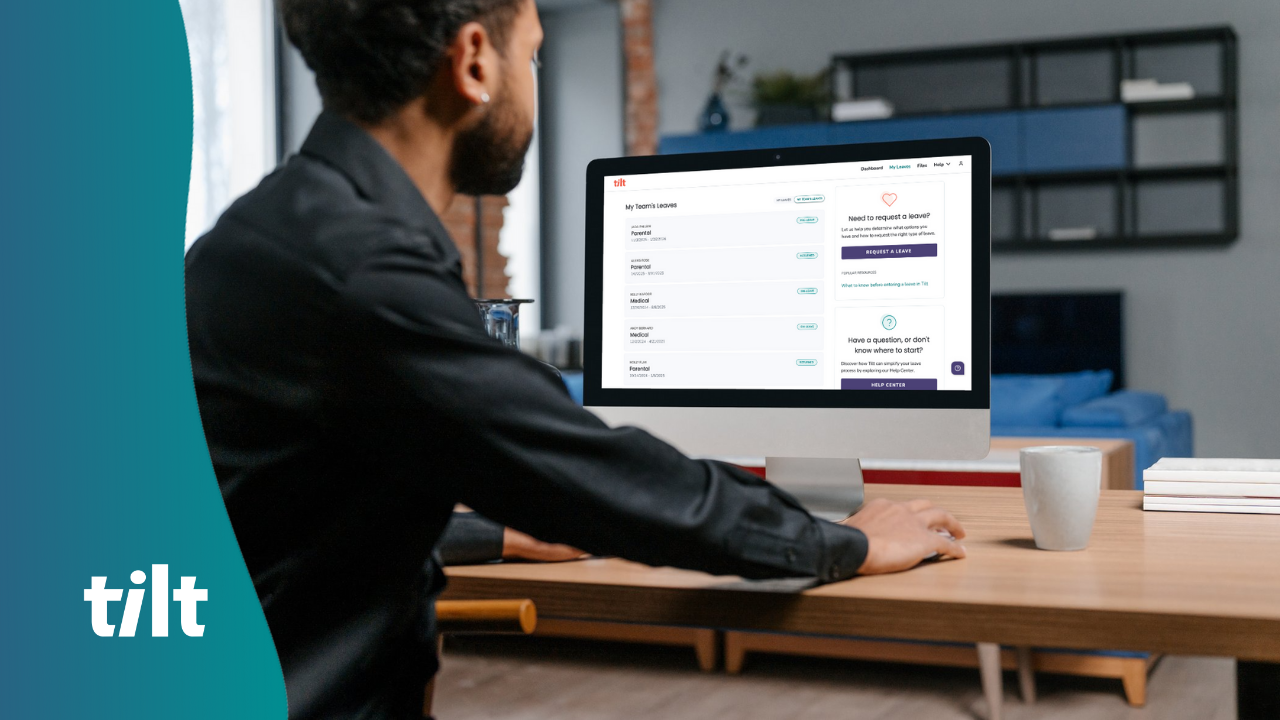
Technology solutions can offer efficiencies and compliance confidence that Excel spreadsheets and leave law Google searches never will. Outsourcing your leave management will not only save your department valuable time and money, but also opens the door to impactful communication and education opportunities so you can get back to focusing on improving the lives of your employees.

Be analytical

Once you’ve got your educational systems (whether in-house or outsourced), the best way to determine if your people are educated on your organization’s leave benefits is to send out surveys. Employees don’t love taking surveys (more hard-hitting journalism), so keep them brief (3-4 questions) and use them sparingly (once every 6 months). 

The results of a leave benefit survey can tell you everything you need to know about how informed your people are as it pertains to leave at your organization. It can show where educational gaps exist so you can continue to refine your strategy and improve the leave experience over time.

About Tilt

Tilt is leading the charge in all things leave of absence management through easy-to-use tech and human touch. Since 2017, our proprietary platform and Empathy Warriors have been helping customers make leave not suck by eliminating administrative burdens, keeping companies compliant, and providing a truly positive and supportive leave of absence experience for their people.

Related Posts

Spreadsheets and Soft Skills: How Tilt Replaces One and Boosts the Other

Updated on May 5, 2025

We wanted to take this opportunity to issue a sincere, but not-so-formal apology to spreadsheets. There are some spreadsheets out there that do tremendous work (we see you vacation packing lists) and yet over the years Tilt and our customers have had some less-than-flattering things to say about spreadsheets.

So when we talk about how spreadsheets cause HR teams managing their leaves of absence to react anywhere from keyboard flipping to mild aneurysms, we aren’t directing disdain toward spreadsheets themselves, just the maddeningly frustrating experience of trying to use them to navigate and store data for extremely complicated workflows like LOA management.

We also want to take this opportunity to talk to managers of employees taking a leave of absence. Managers…we love you. Your jobs are impossibly hard and stressful and we get it, you’re not LOA experts. That said, there are important skills managers need to have when handling an employee’s leave of absence that they aren’t exposed to while climbing the ladder.

Go tab-less with Tilt

Leave dates. Payroll. Tracking multiple employees. Leave Laws. State benefit program deadlines. Yeah, there is a lot to manage when an employee goes on leave. Depending on which systems your information lives in, you might be pulling and compiling from all sorts of different sources that can make your spreadsheets a tangled tab nest of nastiness that you have to navigate every time a new leave pops up.

Tilt removes the need for spreadsheets by providing a single-source-of-truth software platform that’s as intuitive as it is efficient and effective for managing leaves. Not only is everything housed in one place for all necessary stakeholders (i.e. payroll and the employee’s manager) to access insights on a given leave, but you also have dedicated Tilters there to help answer any questions you or your employees taking leave may have.

Our customer success and leave success managers are both backed by payroll specialists and leave law experts to ensure that when you hand off your leave to Tilt, all your leave woes go the way of the spreadsheet; bye-bye.

The hard truth about soft skills

Soft skills are like Maybelline, some managers are born with it…others have some makeup (puns are fun) to do. One of the most important obstacles Tilt faced when developing the industry’s best leave management solution was figuring out how to break down stigmas and eliminate bad habits from employers.

While managers continue to be one of the leading causes of employment law violations, many times they don’t even know they’re acting outside of accordance with the law.   

Educating managers about harmful stigmas and assumptions around taking a leave of absence is a way to level up the soft skills required to handle an employee going on leave. In this regard, the manager plays a vital role in the efficacy of a leave of absence. 

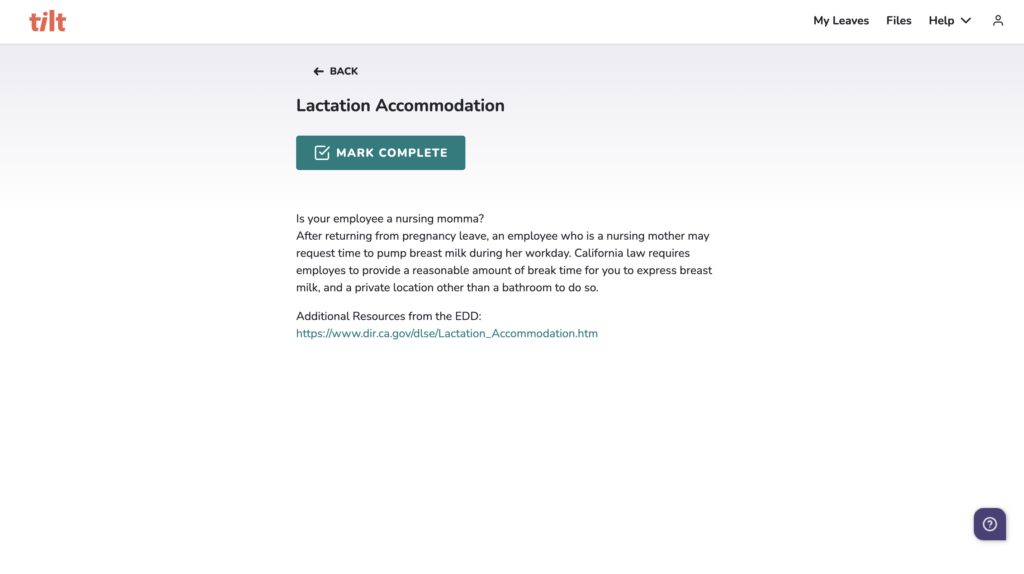
Throughout the leave journey, Tilt provides managers with education about the specific leave their team member is taking, as well as things they can and can’t do, or can and can’t say to their employees before they take a leave, while they’re on leave, and when they return from leave.

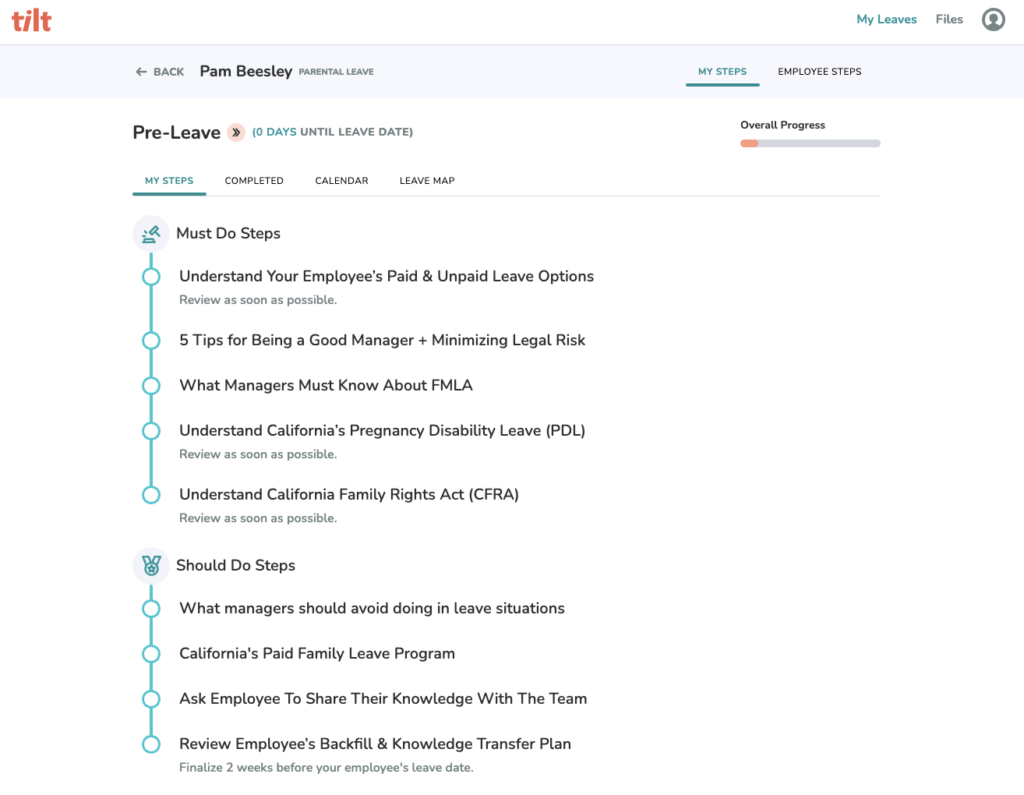
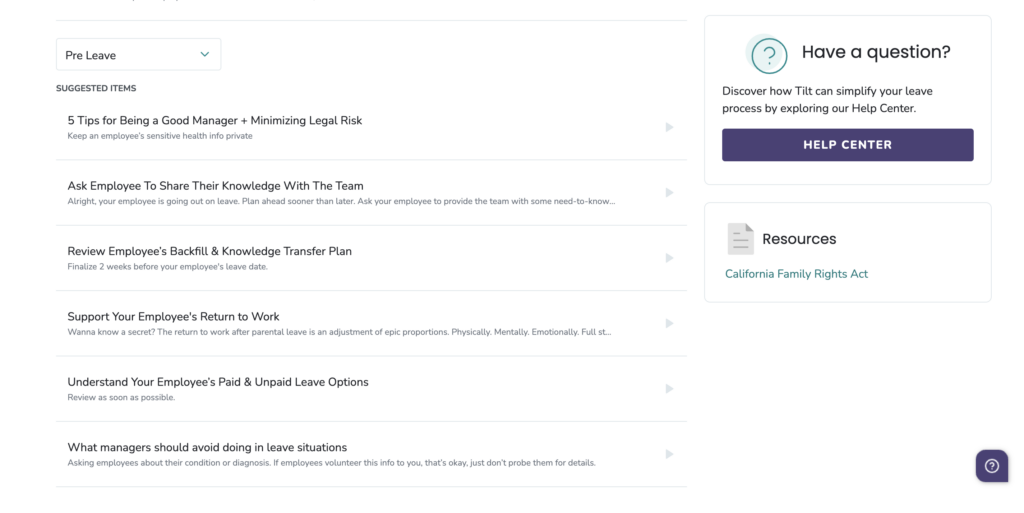
Pre-Leave: Tilt provides education to each manager so they can successfully support their employees
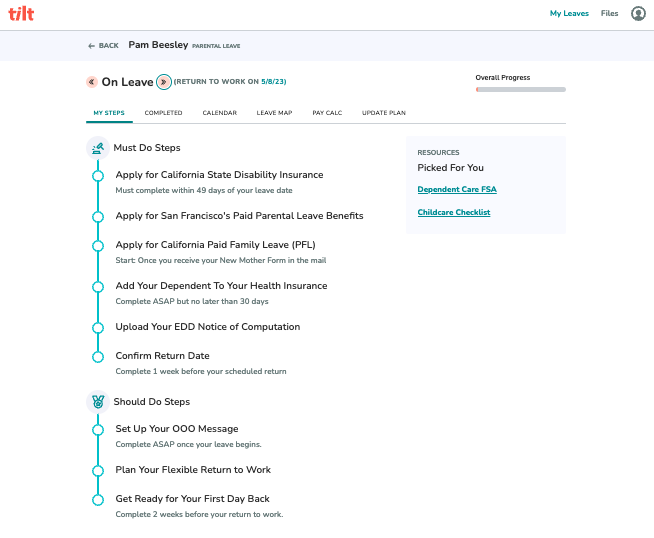
On Leave: Tilt offers guidance on what managers can and can’t say while an employee is out on leave
Returning to Work: We customize every leave plan so when an employee returns to work they feel supported in the ways that matter to them.

Tilt makes life easier for everyone

Tilt’s holistic approach to leave of absence management means that People Teams are free to ditch the spreadsheets and focus more on the work they love, employees are given the TLC that matters when they need it most, and managers are educated on how to be better leaders throughout the journey (and also help mitigate potentially costly lawsuits).

About Tilt

Tilt is leading the charge in all things leave of absence management through easy-to-use tech and human touch. Since 2017, our proprietary platform and Empathy Warriors have been helping customers make leave not suck by eliminating administrative burdens, keeping companies compliant, and providing a truly positive and supportive leave of absence experience for their people.

Related Posts

Top 7 HR Productivity Killers to Avoid

Do you ever sit and ask yourself, “Why would I spend 5 minutes doing a work task when it could bog down a full hour and a half of your day and make me pull my hair out?” Productivity woes are commonplace in every department, and when it comes to fighting the never-ending battle against workplace inefficiencies, HR is certainly no exception. 

You can’t know what to fix until you know what’s truly broken. Identifying which pain points you currently have is the most important step in improving your HR team’s productivity. Unsure where to start? Well, that’s why you clicked on this blog right?

1. Manual processes and spreadsheets

You don’t need to communicate via carrier pigeon anymore (though how sweet would that be?). Similarly, your team doesn’t need to do half of the manual tasks it’s currently managing. Doing a process audit will help you identify what your department’s most inefficient tasks are so you can prioritize how you want to minimize the manual work. 

We’d never speak ill of the cultural contributions “the spreadsheet” has given to society, but holy [redacted] they can be a nightmare to manage. It’s one of the biggest complaints our customers have when it comes to leave of absence management, and the lack of sophistication is robbing your team of time and the joys of MFMs (Migraine-Free Mondays), and depending on what’s in the spreadsheet could be increasing your compliance risks. All productivity killers.

2. A lack of workforce data and insights

A wise person once said in this blog, “It’s important to have workforce data and insights.” Keeping the metrics that make your team tick readily accessible can increase productivity in a variety of ways. HR teams get asked a lot of questions. A LOT of questions. From needing to know the headcount of a particular region or what the turnover was in the last year and the reasons behind it, a few questions could send you down an inefficient rabbit hole of emails and spreadsheets to try to get some accurate data.

Collecting data on your team members themselves can paint a picture of where you might need to improve as a functioning department. With those insights you can put policies and procedures in place that can boost employee morale and engagement, which has a direct positive effect as they become motivated beyond personal factors.

3. Talent acquisition and retention

Finding talent can sometimes feel like finding a needle in a haystack, the OG productivity-killing activity. Increase your speed and hit rate by reducing lengthy applications that then need reviewing, taking the time to work with managers to develop clear job descriptions, keeping early-round interviews tight and focused, and avoiding dragging out the time in between steps. 

SHRM states that the average time it takes to fill a position is 41 days. A great way to avoid the painstaking and lengthy process of hiring new talent is to do everything possible to keep the talent you have. Though sometimes retention is out of the control of HR (i.e., layoffs, retirement, pool leadership), pulse surveys can gauge employee satisfaction at a high level, and being a champion for better benefits and support that matter to your people can help boost employee engagement. Keeping the people in your organization happy can be a major productivity boon for HR.

4. Social media screw-ups

Nothing derails a day like learning one of your employees has gone and acted a fool on social media. Having a well-developed and comprehensive social media policy can help minimize these snafus, but nothing can be done to quell them completely. This is why it’s not only important to have clear guidelines of what is and isn’t considered acceptable social media etiquette as a representative of your brand, it’s equally important to have an easy-to-follow and administer plan of action should an employee cross the line.

5. Training...everybody’s favorite

Look, we aren’t going to stand behind the safety of our keyboards and tell you there’s some magical way to make training fun, we aren’t that edgy here at Tilt. When it comes to job training and employee productivity, however, our good friends at Udacity share that effective job training can boost employee satisfaction, help retain employees, and can boost long-term organization success.

Having well-trained employees outside of HR means fewer administrative headaches for the folks in HR. Furthermore, applying the same approach within your department can help you reap the benefits of training directly as a team.

6. Tech that's out of touch

If the manual processes and spreadsheets from section one make your workflows tedious and tumultuous, dispersed tech systems that have been extended well beyond their useful life are only adding fuel to your dumpster fire. 

Auditing your existing software systems and investing the time and resources to improve your tech stack can not only increase productivity, it can eliminate some of your manual processes altogether. Look for solutions that can consolidate multiple systems into one and can automate some of your least efficient to-dos in the process.

7. Culture that's an afterthought

There’s no comprehensive cure-all for productivity woes, but if you’ve made it this far (hi), you’ll notice that a majority of the productivity killers we’ve discussed have some level of interconnectedness. Perhaps no productivity parameter is more pervasive than your culture.

The upper limit of your department’s productivity is capped by its culture. You could have the most efficient processes and high-end software solutions at your disposal (dare to dream, right?) but if your team’s culture is toxic and your people don’t feel supported you’ll still be performing at suboptimal levels.

A positive culture is linked to employee retention, high satisfaction levels, and a more engaged workforce that’s ready to capitalize on all of these productivity-enhancing efforts.

About Tilt

Tilt is leading the charge in all things leave of absence management through easy-to-use tech and human touch. Since 2017, our proprietary platform and Empathy Warriors have been helping customers make leave not suck by eliminating administrative burdens, keeping companies compliant, and providing a truly positive and supportive leave of absence experience for their people.

Related Posts

How Leveraging Tilt Eases Stress When Hiring is Slow

Whether you’re struggling to find talent or struggling to find budget, a slow-down in hiring can have frustrating ramifications for an HR department. If you’re having trouble filling important positions outside of the HR Team that of course can prolong the draining of your resources, but when it impacts your team directly you could be faced with some serious capacity problems on the horizon. 

Hiring also might be slow because your organization has decided to put new hires on pause for a hot sec, and here too your team might be faced with doing less with more (as if you aren’t experts in that already).

To keep that rising tide of anxiety at bay, most HR Managers we interact with have performed audits of their least efficiently run tasks. From there they started looking for affordable solutions to streamline their clunkiest to-dos, i.e. a solution that wouldn’t require headcount. Perhaps unsurprisingly since this is a blog from an LOA management tech company website, leave of absence management was a major thorn in the side for nearly all People Teams looking for relief. 

As luck would have it, Tilt happens to have the best solution for precisely that. 

“I immediately think of all the time I now have back to focus on other things. I have been able to put a lot of effort and work into improving our company’s culture since I haven’t been so focused on leave management.” – Sr. HR Operations Manager at Ease and Tilt user/super fan.

Money matters

It’s not just time and sanity you’ll save with Tilt (on average it takes 10-20 hours of HR bandwidth to manage one leave), your organization also can mitigate compliance risks by ensuring your employee’s leaves aren’t being mismanaged, and their managers are being educated on proper behavior and the latest job protection laws.

We also make filling out and filing state benefit forms a breeze (we even send deadline email reminders) which helps ensure your organization will cash in on any applicable program funds. Furthermore, a negative LOA experience could mean they’re DOA when they get brought back into the fold. A positive experience increases the likelihood that they won’t be eyeing a new job because either their manager kept (illegally) blowing them up while they were on leave or they came back and found their position or career path isn’t what it once was. Or perhaps payroll was a nightmare while on leave and they have resentment toward their employer for it. 

Having to backfill an employee because their LOA takes both time and money, all of which can be avoided when you give leave some love.

How Tilt uses less to give more

If headcount capital is restrictive and your team’s bandwidth is tight it might be time to break free from archaic systems and processes and explore outsourcing options like Tilt for leave of absence management. Tilt’s proprietary platform removes the HR and payroll burdens from People Teams while providing a human-centric (from real Tilters) and empathetic approach to managing their leave journey.

What you won’t be doing is struggling through a matrix of spreadsheets, googling leave laws for states you’ve never stepped foot into, trying to manage personal employee information across multiple systems and praying you’ve got payroll correct. All of your least favorite tasks go away with Tilt, everyone gets access to the information they need under one roof, and all while resting easy knowing that your employees are being given world-class support on their journey. 

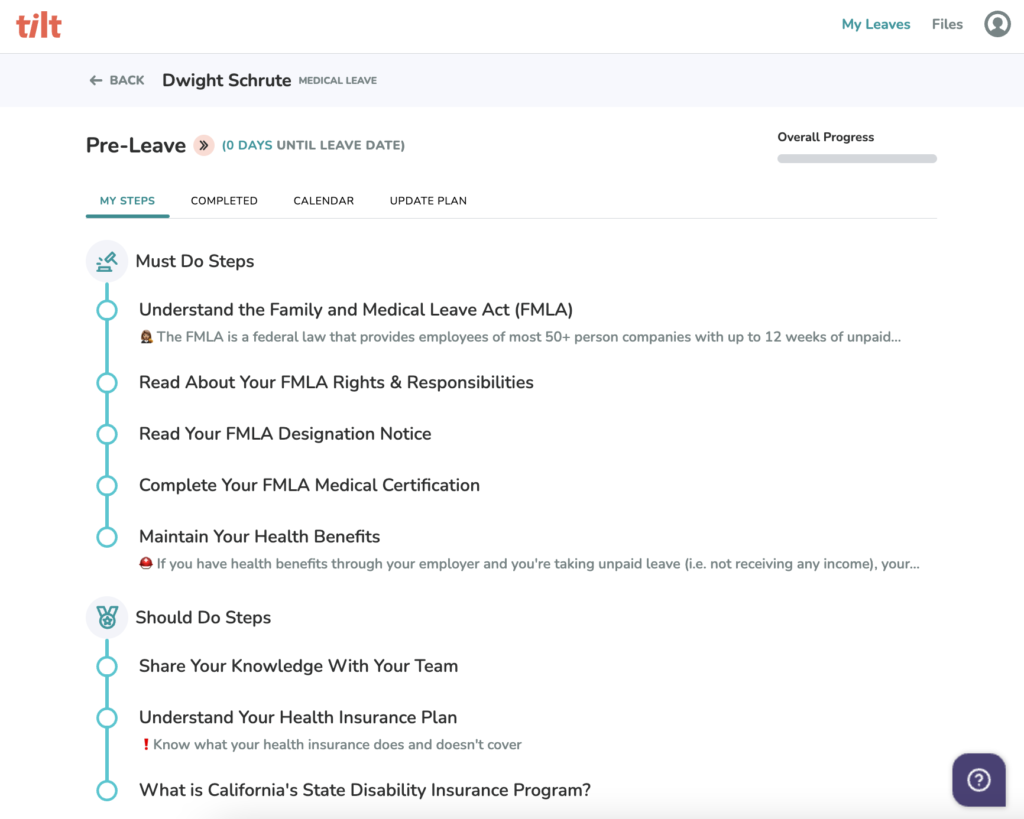
When an employee logs into Tilt they are shown a fully developed and personalized leave plan that shows them exactly what they can expect and what they need to know for their leave.

Tilt's personalized leave plans are built to help support employees for their specific leave journey.

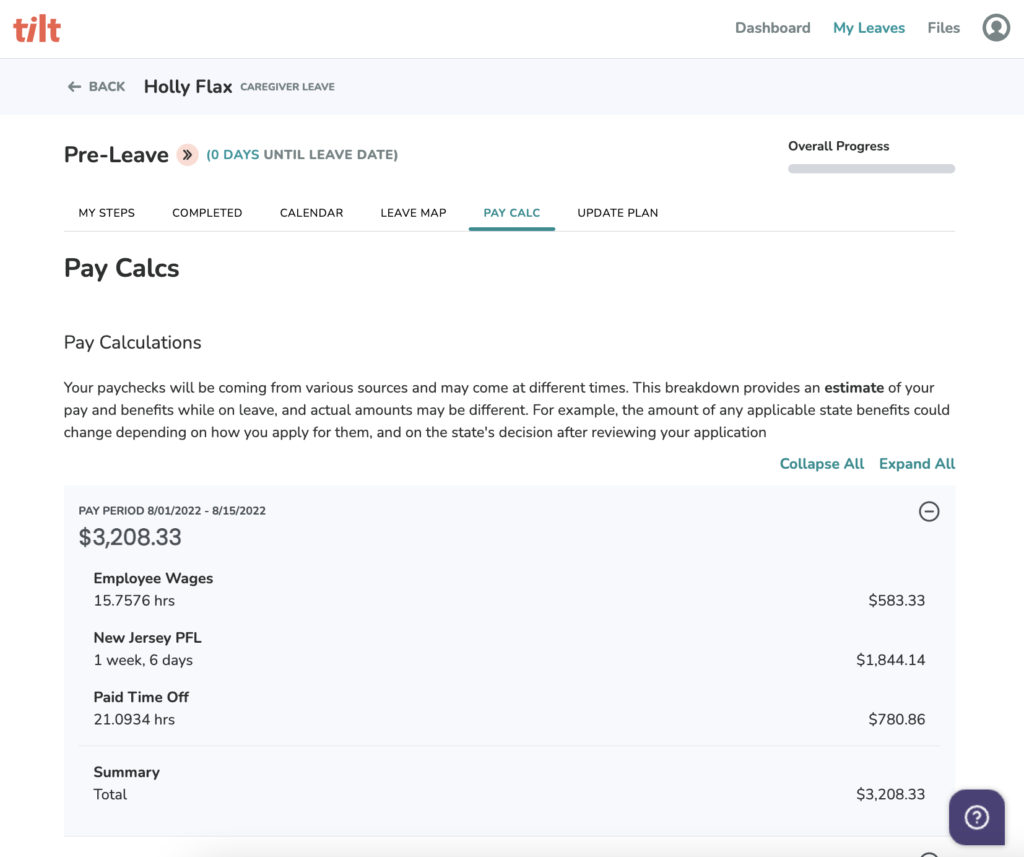
What about payroll? Well, they have access to Tilt too, but only to what they need to see in order to make sure your people are getting paid. Employee privacy FTW!

Pay calculations make ensuring your people get paid a cinch

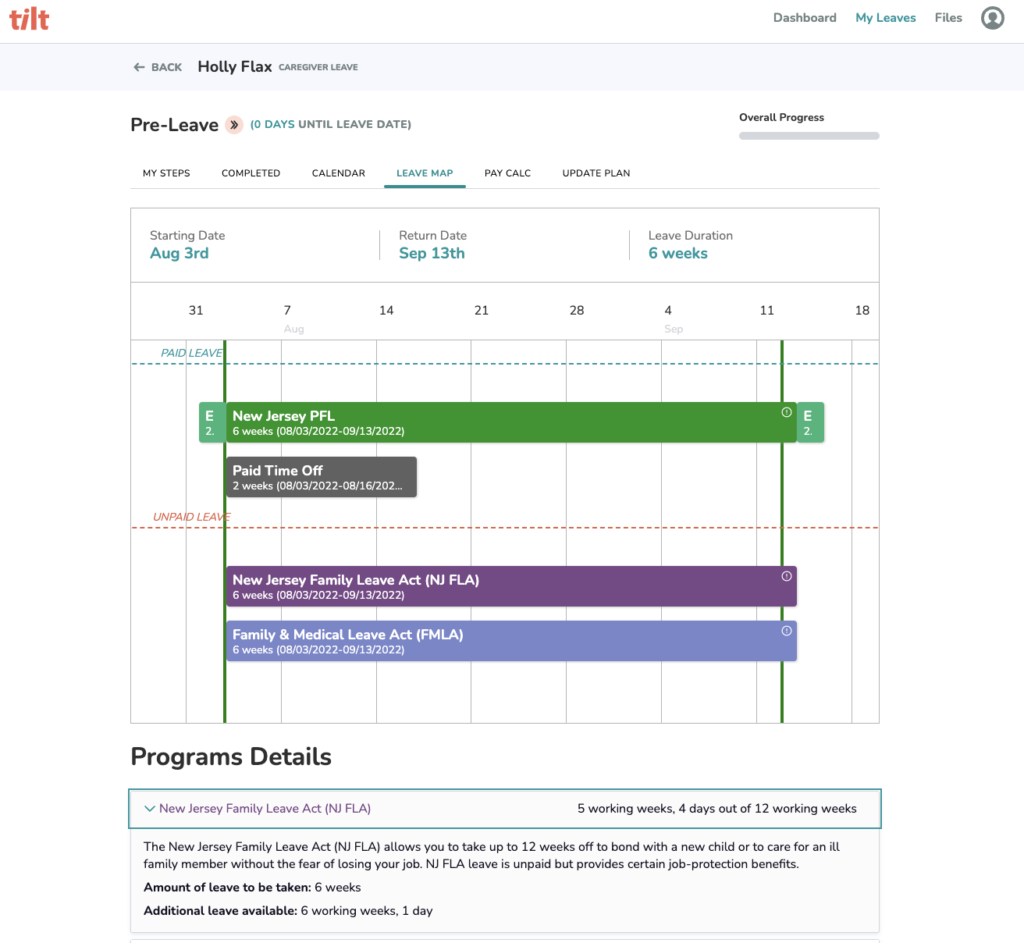
We also make it easy to understand where your employees are on their leave journey, as well as when certain benefits or programs start and stop. 

Easily see when benefits start and stop along the leave journey

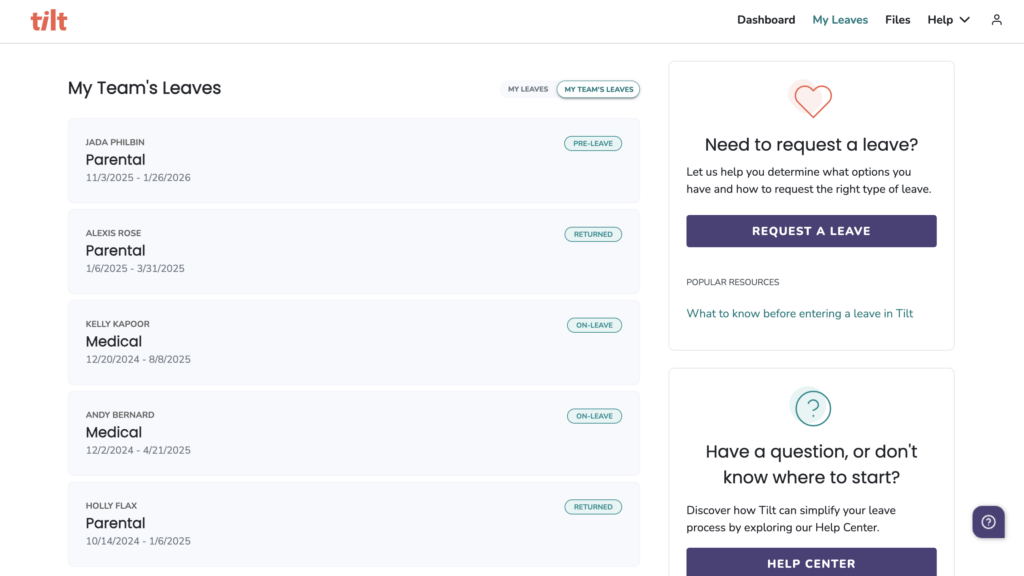
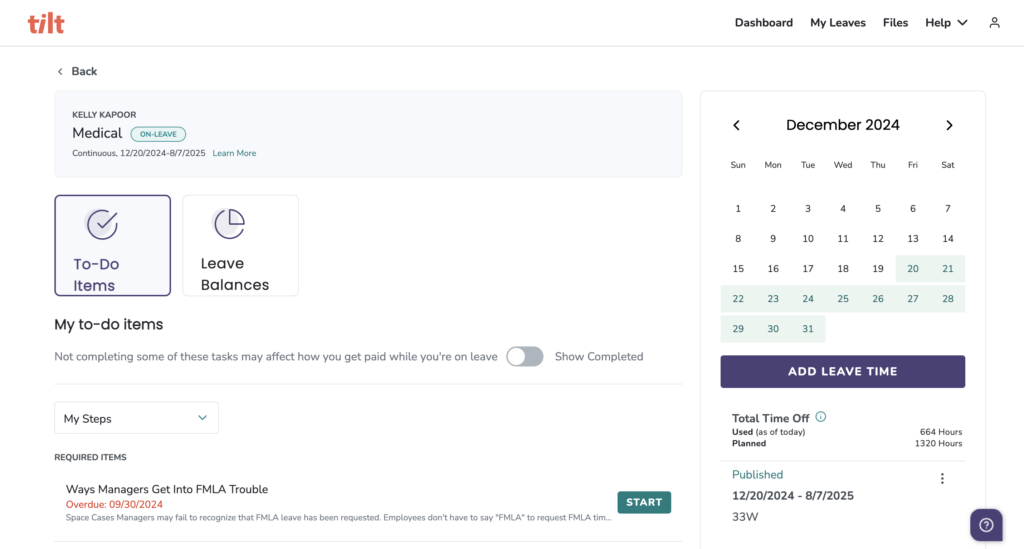
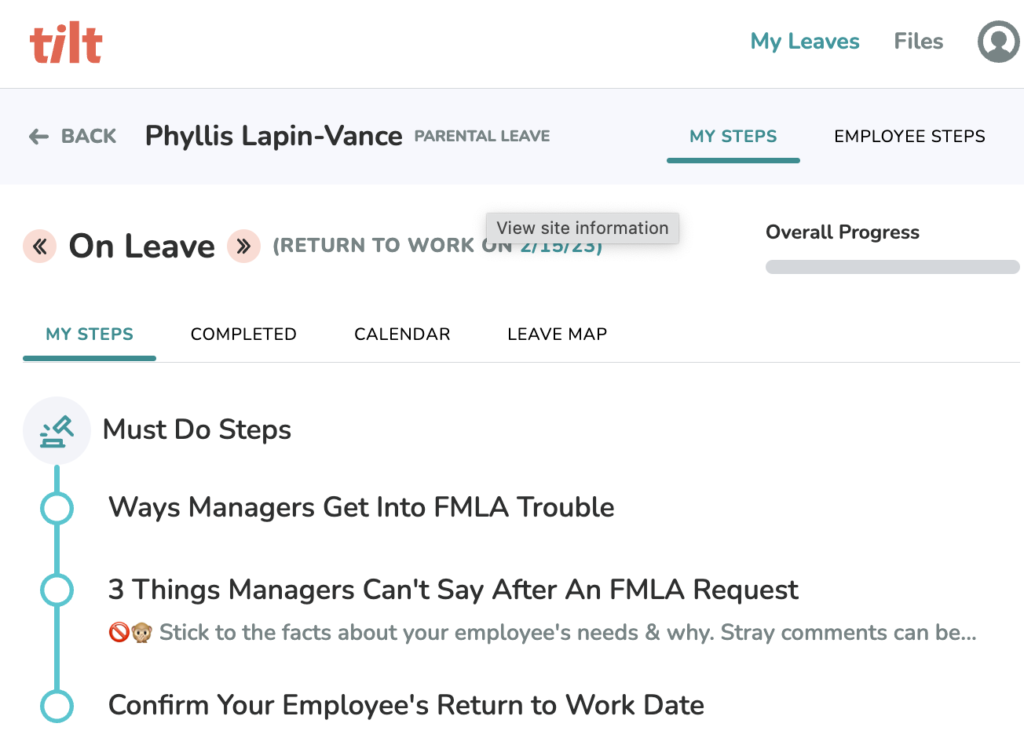
As for the managers, they’ll also be given access to Tilt with a window to see their employee’s leave status, details around their specific leave as well education for what they can do to facilitate a successful re-boarding.

Manager education is critical for LOA efficacy

Humanity matters

If Tilt only offered tech we wouldn’t be completely fulfilling our mission of making leave not suck. Taking a leave of absence might very well be one of the most human experiences your employees will go through, which is why we also have an in-house team of Leave Success Managers (AKA Empathy Warriors, AKA “The Heartbeat of Tilt,” learn more about them here) that are your employees’ personal guide to help them through the complexities that may arise throughout a leave.

Hiring slow-downs don’t have to hinder HR success

A hiring slowdown is an opportunity to find ways to reduce the friction in your team’s current day-to-day. With Tilt, you can unload the heavy burden of managing leave to us; we friggin’ love providing the best leave experience in the world for employees, HR, Payroll and managers. 

So ditch the spreadsheets, reduce your stress, and save time and money with Tilt.

About Tilt

Tilt is leading the charge in all things leave of absence management through easy-to-use tech and human touch. Since 2017, our proprietary platform and Empathy Warriors have been helping customers make leave not suck by eliminating administrative burdens, keeping companies compliant, and providing a truly positive and supportive leave of absence experience for their people.

Related Posts

HR Teams Are Smaller Than Planned…Now What?

“Every HR department has a headcount plan until their budget gets punched in the mouth.” – Mike Tyson…if he was in HR…probably.

From large organizations to scrappy startups, one constant remains: HR departments are rarely given the headcount needed to effectively support their people. As the rapid company growth we’ve seen in years past shows signs of slowing down, the roles and responsibilities of HR managers across the country are continuing to climb, or if you’re lucky, staying at their normal overwhelming levels.

If the hopes and dreams of your department were banking on some additional budget for more bodies that didn’t come to fruition, you aren’t alone. You also aren’t out of options.

Much ado about budgets

According to Gartner, HR’s budget allocations are roughly 2% of organizational operating expenses. Breaking that down a little further, the current numbers show there is roughly 1 HR employee per 66 FTEs, and roughly 9% of HR’s budget is spent on technology.

Some of you reading this might look at those numbers and immediately start to laugh-cry at your desk. Others might still be in the financial fight and are scrapping and clawing for headcount so you can effectively and efficiently do all of the primary functions of a healthy HR team. Others still might be facing the harsh reality that the HR department you have today might be looking leaner come next year.

Whichever scenario you find yourself, the budget will always be one of your HR department’s biggest constraints for success.

Audit for inefficiencies

If you can’t work larger, work smarter. You might have no control over what the final budget numbers or headcount are for your department, but what you do have control over is identifying and removing inefficiencies in your current processes and systems. Doing so has a double benefit. 

Spending time on inefficient administrative or low-impact tasks not only ties your team up when they could be doing work they’re passionate about for your organization, but also doing that work just kind of sucks, right? It’s a morale killer every time you or someone on your team has to manually dig through and update a labyrinth of spreadsheets and log into outdated systems with the world’s crappiest UIs. So since your team is looking lean, discover opportunities to make their jobs easier so they can focus on supporting your people and doing the work they love.

When is it time for Tech?

Regularly auditing your existing software solutions is generally considered good departmental hygiene, but it’s true now more than ever as HR teams continue to run lean and embrace the trend of digitizing their operations. In fact, the average HR team deployed 16.24 software systems in 2021, compared to 10.23 in 2020 and 8.85 in 2019. 

The good news is that doing an audit has a third benefit (knew we missed one) as it allows you to trim any existing budget fat caused by bloated and inefficient systems. It might not be enough to net you an FTE (even if they’d let you), but software is becoming a much safer budget play to pitch for that very reason. 

Today, many of the most inefficient processes (like leave of absence management, as a completely innocent example) require managing multiple systems that now can be automated and/or outsourced with a single tech solution. Modern tech solutions can not only save your team time, but in some cases can save your team money too.

Where do you start?

This question is a little tricky as each HR Department, whether you’re a team of 30 or one brave soul, operates slightly differently. If you’ve been overseeing a larger HR department it’s a great idea to survey your department on the biggest pain points of their workflows. Whether software systems or manual processes, encouraging your team to flag inefficiencies is a great starting point when evaluating which solutions will have the biggest impact. 

If you work for a smaller HR department, oh yeah, we see you. We know you’re well aware of each and every pain point because there’s just no avoiding them. So if your team isn’t growing, now is a great time to bring these pain points to the surface so you can reduce a bit of the burden.

Once you’ve identified which systems and processes need some TLC, it’s time to crowdsource and research potential solutions that will meet your department’s particular needs. The more intel you have on what’s not working and what solutions can make your operations run smoother, the best position you’ll be in to maximize your team’s efficiency and satisfaction with your given budget.

About Tilt

Tilt is leading the charge in all things leave of absence management through easy-to-use tech and human touch. Since 2017, our proprietary platform and Empathy Warriors have been helping customers make leave not suck by eliminating administrative burdens, keeping companies compliant, and providing a truly positive and supportive leave of absence experience for their people.

Related Posts

How Tilt Supports Managing Mental Health Leaves

Disclaimer: For the sake of this article, it should be noted that when we refer to “mental health leaves” we are talking about employees taking time off of work to address mental health conditions certified by a health care provider. We are not necessarily referring to an employee “taking a mental health day,” which is a colloquial term employees may use to signal that they are taking time to rest and recharge when there is no underlying medical condition.

If you’re living on planet Earth there’s a good chance that life has become a bit more stressful for you over these last few years. In the workplace, that added stress is manifesting itself in a multitude of ways that are having a tangible impact on human resource teams across the map. As one of our customers put it:

“A rapid growth in headcount (400-1,000), increased parental leaves (younger demographic) and an uptick in mental health/medical leaves due to COVID caused essentially a 1900% increase in anticipated leaves per year (from 3 to 40+). The lack of resources at hand makes this especially difficult for a two-person team.”

Without outside help, the rapid rate at which mental health leaves are putting additional burdens on people teams can become overwhelming quickly. This may lead to unsupported employees relying on overworked HR team members to guide them during a time of need, potential compliance risks due to managers who aren’t educated on the do’s and don’ts of mental health leave, and strengthened stigmas signaling to employees that perhaps taking a mental health leave is unacceptable.

Your solution for the unexpected

Mental health leaves aren’t typically planned out in advance. We don’t think to ourselves, “you know, March seems like a good month for my life to feel like it’s completely unraveling.” Because of that, an employee requesting a mental health leave might appear out of the blue, so you need to be ready to manage the leave and support your people at the drop of a hat.

With Tilt, an employee needing a mental health leave will come into Tilt where our Leave Success Managers (AKA LSMs, AKA Empathy Warriors) will build out a personalized leave plan outlining everything they need to know and everything they’ll need to do. It’s common for employees to not be aware that mental health leaves may be covered under the FMLA or similar state leave laws that protect their job and benefits.

As such, our Empathy Warriors will work directly with your employees to ensure they have the proper medical certification with which we can confirm whether or not their leave qualifies under FMLA or state law. Once confirmed, Tilt will send the employer a designation letter stating whether their employee’s time away from work is protected. 

The FMLA lists the types of providers who are qualified to complete medical certifications, but even if the employee isn’t seeing a health care provider specified in the  Department of Labor’s FMLA regulations, an organization’s health insurance provider might allow claims for those providers–and that may require them to accept the paperwork for FMLA purposes as well.. Alternatively, an employer with sufficient knowledge of the employee’s condition might simply decide to accept a medical certification form from a provider not specified in the regulations–or not require paperwork at all– and apply FMLA. 

Sound confusing? Fret not, that’s what we’re here for.

Tilt clears up payroll confusion

Payroll complexities are another reason why it helps to have experts like Tilt on your team. The primary payroll parameter to be mindful of is if the leave is unpaid (i.e., FMLA) or if it’s paid (i.e., employer benefits program, state program, PTO, or some combination of the three).

If the leave is unpaid: If the employee’s leave qualifies as FMLA, and therefore their job and benefits are protected, the employer and employee must make arrangements for how any employee premiums will be paid for while away from work. These arrangements can take many forms (more details from the Department of Labor), and when the employee returns they may be required to pay back their employer for any premium support they were given while on mental health leave. It’s…complicated.

If the leave is paid: If an employer has a paid medical leave policy, or requires employees to use PTO while out on medical leave that covers mental health leaves, then typically any benefit costs the employee was getting taken out of their paycheck will just continue to be taken out of their paycheck. Some states have benefits programs that will help offset the salary costs to employers, but it requires employees to apply for the programs. This isn’t always straightforward for employees, especially those who are battling mental health conditions, but Tilt makes this easy too!

If the leave is partially paid and partially unpaid: Some employers don’t have paid medical or mental health leave, but they do allow employees to take PTO to address their mental health. So in a scenario where the leave is qualified for FMLA (unpaid but benefits protected), but for a portion of the leave the employee uses PTO (paid), you’re now having to calculate payroll for part of a leave where arrangements will need to be made for the employee to pay back the cost associated with their benefits, and then part of the leave where payroll is unaffected. It should be noted that this situation may also apply if the employer offers medical leave but the employee exhausts it because they need more time than is available under the company peace plan.

Sounds like a nightmare to deal with? That’s why we’re here! 

Tilt Tip: A majority of Tilt customers provide fully-paid medical leave benefits (we encourage all companies to explore this option) which covers an employee’s health insurance premiums and their salary while out on mental health leave. This is a good idea for a few reasons:

  1. It’s the human thing to do. An employee needing mental health leave likely is feeling overwhelmed with life in some capacity. If they’re also not being paid their salary, this can make the situation much worse. 
  2. By covering their salary and insurance premiums (remember, if their leave qualifies as FMLA or similar state leave, their benefits are protected) you can avoid having to claw back the overpayment when they return to work.

Tilt provides pay calculations to both an organization’s payroll and People Teams to make figuring out how much is owed a cinch, but we do recommend instituting a company policy to cover an employee’s salary and benefits while they’re on leave.


Cash in on state benefits? Yeah, we help there too

Covering 100% of an employee’s salary while on leave might be costing your organization some serious cash, but with Tilt we help ensure that your employees are applying for any state-related benefits that might be available to them. What this means is that if your employees live in a state that has state-paid medical leave, for example, mental health leaves might be covered. 

Tilt’s in-house legal and compliance team stays up-to-date on the latest state leave laws and our personalized leave plans guide your employees through every step of the way so they can file claims easily and on time. Here’s some information on why this is the best way to handle form filing, and if you want to learn how much you could save by taking advantage of state benefits, check this out

Managers…the hidden danger

Administrative cluster [redacted]s aside, one of the most common ways mental health leaves get mucked up is because of uneducated managers. Stigmas around mental health and a lack of information explaining what managers can and can’t do or say to an employee going through a mental health journey can lead to a crushingly poor employee experience. 

This can make mental health conditions worsen for the employee, and it can break the bond of trust between them and their employer. Managers who don’t know any better can not only cause turnover by getting leave wrong, they can also behave in an illegal manner (intentional or otherwise) and be the cause for legal action against your organization to occur. 

Tilt builds in informational material for managers specific to the leave of absence their employee is taking so that when the time comes they can participate in their employee’s leave journey from an informed position.

About Tilt

Tilt is leading the charge in all things leave of absence management through easy-to-use tech and human touch. Since 2017, our proprietary platform and Empathy Warriors have been helping customers make leave not suck by eliminating administrative burdens, keeping companies compliant, and providing a truly positive and supportive leave of absence experience for their people.

Related Posts

Tilt Recap: The 6 LOA Trends That Defined 2022

From leave law advocacy to remote workforces to mental health, 2022 can be summarized as a continuing shift towards a more human approach to leave of absence management. 2023 promises to be an even more exciting evolution in the way organizations manage leave, so we wanted to share with you what trends our readers found the most impactful over the course of the year. 

1) Mental Health

Excerpt: Supporting employee mental health is the foundational element of any strong company culture. Your organization is only as healthy as the people who are pulling the levers to drive your success. This means that a company should put practices and procedures in place to best equip its people with the tools and support they need to be their best selves inside and outside the office. Read the article.

2) Removing HR Burdens

Excerpt: While HR is required to perform many functions, it’s reported that 40% of the department’s time is spent on administrative tasks, with one report claiming that number actually eclipses the 70% mark. Following these tips can dramatically improve the effectiveness of People Teams so they can spend less time pushing paper, and more time. Read the article.

3) Remote Work & FMLA

Excerpt: The crux of the issue as it pertains to FMLA eligibility and remote workers revolves around this concept of a work site and the 50/75 rule (50 employees within a 75-mile radius). While many employers waive the 75-mile rule, especially if they have remote workers, some employers are more strict with the rule’s application, which comes with potential risks. Read the article.

4) Leave's Impact on Employee Retention & Attraction

Excerpt: You can attract talent by dangling money. You can attract talent with promises and praise, but if they need to take a step back from work when life happens and you don’t respect them as humans, all that money means nothing and that talent walks out the door. Read the article.

5) Getting Involved With Leave Law

Excerpt: Real change can also happen with people we interact with on the regular. A difference can be made by engaging in thoughtful conversations with friends and family (or strangers). A difference can be made by talking with your employer to get involved and amplify the message. Getting involved is asking a lot these days, and if you’re interested in doing so focus on doing what you can. Every little bit helps. Read the article.

6) Reducing LOA Costs

Excerpt: Some costs associated with an employee leave of absence are fixed, namely, the productivity lost due to that employee taking leave, however, there are many elements to a leave of absence that should be considered when evaluating how to minimize their cost on your organization. Read the article.

About Tilt

Tilt is leading the charge in all things leave of absence management through easy-to-use tech and human touch. Since 2017, our proprietary platform and Empathy Warriors have been helping customers make leave not suck by eliminating administrative burdens, keeping companies compliant, and providing a truly positive and supportive leave of absence experience for their people. 

Related Posts

7 Signs an Employee Needs Mental Health Leave

The subject of mental health and its relationship with the way we work is ever-present in the media headlines. A softened stance around hardened hearts has led to a new wave of empowerment for employees who are recognizing that it’s okay to not only feel, but to heal.

Despite a cultural shift in the understanding and support of what it means to be feeling the variety of emotional pushes and pulls we’re regularly facing in society, many are still struggling with the stigmas, both externally sourced and self-imposed, surrounding mental health and taking a mental health leave. 

Employees suffering from mental health is ubiquitous, and something all companies should be taken seriously if they aren’t already. Being proactive in identifying which employees might be exhibiting signs of mental health struggles can make a difference not only to your organization but to the life of a human.

1. Exhibiting or expressing signs of exhaustion

Exhaustion can manifest itself in several ways and is often overlooked as a serious indication of mental health. Physical exhaustion, depending on the employee’s responsibilities, could be represented by constantly feeling tired or by just not having the energy to complete the physical tasks required for the job. Mental exhaustion can be much trickier to identify in others, but the behavioral signs range from a decline in performance and difficulty in managing responsibilities.

Further, failing mental health can impact sleep as the sleep foundation reveals that sleep is tied to a number of specific mental health conditions and neurodevelopmental disorders. If an employee can’t sleep at night due to anxiety, for example, then they may wake up unrested and the cycle of exhaustion is at risk of continuing.

2. Consistently calling out from work

Another indicator that an employee at your organization is showing signs of mental health concerns is an uptick in absences from the office. If an employee feels sluggish at work that’s one thing, but if the sluggish behavior becomes prolonged and that behavior transitions to not being able to show up to work, there’s enough smoke there that there could be a fire that needs addressing. If mental health is contributing to an employee missing time at work, the end result could mean termination for the employee, further exacerbating the condition.

3. Irritable Behavior

The anxiety and stress associated with mental health problems mean many people get frustrated or irritated easily. Regardless of what Snickers commercials might lead you to believe, irritable behavior can be a sign of much more than being hangry, and deserves attention beyond milk chocolate, peanuts and corn syrup. If an otherwise mild-mannered employee is suddenly starting to clash with colleagues or become confrontational when expressing ideas, this could be a sign that a mental health leave is in order so that the employee can take time to heal what’s ailing their mind.

4. Disconnectedness and Indifference

Staring at a computer for 8-10 hours a day can be enough for even the mentally strong to feel disconnected from reality. Add to that the increase in remote work opportunities and you can find employees feeling removed from the human equation altogether. If an employee is showing signs of indifference where there used to be fire, or disengages from your work culture altogether it could be a sign of something more serious.

5. Mistakes and Lack of Focus

If you notice your employee is having a difficult time focusing, solving problems, or is easily getting confused, it could be a sign of a mental health issue. In this particular instance, an employee might not even recognize that there could be an underlying problem relating to their mental well-being. If they are aware, they might feel extra stress if they start to believe that their mental condition is making things worse for them. We all make mistakes and we all lose focus, but when it becomes a prevailing theme in an employee’s behavior there’s likely a more serious cause.

6. A Disheveled Appearance.

Discovery Mood points out that many people with mental health issues find it difficult to keep up their appearance and may have poor hygiene habits, dress inappropriately at work. Look for noticeable changes the appearance of your employees as that might shine a light on a much bigger issue surrounding their mental health. It’s important to note that this behavior might have nothing to do with work as many external factors can contribute to mental health struggles, but a mental health leave could do wonders for an employee who seems to be struggling with their appearance.

7. They tell you they need mental health leave

This one seems obvious, but it’s important. When an employee tells you or anyone in their organization that they need a mental health leave, believe them. In order to qualify for job-protected mental health leave they’ll need a note from a therapist or a psychologist, though some organizations offer paid mental health leave that doesn’t require a letter in writing from a professional.

If an employee tells you they need a mental health leave and they either haven’t or won’t seek a professional opinion, it should be suggested that they take any sort of personal leave or vacation time they’re given from the company to help with their condition.

How you can help

It’s important to keep in mind that for most people suffering from a mental health issue, it’s not how they’d choose to live their life. Even if you don’t understand what’s going on, you must be empathetic to their concerns, issues, and personal problems. Never discriminate against someone with a mental illness and be sure to have your conversation in private. 

It’s important to have a plan, to provide your employees the freedom to speak openly about what it is that is making work troublesome for them. Depending on how that meeting or conversation goes, it’s imperative you allow them the opportunity to seek help if they are agreeable to it.

*Note: Content within this blog was not written by a mental health expert.

About Tilt

Tilt is leading the charge in all things leave of absence management through easy-to-use tech and human touch. Since 2017, our proprietary platform and Empathy Warriors have been helping customers make leave not suck by eliminating administrative burdens, keeping companies compliant, and providing a truly positive and supportive leave of absence experience for their people.

Related Posts

How Tilt’s Empathy Warriors Keep LOAs Running Smoothly

Those who know Tilt know we do things just a little bit differently around here. Like most tech companies, we’re driven by providing the most seamless and impactful experience possible to our Tilt-user family, but we knew we our service couldn’t stop at only offering the sleekest leave management platform out there.  

We believe in the power of going beyond the screen so your people feel seen. And in order to do that we’ve invested in the most powerful resource imaginable…

Human hearts.

Our Leave Success Managers, or LSMs, or Empathy Warriors, are the beating heart of Tilt. A living, breathing support system at the ready to help your most important humans when they need it most. We know that a leave of absence can take twists and turns at any step in the journey, and no human shouldn’t have to seek help via, “Press 6 for more options.”

Our Empathy Warriors are an integral part of Tilt’s Leave Management service and go hand in hand with our top-notch tech. Here’s how they do it:

Building personalized leave plans

Our LSMs ensure that every step of the leave journey is laid out for for your employees. Even still, it’s still possible that an upcoming leave might be causing some anxiety, or might raise some questions about specifics programs or about unforeseen changes that have recently taken place. This is where going beyond the screen makes a difference. 

This is what it feels like to have support from a true Empathy Warrior:

Julia Benjamin, LSM

“I had a wonderful experience with Tilt, and Julia was a big part of it! I appreciated the 1×1 experience, I previously took a maternity leave with a different large company, and while they had great resources, I did not receive the personalized support that Tilt offered. I really loved the Pay View, this was extremely helpful in understanding where the pay was coming from and how much each pay period.” -Laura F, ZScaler

Friendly reminders

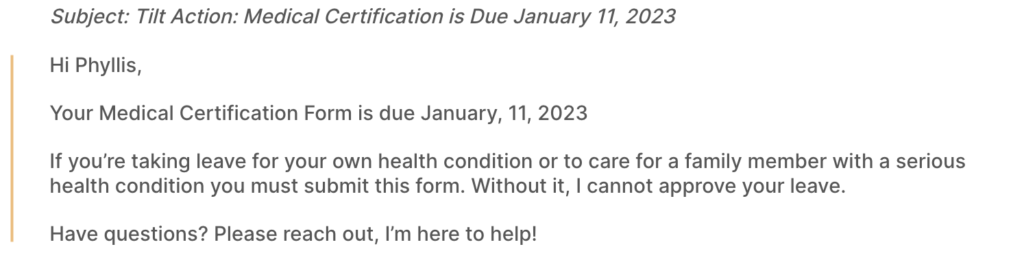
Throughout the leave journey your employees might have deadlines to acquire certain information or submit certain forms. That’s certainly something People Teams shouldn’t have to manage, and it’s definitely unfair to place the burden on the employees. Not only does Tilt make the process easy as pie to follow, we make sure your employees stay informed with reminders so no deadlines get missed.

Born with empathy, backed by experts

Our LSMs exist to triage any questions your employees may have, and the byproduct of their commitment is happy employees and a relieved people team. You no longer have to answer those curveball questions that keep you up at night Googling, and you no longer have to worry about unique situations of employees moving from state to state and how that impacts a leave. 

Our in-house payroll and legal and compliance team are there to back our LSMs and provide you and your people with the most accurate and up-to-date leave law information so that no LOA gets derailed and your employees stay on track for a successful leave of absence.

It’s about our mission

At Tilt we aren’t just looking to provide a tech solution that marks all your LOA hopes and dreams come true. We do that of course, but it’s also about making leave not suck once and for all. Every Tilter is here for that mission, and our LSMs embody our mission more than anyone. But don’t take it from this blogger, hear it straight from them:

Catrina Hulbert, LSM

“To me, being a Leave Success Manager is more than just knowing how applicable laws impact a person’s time off work (although that is definitely a large part of it). When people are on a leave of absence they are typically going through what is already an incredibly stressful and difficult part of their lives. To get to be a helping hand in that journey– answering questions, receiving baby pictures, updates about how their surgery went, or sharing the good news of their wedding that their surgery made possible– is one of the greatest honors a job could give me.” – Catrina Hulbert

Christian Castorena, LSM

“I would have to say that my favorite thing about being an LSM is that I get to ensure that employees never have to go through the horrific situation that my father had to endure when he was requesting FMLA leave for the first time. I love being able to answer employee questions and provide them with all the options and resources needed to help get them ready for leave, so it’s one less thing they have to worry about, and they can focus on themself and/or their loved ones. Plus, it gives back time and resources to HR, so they can focus on other important HR aspects to make the company more efficient!” – Christian Castorena

About Tilt

Tilt is leading the charge in all things leave of absence management through easy-to-use tech and human touch. Since 2017, our proprietary platform and Empathy Warriors have been helping customers make leave not suck by eliminating administrative burdens, keeping companies compliant, and providing a truly positive and supportive leave of absence experience for their people.

Related Posts

How Leave Management Can Reduce Employee Attrition and Turnover Costs

In the working world (is there any other world?), employee attrition can be defined as the departure of employees from your company regardless of the reason, voluntary or involuntary.  These reasons can range from resignation to termination, death or retirement, and they all have a cost associated with them that vary in severity and form.

There are times when a People Team really has no control over the attrition of employees. For example, attrition could stem from a response to the market or lack of success as a company leading to workforce reduction, which seems like cost savings on the ledger, but could have mental health costs to remaining employees that don’t show up as a line item until they too seek the exit.

Aside from bringing in the best talent possible for every open rec, one of the most important charges a People Team has is to do everything in its power to proactively minimize employee attrition. This is why today there is so much emphasis being placed on the way in which companies manage a leave of absence. Mucking up a miscarriage leave can break an employee’s trust in an organization forever, conversely, showing empathy and holistic support in an employee’s most critical life moments can help build an unbreakable bond between your company and your people. 

To underscore the importance of getting Leave Management right, let’s break down the different costs associated with getting it wrong.

How Losing Benjamin Can Cost Benjamins

  1. Cost to hire a replacement: They say the best things in life are free, which leads us to believe that having to replace an established employee is far from a “best thing.” The numbers of course vary depending on employee type (hourly vs. salary), seniority of the role, scarcity of the talent for that role and more, but for a mid-level employee it can reach upwards of 150% of that employee’s salary.
  2. Cost of loss in production: Losing any employee is going to impose a hit on production. If we’re operating under the assumption that the position provided some value to the company’s bottom line in the first place, then whatever that value was either needs to be picked up by others in the organization (burnout alert) or it just won’t be a source of production until the replacement is found. Deadlines can be missed, customer service can plummet. Money out (finding the replacement)…money out (loss of production). 
  3. Cost of loss from intangible institutional knowledge: Every organization is a complex engine and leadership is always striving to have it fire on all cylinders. It’s not horsepower that allows your org to rev its engine, however, it’s brain power. Intangible institutional knowledge is derived from the experience and wisdom of an individual in your organization. If they need to take a leave of absence and it isn’t handled properly, you’re at serious risk of losing that knowledge if they look for an opportunity elsewhere.

How Losing Benjamin Can Cost Katrina

  1. Losing a pal impacts morale: An organization is a complex engine, sure, but HR leaders know it has a delicate ecosystem. If a beloved employee leaves to take care of a loved one and never comes back because they were being pressured to work, or weren’t given the guidance necessary to have a successful and supported leave journey, your remaining employees might be wondering if your organization is right for them, impacting their engagement, satisfaction and productivity.
  2. Employer brand becomes top-talent repellant: Attracting new talent is hard as it is, and word can spread like wildfire if your organization has a reputation for not supporting employees properly when life’s most critical moments happen. If you are known for having high turnover you’ll soon be no option stuck with no option but to hire low-quality candidates.
  3. The cumulative effect: Losing an employee due to a mismanaged leave negatively impacts morale, which can lead to burnout and distrust, which can lead to more turnover, which can lead to lower quality candidates, which can lead to overstressed and underperforming teams, which can lead to even more turnover. The cost of getting your leave management wrong can snowball tremendously.

Getting Leave Management Right

Retention is often really about proactivity. Companies who take initiative on behalf of their people without waiting for the [redacted] to hit the fan first are more likely to develop a culture of trust and compassion. An engaged workforce is a motivated workforce, and today’s workforce wants to be treated like a human, especially when life is calling on them to step away from work. 

Making an employee’s leave journey easy, supportive and positive can do wonders for an organization’s retention by not only keeping your existing employees happy, but also by showing prospective talent that your organization cares about its people. Being human and supporting leaves of absence doesn’t have to be hard, but failing to do so could mean hard times for your company. 

About Tilt

Tilt is leading the charge in all things leave of absence management through easy-to-use tech and human touch. Since 2017, our proprietary platform and Empathy Warriors have been helping customers make leave not suck by eliminating administrative burdens, keeping companies compliant, and providing a truly positive and supportive leave of absence experience for their people.

Related Posts

Join us February 20th, 2025 at 11AM MST – Tilt Live Demo | Register Now>>